
What is Sustainable Investing?
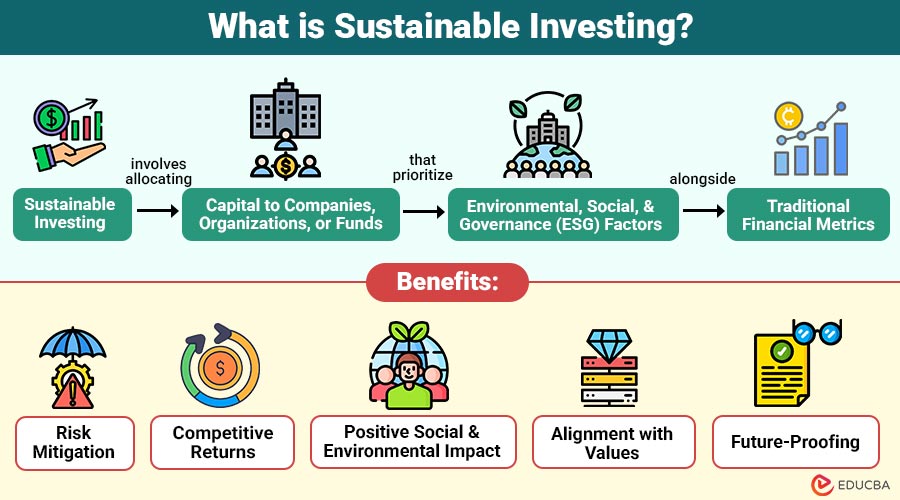
Sustainable investing involves allocating capital to companies, organizations, or funds that prioritize environmental, social, and governance (ESG) factors alongside traditional financial metrics.
It addresses urgent global issues including social fairness, resource scarcity, climate change, and corporate transparency while concentrating on fostering long-term value generation. Unlike traditional investing, which primarily focuses on financial performance, sustainable investing considers non-financial metrics to assess the broader impact of an investment.
Investors often ask questions like:
- Does the company reduce its carbon footprint?
- Are labor practices ethical and inclusive?
- Is the leadership transparent and accountable?
These elements help investors identify businesses well positioned for long-term growth while reducing the risk of environmental harm, societal backlash, or legal repercussions.
Table of Contents:
Key Takeaways:
- Sustainable investing integrates ESG factors with financial metrics to create long-term value and positive impact.
- Companies with strong ESG practices reduce risks, enhance efficiency, and demonstrate resilience for future growth.
- Investors can use strategies such as research, diversification, engagement, and impact monitoring to build responsible portfolios.
- Sustainable investing is growing, driven by regulation, technology, measurable impact, and the adoption of corporate sustainability culture.
Key Principles of Sustainable Investing
Sustainable investing relies on several foundational principles that guide decision-making:
1. Environmental Responsibility
Companies are assessed based on their ecological impact. Key considerations include the following:
- Carbon emissions and greenhouse gas management
- Energy efficiency and renewable energy adoption
- Waste management and water conservation
- Biodiversity protection and sustainable sourcing
2. Social Responsibility
Social factors examine how a company interacts with its employees, customers, and communities:
- Labor rights and employee welfare
- Diversity, equity, and inclusion (DEI) policies
- Community engagement and philanthropy
- Customer privacy and product safety
3. Governance
Good governance ensures that companies operate transparently and ethically:
- Board diversity and independence
- Executive compensation is aligned with performance
- Anti-corruption and ethical business practices
- Stakeholder engagement and accountability
4. Long-Term Value Creation
Sustainable investing prioritizes long-term growth and stability over short-term profits. Key considerations include the following:
- Reducing exposure to environmental, social, and regulatory risks.
- Investing in companies that can adapt to market and societal changes.
- Focusing on innovation, efficiency, and responsible expansion.
- Balancing present performance with the needs of future generations.
Types of Sustainable Investing
Sustainable investing is not one-size-fits-all. Investors can choose from different approaches based on their goals, risk appetite, and values:
1. Negative Screening
This traditional approach excludes companies involved in industries deemed harmful, such as tobacco, fossil fuels, or weapons manufacturing.
2. Positive Screening
Investors actively seek companies that demonstrate strong ESG practices, such as renewable energy firms or socially responsible technology companies.
3. ESG Integration
This approach integrates ESG criteria into the core investment analysis alongside financial metrics. Companies are evaluated for both performance and ethical standards.
4. Impact Investing
In addition to financial gains, impact investing seeks to produce quantifiable social or environmental benefits. For instance, funding clean energy firms or affordable housing initiatives.
5. Shareholder Advocacy
Investors can influence company policies by exercising shareholder rights, such as voting on ESG resolutions or engaging directly with corporate leadership to drive change.
Benefits of Sustainable Investing
Sustainable investing offers a mix of financial, ethical, and strategic benefits:
1. Risk Mitigation
Companies with strong ESG practices are less likely to face regulatory penalties, environmental disasters, or reputational crises, reducing long-term investment risks.
2. Competitive Returns
Sustainable investments can match or exceed traditional returns, as ESG-focused companies often show efficiency, innovation, and strong governance practices.
3. Positive Social and Environmental Impact
Sustainable investing channels capital to initiatives that protect the planet, enhance communities, and promote ethical corporate behavior.
4. Alignment with Values
Investors can align their portfolios with personal or organizational values, supporting industries and companies they believe in.
5. Future-Proofing
As governments and societies impose stricter ESG regulations, companies with sustainable practices are better positioned for long-term success.
Challenges of Sustainable Investing
Despite its advantages, sustainable investing also faces several challenges:
1. Data Inconsistency
Companies frequently self-report ESG data, leading to disparities and a lack of uniformity across sectors and regions.
2. Greenwashing
Some companies may exaggerate their ESG efforts to attract investment without implementing meaningful change, misleading investors.
3. Limited Historical Performance Data
While evidence suggests sustainable investments can be profitable, long-term historical data remains limited compared to traditional investment metrics.
4. Complexity and Expertise
Evaluating ESG factors requires specialized knowledge and tools, which can be a barrier for individual investors.
5. Balancing Financial and Ethical Goals
Investors may struggle to reconcile high financial returns with strict ESG criteria, especially in industries undergoing transition.
Strategies for Sustainable Investing
To navigate sustainable investing effectively, investors can adopt several practical strategies:
1. Research and Due Diligence
Analyze ESG ratings, corporate sustainability reports, and third-party evaluations to assess a company’s commitment to sustainable practices.
2. Diversified Portfolio
Include a mix of ESG-focused stocks, bonds, and funds to reduce risk while supporting sustainable initiatives.
3. Engage with Fund Managers
Join investment managers focused on sustainable investing to leverage their expertise and identify top-notch ESG opportunities.
4. Monitor Impact
Track both financial performance and ESG outcomes. Use metrics like carbon footprint reduction, social impact scores, or governance improvements to evaluate effectiveness.
5. Long-Term Focus
Prioritize investments that demonstrate resilience and sustainability over time rather than chasing short-term gains.
Real-World Examples
Here are some practical examples of sustainable investing across different sectors and strategies:
1. Renewable Energy Companies
Investing in solar, wind, or hydroelectric firms supports the global transition to clean energy while benefiting from growing demand for sustainable power sources.
2. Green Bonds
Governments and corporations issue green bonds to fund environmentally beneficial projects, such as energy-efficient infrastructure or reforestation.
3. ESG-Focused Funds
Funds like the iShares ESG Aware MSCI USA ETF or the Parnassus Core Equity Fund invest exclusively in companies with strong ESG performance.
4. Social Impact Startups
Impact investors fund startups addressing critical social needs, such as affordable healthcare, education, or clean water initiatives.
Future of Sustainable Investing
Sustainable investing is expected to grow exponentially as awareness of climate change, social inequality, and corporate accountability rises. Key trends shaping the future include the following:
1. Stronger Regulatory Oversight
Governments worldwide will enforce stricter ESG disclosure rules, improving transparency, comparability, accountability, and reducing greenwashing across global financial markets systems.
2. Integration of Technology
Artificial intelligence and blockchain technologies will enhance ESG data accuracy, real-time tracking, verification, automation, and trust across sustainable investment ecosystems.
3. Rise of Impact Measurement Tools
Advanced impact measurement tools will enable investors to quantify environmental and social outcomes, linking capital allocation directly to measurable results.
4. Corporate Sustainability Culture
Organizations will integrate sustainability into core strategies, operations, and governance, driving resilience, innovation, risk management, and enduring long-term shareholder value.
Final Thoughts
Sustainable investing represents a powerful shift toward responsible wealth creation, blending financial performance with meaningful environmental and social impact. As ESG integration matures, investors gain better tools to assess risks, identify resilient businesses, and support positive change. By adopting a long-term, informed approach, sustainable investing enables portfolios to grow while contributing to a more equitable, transparent, and sustainable global economy.
Frequently Asked Questions (FAQs)
Q1. Is sustainable investing profitable?
Answer: Yes, multiple studies show ESG-focused investments can match or outperform traditional portfolios while mitigating long-term risks.
Q2. Can individual investors participate in sustainable investing?
Answer: Absolutely. Individual investors can choose ESG funds, green bonds, or companies with strong sustainability practices to align portfolios with their values.
Q3. How can I avoid greenwashing?
Answer: Check independent ESG ratings, audited reports, and measurable impact data. Avoid companies with vague claims and poor transparency.
Q4. Does sustainable investing limit diversification?
Answer: Not necessarily. Sustainable investing offers wide range of options, including stocks, bonds, ETFs, and mutual funds, allowing investors to maintain diversified portfolios.
Recommended Articles
We hope that this EDUCBA information on “Sustainable Investing” was beneficial to you. You can view EDUCBA’s recommended articles for more information.

