


Maximizing Returns Through Smart Stock Filtering Methods
In an age where global markets move faster than ever, investors cannot afford to rely solely on instinct or scattered information. Stock filtering methods offer a structured approach to identifying opportunities in a vast sea of options. Whether you are a day trader looking for quick momentum plays or a long-term investor seeking undervalued gems, a well-designed filtering process allows you to focus on quality rather than quantity.
The power lies in combining multiple factors, fundamentals, technicals, performance metrics, and market sentiment into a clear decision-making framework. This article explores advanced strategies to maximize your returns through precision stock filtering, complete with practical tips and tools to help you get started.
Why Smart Stock Filtering Methods Matter?
When you open any trading platform, you face thousands of listed securities. Without a clear filtering method, you might be tempted by hype, news headlines, or impulsive social media tips, often leading to inconsistent results.
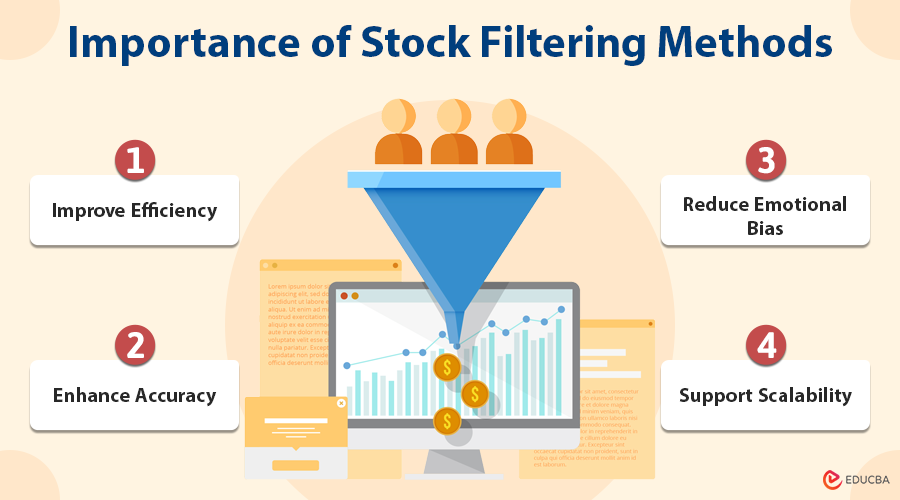
Smart stock filtering methods matter because they:
- Improve efficiency: Instead of scanning hundreds of charts, you focus only on the ones matching your strategy.
- Enhance accuracy: You can systematically find stocks that meet your specific risk/reward profile.
- Reduce emotional bias: By sticking to predefined filters, you avoid making panic-driven trades.
- Support scalability: You can apply the same method across markets (US, Europe, Asia) with minimal tweaks.
For example, a growth investor might filter for companies with revenue growth above 20% YoY and a PEG ratio under 1. A swing trader might look for RSI between 30 and 40 on a bullish divergence setup. Without filters, spotting such opportunities would be like finding a needle in a haystack.
Essential Criteria for Filtering Stocks
To create effective stock filtering methods, you need to combine different types of data:
1. Fundamental Metrics
These help you understand the company’s intrinsic value and financial health:
- P/E ratio: Indicates valuation relative to earnings.
- Debt-to-equity: Measures leverage risk.
- ROE (return on equity): Reflects management efficiency.
- Revenue & EPS growth: Tracks long-term business potential.
2. Technical Indicators
These show market sentiment and momentum:
- RSI: Identifies overbought/oversold levels.
- MACD: Signals potential trend changes.
- Moving averages (SMA, EMA): Define trend direction.
- Bollinger bands: Measure price volatility.
3. Performance Metrics
These capture recent trends:
- 52-week high/low: Indicates strength or weakness.
- Monthly % change: Tracks short-term momentum.
- Beta: Measures volatility vs. the market.
4. Liquidity & Volume
You can get in and out of trades easily when a stock has high liquidity. For example, filtering for average daily volume above 500,000 can help avoid illiquid stocks with high bid-ask spreads.
How to Implement Smart Filtering – A Step-by-Step Strategy
Step 1: Define Clear Investment Goals
Decide if you are targeting growth, value, dividends, or momentum. Base your filters on these goals.
Step 2: Build Your Screening Criteria
For example:
- Value investor: Low P/E, high dividend yield, strong cash flow.
- Momentum trader: High relative strength, above moving averages, strong volume spikes.
Step 3: Apply Technical Triggers
Combine fundamentals with technical filters for precision.
Example: P/E < 20, revenue growth > 10%, RSI between 30–50, MACD bullish crossover.
Step 4: Use Tools to Automate the Process
One efficient way to apply these techniques is by using a stock screener that supports customizable filters, heatmaps, and real-time updates.
Step 5: Save and Reuse Templates
If you trade frequently, save your filter combinations to quickly scan the market without starting from scratch every day.
Example Workflow for Applying Stock Filtering Methods
While there are many stock analysis platforms available, the overall process of applying smart stock filtering methods follows a similar pattern:
Step-by-Step Example:
1. Access a Screening Tool
Use any reliable platform that lets you filter by fundamentals, technicals, and performance metrics.
2. Set Fundamental Filters
Example: Market Cap > $1B, EPS growth > 15%, Debt/Equity < 0.5.
3. Add Technical Filters
Example: RSI < 40 with price above the 200-day SMA for potential bullish setups.
4. Choose Your Display Format
Some traders prefer a table for quick sorting; others like heatmaps or mini-charts to spot visual trends.
5. Save or Document Your Criteria
Store your setup for consistency and to avoid re-creating it every session.
6. Review & Adjust Regularly
Market conditions change, so tweak your filters based on volatility, sector rotation, or new economic data.
This systematic approach ensures you are making objective, data-backed decisions instead of emotional trades.
Real-World Feedback & Considerations
Even with a strong filtering process, traders face practical challenges:
- Over-filtering: Being too strict with criteria can result in missing out on promising opportunities.
- Under-filtering: Too many loose filters can overwhelm you with irrelevant results.
- Changing market cycles: A filter that works in a bull market might underperform during sideways or bearish phases.
- Platform updates: Screening tools sometimes change their layout or features, so being adaptable is key.
Final Thoughts
The right stock filtering methods transform chaos into clarity. By combining fundamental metrics, technical analysis, and performance tracking into a structured filter system, you can consistently target the stocks most aligned with your strategy.
Pairing these methods with a feature-rich platform ensures you are making data-backed decisions in real time, giving you an edge in fast-moving markets.
Whether you are trading daily or building a long-term portfolio, smart filtering is the foundation of sustainable returns.
Recommended Articles
We hope this guide on stock filtering methods was helpful. Explore related articles on fundamental analysis techniques, technical trading strategies, and effective portfolio diversification methods to enhance your investment decisions.

