


What is Separation of Duties?
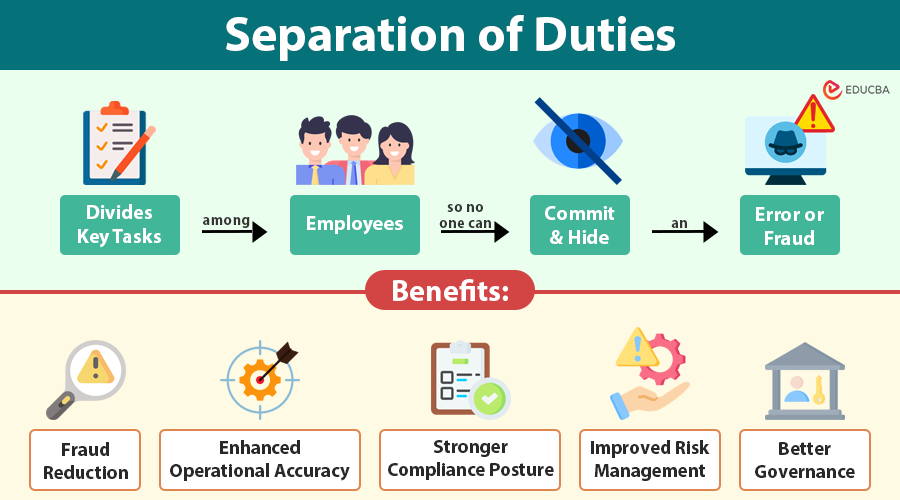
The separation of duties means dividing key tasks among different employees to ensure that no single person can both commit and conceal an error or irregularity. This control mechanism prevents abuse of power, manipulation of records, and concealment of unauthorized activities.
An example of separation of duties in a financial transaction is:
- The initiator creates the payment request.
- The approver validates and authorizes it.
- The accountant records it in the financial system.
This ensures that if one person makes an error (or attempts fraud), another can detect it.
The primary purpose of separating duties is to establish a system of checks and balances, thereby enhancing organizational resilience and mitigating vulnerabilities that arise from concentrated authority.
Table of Contents
- Meaning
- Explanation
- Objectives
- Examples in Different Functions
- Separation of Duties in Information Security
- Benefits
- Challenges in Implementing
- Best Practices for Implementing
- Separation of Duties and Regulatory Compliance
- Separation of Duties vs. Least Privilege
Explanation of the Separation of Duties
Separation of duties (SoD) is a fundamental concept in corporate governance, internal controls, accounting, and information security. It ensures that no single person is responsible for all aspects of any critical process. The principle divides authorization, recordkeeping, and custody duties among different individuals to minimize the risk of fraud, misuse, and human error.
In modern organizations, where digital systems and financial transactions are highly integrated, separation of duties acts as a first line of defense against insider threats, data manipulation, and financial misreporting. It forms a key part of major risk management frameworks, such as COSO and COBIT, and helps organizations comply with laws like the Sarbanes-Oxley Act (SOX).
By distributing responsibilities, companies enhance accountability, transparency, and trust, ensuring that decisions are verified and validated through multiple layers of oversight.
Objectives of Separation of Duties
Implementing separation of duties helps organizations meet several important objectives:
- Fraud prevention: By dividing control and oversight, SoD makes it harder for any one individual to commit fraud. Fraud typically requires both opportunity and concealment; separation of duties removes that opportunity.
- Error detection and prevention: Even well-intentioned employees can make mistakes. Having different individuals review, verify, and approve work reduces unintentional errors and improves the accuracy of business operations.
- Strengthening accountability: Each employee has clearly defined responsibilities and limited access, making it easier to trace actions and hold individuals accountable for their work.
- Ensuring compliance: SoD supports compliance with various regulations like SOX, GDPR, and ISO 27001. These laws require companies to have effective internal control mechanisms in place to prevent unauthorized activities and ensure accurate and reliable reporting.
- Building organizational integrity: A culture that supports checks and balances promotes ethical behavior and reinforces stakeholders’ confidence in the organization’s governance and control systems.
Examples of Separation of Duties in Different Functions
The following examples demonstrate how SoD is applied across various business areas to ensure accountability, prevent fraud, and maintain operational integrity.
1. Finance and Accounting
In financial management, the separation of duties is crucial to prevent the misappropriation of funds and the manipulation of financial records.
Example Workflow:
- Initiation: One employee prepares or initiates a vendor payment.
- Approval: Another employee reviews and authorizes the payment.
- Reconciliation: A third employee reconciles the bank account and records the transaction.
Purpose:
This segregation ensures that no single individual can both authorize and benefit from an unauthorized or fraudulent transaction. It also provides multiple checkpoints to detect and correct errors before they affect financial reporting.
2. Procurement
In the procurement process, separation of duties helps maintain financial prudence, eliminate conflicts of interest, and prevent kickbacks or fraudulent purchasing.
Roles and Responsibilities:
- Requestor: Identifies the need for goods or services.
- Approver: Reviews and approves the purchase request or purchase order.
- Receiver: Verifies the goods or services received for quality and quantity.
- Accounts payable: Processes and approves vendor invoices for payment.
Purpose:
This layered approval chain ensures transparency, prevents unauthorized purchases, and guarantees that payments are made only for legitimate and verified transactions.
3. Human Resources (HR) and Payroll
In human resources and payroll management, separation of duties prevents payroll manipulation, unauthorized salary adjustments, and the creation of “ghost employees.”
Typical Division of Duties:
- HR department: Enters and maintains employee data (such as new hires, terminations, and position changes).
- Finance team: Reviews and verifies salary computations, deductions, and benefits.
- Accounting department: Processes salary disbursement and maintains payroll records.
Purpose:
By dividing these duties, organizations ensure that employee data, salary calculations, and fund disbursements are cross-checked and independently verified, reducing the risk of internal fraud.
4. Information Technology (IT) and Cybersecurity
In IT and cybersecurity, SoD helps protect systems and data from unauthorized changes, insider threats, and security breaches.
Example Distribution of Roles:
- Developers: Write and modify code or software applications.
- Testers (quality assurance): Verify code functionality, integrity, and performance to ensure optimal quality and reliability.
- Operations team: Deploy approved applications into production environments.
- Security Officer/Auditor: Monitors system access, performs audits, and reviews logs to ensure compliance with regulations.
Purpose:
This structure prevents a single individual from developing, approving, and deploying software, thereby reducing the risk of introducing malicious code or bypassing security controls.
5. Inventory and Supply Chain Management
In inventory management, organizations ensure separation of duties by independently managing the handling of goods, ordering, and recordkeeping to prevent theft or manipulation.
Typical Workflow:
- Ordering: One employee places purchase orders or requests inventory restocks.
- Receiving: A separate individual verifies delivery, inspects the quality, and signs off on the received goods.
- Inventory control: Another team member updates stock records and tracks the usage of items.
Purpose:
This segregation prevents over-ordering, unauthorized stock movement, and record tampering, ensuring accurate inventory tracking and accountability throughout the supply chain.
Separation of Duties in Information Security
In the field of information security, the separation of duties prevents single points of failure and insider threats. Cybersecurity frameworks like NIST and ISO 27001 explicitly emphasize SoD to safeguard sensitive data and systems.
For instance:
- System Administrators manage configurations but cannot alter logs.
- Security Analysts monitor alerts but cannot turn off security systems.
- Auditors review system activities independently.
This structure ensures that unauthorized changes or suspicious activities are detected promptly.
Furthermore, in cloud environments, separation of duties extends to identity and access management (IAM), where policies determine who can perform administrative actions, deploy resources, or access sensitive information.
Example:
If a database administrator could both create and approve new users, they could grant themselves unauthorized access. By separating approval and creation roles, the organization ensures security oversight.
Benefits of Separation of Duties
Implementing SoD yields numerous benefits for businesses and institutions:
- Fraud reduction: No single person has unchecked control, lowering the potential for financial misconduct.
- Enhanced operational accuracy: Independent verification improves the quality of data and decisions.
- Stronger compliance posture: Meets external audit and legal requirements efficiently and effectively.
- Improved risk management: Detects problems early and minimizes business disruptions.
- Greater stakeholder confidence: Transparent operations inspire trust among investors, customers, and employees.
- Better governance: Encourages responsibility, ethical behavior, and oversight across organizational levels.
Challenges in Implementing Separation of Duties
Despite its benefits, organizations face practical challenges while implementing SoD:
- Limited resources: Small organizations may lack enough staff to distribute duties effectively.
- System complexity: Large enterprises with integrated systems can struggle to track overlapping roles or conflicting privileges.
- Resistance to change: Employees accustomed to multitasking may perceive SoD as restrictive or bureaucratic.
- Cost and administrative overhead: Maintaining SoD frameworks requires continuous monitoring, periodic audits, and software tools, which add to operational costs.
- Cloud and remote work environments: Distributed teams make it more challenging to effectively monitor access and segregation.
To overcome these, organizations often use automation, compliance software, and risk-based prioritization, applying stronger SoD controls to high-risk areas.
Best Practices for Implementing Separation of Duties
Successful implementation of the separation of duties requires a strategic and structured approach:
- Perform a risk assessment: Identify which processes are most vulnerable to errors or fraud and prioritize them for SoD controls.
- Define clear roles and responsibilities: Utilize job descriptions and access control matrices to document who is responsible for what tasks.
- Use Role-Based Access Control (RBAC): Assign permissions based on functional roles rather than individuals to simplify management.
- Automate controls: Utilize automated compliance tools to detect policy violations and conflicting roles in real-time.
- Regularly review and update access rights: Conduct periodic audits to ensure employees retain only necessary permissions.
- Implement compensating controls: In smaller teams where full SoD is impossible, introduce monitoring or independent reviews.
- Provide continuous training: Educate employees about the rationale behind SoD to foster compliance and awareness.
- Monitor and audit regularly: Establish ongoing reviews by internal audit teams to ensure controls remain effective.
Separation of Duties and Regulatory Compliance
Many global regulatory frameworks mandate or encourage the implementation of separation of duties as part of their internal control requirements:
- Sarbanes-Oxley Act (SOX): Requires companies to establish controls to ensure accurate financial reporting. SoD supports this by segregating financial functions.
- ISO 27001: Emphasizes access control and segregation of duties for information security management systems.
- GDPR: Encourages segregation of roles between data controllers and processors to protect user privacy.
- PCI DSS: Mandates separate roles for those handling payment processing and security management to prevent data breaches.
- HIPAA: For healthcare organizations, SoD ensures that patient data is accessed and modified only by authorized personnel.
Compliance with these frameworks not only reduces legal risk but also enhances operational reliability and audit readiness.
Separation of Duties vs. Least Privilege
Organizations often employ the separation of duties and the principle of least privilege in tandem, but each addresses a distinct aspect of control.
- Separation of duties: Divides tasks among different individuals to prevent fraud and errors.
- Least privilege: Ensures individuals only have the access rights necessary to perform their job functions, nothing more.
When combined, they create a robust defense mechanism that limits both what users can do and how much control they have, reducing the organization’s overall attack surface.
Final Thoughts
The separation of duties principle is not merely a procedural requirement; it is a critical safeguard that strengthens integrity, prevents misconduct, and ensures accurate and transparent operations. Whether in finance, IT, or compliance, implementing SoD helps organizations maintain trust, meet regulatory standards, and operate efficiently in a world where accountability and data protection are paramount.
Every organization, regardless of size, should regularly review its internal processes and implement separation of duties controls tailored to its risk profile and operational realities. When properly enforced, SoD becomes a cornerstone of good governance, ethical conduct, and sustainable business success.
Frequently Asked Questions (FAQs)
Q1. Why is the separation of duties important in internal control systems?
Answer: Separation of duties is essential because it prevents any single person from controlling all aspects of a critical process. This reduces the chances of fraud, misappropriation, or concealment of errors. By enforcing checks and balances, organizations strengthen accountability and improve the reliability of their financial and operational controls.
Q2. Can the separation of duties prevent cyberattacks or insider threats?
Answer: Although SoD cannot stop all cyberattacks, it greatly lowers the risk of insider threats. By restricting who can approve, deploy, or modify systems, organizations limit opportunities for unauthorized access, data theft, or sabotage. When combined with least privilege and continuous monitoring, SoD forms a strong cybersecurity control layer.
Q3. What tools or software help enforce the separation of duties?
Answer: Organizations use Enterprise Resource Planning (ERP) systems like SAP, Oracle, and Microsoft Dynamics, and Identity and Access Management (IAM) tools such as Okta, SailPoint, and Azure AD to manage and monitor SoD conflicts. These platforms automate user access reviews, detect role overlaps, and generate audit-ready reports.
Q4. Can the separation of duties slow down business operations?
Answer: While SoD can add additional steps for review and approval, its benefits far outweigh the delays. Many organizations utilize workflow automation tools to strike a balance between efficiency and control, maintaining speed while maintaining oversight.
Q5. What is an example of a separation of duties violation?
Answer: A classic example is when a single employee has access to both create vendors and issue payments. This conflict allows potential fraud, such as creating a fake vendor and transferring funds to personal accounts. Organizations must avoid or closely monitor such situations to prevent complications.
Recommended Articles
We hope this comprehensive guide on Separation of Duties helps you understand its concept, importance, and implementation strategies. Read our related articles to learn more about controls, risk management, and governance that keep organizations safe and strong.


