


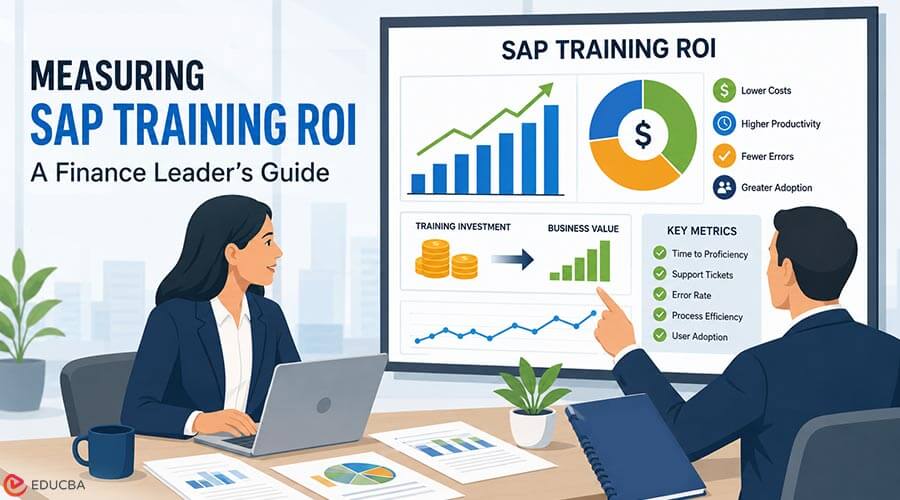
Training is one of those expenses that finance executives authorize because it is necessary. Still, it is rarely evaluated with the same rigor as a software license, consulting engagement, or infrastructure investment. That must be changed. Although an SAP setup can cost a lot of money, the system does not add value on its own. Individuals do. The anticipated return from SAP begins to drain away if finance teams can not process transactions effectively, complete month-end close accurately, use reporting features appropriately, or adapt to new workflows. That is why measuring SAP training ROI is more than just an educational expense. It should be evaluated as a business-performance investment.
SAP also recognizes training as an important part of supporting S/4HANA transformation, with learning paths covering areas such as finance, management accounting, analytics, integration, and other business functions.
Why is Measuring SAP Training ROI More Difficult?
Typically, the training dashboard is constructed using metrics like:
- Number of employees trained
- Completion rate
- Assessment scores
- Training hours
- Learner satisfaction
These figures help, but they do not tell a CFO whether training made the company better. A 98% completion rate does not always mean workers can execute SAP workflows proficiently. Similarly, faster invoice processing or a more seamless financial close do not always correlate with a high assessment score. Connecting training activities to operational outcomes is a superior strategy. Metrics like transaction mistakes, time-to-proficiency, support demand, adoption, and productivity are increasingly prioritized over completion alone in recent SAP-focused research and guidance. Finance leaders should focus on that.
7 Steps to Accurately Measure SAP Training ROI
Here are seven practical steps to measure the business value of SAP training:
1. Prioritize the Business Case
Determine what was anticipated to be improved by the SAP expenditure before calculating ROI. For a financial institution, that might consist of:
- Quicker month-end closure
- Reduced mistakes in invoicing or posting
- Decreased manual reconciliation
- Quicker financial reporting
- Reduced reliance on super users or IT
- Increased utilization of SAP features
- Quicker onboarding of new finance staff
- Reduced expenses for retraining and assistance
Once established, you can assess training against those goals. For instance, training should help staff achieve the 20% reduction in invoice processing time that the business case predicts, rather than just proving they attended a session. As a result, the relationship between training expenditure and business value strengthens significantly.
2. Accurately Calculate Training Expenses
If the cost side is not complete, it is impossible to determine training ROI. Trainers, content creation, learning platforms, and staff training are the apparent expenses.
However, SAP training may also have less obvious expenses:
- IT and Basis support
- Sandbox maintenance
- Data refreshes
- Travel and classroom expenses
- Content updates after system changes
- Retraining
- Productivity lost while employees attend training
- External consultants and temporary support
- SAP training-client infrastructure
This is especially crucial during S/4HANA initiatives, since user responsibilities, interfaces, screens, and procedures may all change dramatically. According to Assima’s latest report, training material, training environments, system complexity, and implementation deadlines are all significant factors in the overall cost of SAP training. The lesson for finance directors is clear: do not evaluate training providers based solely on training costs. Examine the overall cost of becoming proficient.
3. Monitor Time-to-Proficiency
It is easy to ignore one of the most important SAP training indicators. How long does it take for an employee to start producing on their own? You can calculate time-to-proficiency from an employee’s initial exposure to SAP or from go-live until they can reliably complete specified workflows without help.
These workflows could involve the following for financial teams:
- Creating journal entries
- Processing invoices
- Performing account reconciliation
- Running financial reports
- Completing period-end activities
- Managing purchase-to-pay processes
Define proficiency in business terms, not just by finishing a course.
4. Give Errors a Dollar Value
For finance, training ROI becomes very concrete when mistakes occur. Rework may result from an incorrect posting. A poorly processed invoice may delay payment. During closure, a mistake might cost the finance staff crucial hours. Inaccurate reporting might lead to operational and regulatory issues later on. Compare error rates before and after training rather than just tracking whether people passed.
5. Assess Dependency on Support
The level of assistance employees need after training is another powerful indicator. Track:
- Helpdesk tickets for SAP
- Making calls to super users
- IT escalations
- Frequently asked, “how do I?”
- Time devoted to helping new hires
These figures can drive significant financial gains if they decline. According to Assima’s SAP training guidelines, helpdesk demand, transaction errors, productivity, and time-to-proficiency are all important measures of training efficacy. Setting a baseline before training and comparing it with the same time frame after training is crucial.
6. Pay Attention to Training Infrastructure Expenses
The training environment itself can play a big role in the ROI calculation for major SAP programs. Traditional SAP training clients and sandboxes require infrastructure, upkeep, updates, management, and ongoing support. Another alternative is simulation-based training, which lets people practice realistic SAP procedures without working in production.
Assima presents this strategy as an alternative to retaining dedicated SAP training clients, using customizable simulators to replicate SAP settings for hands-on practice. With its S/4HANA offering, training assets can be updated without recapturing complete process flows, reducing the effort required to keep training aligned with system changes.
7. Calculate ROI After Go-Live
Treating training as a pre-go-live event is one of the most common errors enterprises make. SAP systems change over time. Workers switch positions. New employees show up. Procedures are changed. Updates introduce new features. Therefore, track training ROI after deployment rather than letting it fade after everyone finishes the first course.
Final Thoughts
Finance executives do not require an additional training report with completion rates. They need evidence. The finance function’s priorities, such as cost, productivity, accuracy, risk, speed, and business performance, are linked to learning through the best SAP training ROI measurement. This also shapes training design. Role-based learning, demonstrable competency, ongoing support, and hands-on simulation can help connect training to real operational outcomes.
While current ERP data confirms that the value of an ERP ultimately hinges on whether employees can use it effectively in their everyday job, SAP itself continues to stress the significance of growing people alongside S/4HANA transformation.
Recommended Articles
We hope this guide to SAP Training ROI helps you maximize training value. Check out these recommended articles for more SAP insights and strategies.


