


What is Rescission?
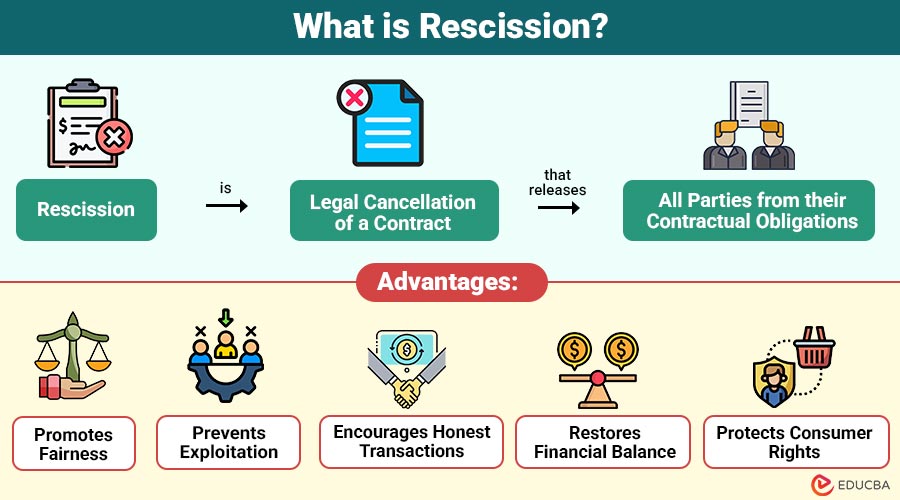
Rescission is legal cancellation of a contract that releases all parties from their contractual obligations. Once a contract is rescinded, it is treated as though it never existed. The primary objective is to restore the parties to their original positions before entering agreement.
Rescission may occur:
- By mutual consent of the parties
- By law, through court intervention
- Due to invalid or unlawful contract formation
- Because of fraudulent or misleading conduct
For example, if a buyer purchases property based on false information provided by the seller, the buyer may seek rescission of contract and request a refund of the purchase price.
Table of Contents:
Key Takeaways:
- Rescission cancels contracts and restores the parties to their original pre-contract positions.
- Rescission is available primarily in cases of fraud, misrepresentation, mistake, coercion, and illegal contracts.
- Rescission may occur through mutual, unilateral, judicial, or statutory mechanisms under the law system.
- Rescission terminates contracts, discharges obligations, and requires restitution to prevent unjust enrichment outcomes.
Features of Rescission
Given below are the features of rescission:
1. Cancellation of Contract
Rescission legally cancels the contract, ending obligations and completely releasing both parties from future contractual responsibilities.
2. Restoration to Original Position
Both parties must return any exchanged money, goods, property, or benefits to restore their positions to their original state before contracting.
3. Applicable to Voidable Contracts
Rescission mainly applies when contracts are voidable due to fraud, coercion, undue influence, or misrepresentation.
4. Mutual or Court-Ordered
Rescission may occur through mutual agreement between the parties or by court order to enforce fairness and justice.
5. Equitable Remedy
Courts treat rescission as an equitable remedy designed to prevent unfairness and restore balance between contracting parties.
Grounds for Rescission
Several legal grounds may justify rescission of a contract.
1. Misrepresentation
Misrepresentation occurs when false or misleading statements induce another party to enter a contract, affecting consent and making the agreement voidable.
2. Fraud
Fraud involves intentional deception, dishonesty, or concealment of facts to gain an unfair advantage, allowing the injured party to rescind the contract.
3. Mistake
A mistake arises when parties enter into a contract based on incorrect assumptions about essential facts, rendering the agreement legally unenforceable or voidable.
4. Coercion or Undue Influence
Coercion or undue influence occurs when pressure, threats, or manipulation force someone into a contract without genuine free and voluntary consent.
5. Lack of Capacity
Lack of capacity means a person cannot legally understand or consent to contractual obligations due to age, mental condition, or intoxication.
6. Breach of Contract
When one party materially fails to carry out their end of the bargain, it is considered a breach of contract and the other party may pursue rescission remedies.
7. Illegality
Illegality exists when a contract involves unlawful activities or violates legal principles, making the agreement void and unenforceable by courts.
Types of Rescission
Here are the different types of rescission commonly recognized in contract law:
1. Mutual Rescission
When all parties to a contract freely decide to end it and absolve one another of all further legal duties, this is known as mutual rescission.
2. Unilateral Rescission
Unilateral rescission occurs when one party independently rescinds the contract due to fraud, breach, coercion, misrepresentation, or other recognized legal defects.
3. Judicial Rescission
Judicial rescission is a court-ordered cancellation of a contract after a legal examination determines that valid grounds exist to terminate the agreement.
4. Statutory Rescission
Statutory rescission refers to cancellation rights granted under specific laws, allowing parties to withdraw from contracts within legally prescribed conditions.
Process of Rescission
The rescission process generally involves several steps.
Step 1: Identification of Legal Grounds
The affected party identifies valid legal grounds for the cancellation of the contract and related obligations.
Step 2: Notice of Rescission
The rescinding party formally informs the other party of the termination of the contractual agreement.
Step 3: Return of Benefits
Both parties return the money, goods, services, or benefits exchanged under the previously existing contractual arrangement.
Step 4: Legal Action if Necessary
If disagreements continue, the parties may initiate legal proceedings to officially resolve disputes over rescission.
Step 5: Court Decision
The court determines the validity of rescission and orders restitution, compensation, or other legal remedies accordingly.
Effects of Rescission
Rescission has important legal and financial consequences.
1. Contract Termination
Rescission ends the contract completely, making the agreement legally unenforceable among all parties involved thereafter.
2. Discharge of Obligations
Rescission releases both parties from performing future contractual duties, responsibilities, and obligations under the terminated agreement.
3. Restitution
Restitution requires parties to return money, property, goods, or benefits previously exchanged under the rescinded contract.
4. Financial Recovery
The injured party may recover financial losses, compensation, or payments made as a result of the invalid contractual agreement.
5. Prevention of Unjust Enrichment
Rescission prevents parties from unfairly retaining benefits or profits obtained through an invalid or defective contractual arrangement.
Advantages of Rescission
Given below are the advantages of rescission:
1. Promotes Fairness
Rescission ensures fairness by allowing cancellation of contracts that are fraudulent, misleading, or unjust, protecting parties from unfair legal consequences.
2. Prevents Exploitation
It effectively prevents exploitation by providing legal remedies to victims of fraud, coercion, or undue influence in contractual agreements.
3. Encourages Honest Transactions
Rescission encourages businesses and individuals to act honestly and disclose accurate information when forming legally binding contracts.
4. Restores Financial Balance
By putting all parties back in their pre-contractual positions, it reestablishes financial equilibrium.
5. Protects Consumer Rights
Rescission safeguards consumers against deceptive practices, enabling them to cancel unfair contracts and receive appropriate legal protection and relief.
Disadvantages of Rescission
Given below are the disadvantages of rescission:
1. Complex Legal Procedures
Rescission often involves lengthy, complicated, and costly court procedures that can significantly burden the parties involved.
2. Difficulty in Restoration
Restoring both parties to their original pre-contract positions can be difficult in practice, especially in complex transactions.
3. Financial Losses
Some financial losses incurred during the contract period may not be fully recoverable through rescission remedies.
4. Evidence Requirements
Strong and convincing evidence of fraud, misrepresentation, or coercion is usually required to successfully claim rescission.
5. Time Limitations
Rescission claims must be filed within legally defined time limits, or the right to cancel the contract may be lost.
Examples
Here are some practical examples illustrating situations where a contract may be legally rescinded due to fraud, misrepresentation, or unfair practices.
1. Real Estate Fraud
A buyer purchases property after the seller hides structural defects. The buyer later discovers the issue and seeks rescission of the sale contract.
2. Insurance Misrepresentation
An insurance policy may be rescinded if the applicant intentionally provides false medical information.
3. Consumer Purchase
A consumer rescinds an online purchase agreement after receiving counterfeit goods.
4. Employment Agreement
An employee contract may be rescinded if the employer obtained consent through false promises.
Best Practices to Avoid Rescission Disputes
Here are the best practices that help minimize misunderstandings and ensure contracts remain valid and enforceable.
1. Clear Contract Drafting
Contracts should be written in precise, unambiguous language with clearly defined terms, conditions, and obligations to avoid misunderstandings.
2. Honest Disclosure
All parties must provide complete and truthful information during negotiations to ensure transparency and prevent future disputes.
3. Legal Review
Seeking professional legal advice before signing helps identify risks, ensure validity, and reduce chances of rescission-related conflicts.
4. Proper Documentation
Maintaining written records of communications, agreements, and changes provides strong evidence in case of disagreements or legal issues.
5. Compliance with Laws
Making sure contracts abide by all relevant laws and regulations lowers the possibility of rescission and helps prevent illegality.
Final Thoughts
Rescission is a legal remedy canceling contracts formed through fraud, mistake, coercion, or misrepresentation. It restores original positions, ensuring fairness and preventing unjust enrichment. Despite legal complexities, it effectively protects rights in business, consumer, insurance, employment, and real estate transactions.
Frequently Asked Questions (FAQs)
Q1. Can rescission happen without court involvement?
Answer: Yes. The parties may mutually agree to rescind a contract.
Q2. Can partial performance affect rescission?
Answer: Yes. Even if partly performed, rescission may be allowed, but courts require restitution to restore both parties as far as possible to their original positions.
Q4. What happens if restoration is not possible after rescission?
Answer: If restoration cannot be fully done, courts grant monetary compensation instead to ensure fairness between the parties.
Recommended Articles
We hope that this EDUCBA information on “Rescission” was beneficial to you. You can view EDUCBA’s recommended articles for more information.


