
What is a Patent Troll?
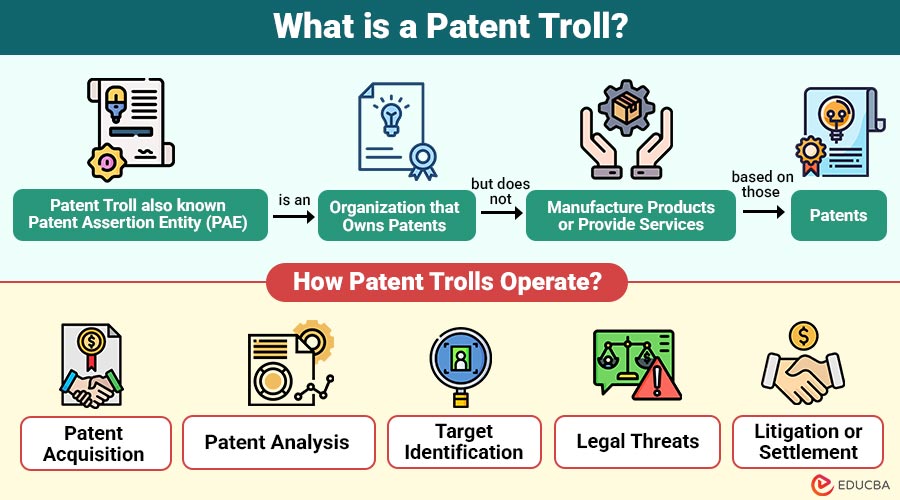
A patent troll, also known as a patent assertion entity (PAE), is an organization that owns patents but does not manufacture products or provide services based on those patents.
Instead, their primary business model revolves around:
- Acquiring patents (often from bankrupt companies or inventors)
- Identifying companies that may unknowingly use similar technology
- Filing lawsuits or threatening legal action
- Demanding licensing fees or settlements
Table of Contents:
- Meaning
- How do Patent Trolls Operate?
- Why are Patent Trolls Controversial?
- Impact on Businesses
- Real-World Examples
- Difference
- How Can Companies Protect Themselves?
- Criticisms
- Future
Key Takeaways:
- Patent trolls acquire patents to demand fees rather than to create or commercialize innovative products.
- Their activities increase legal costs, create uncertainty, and discourage innovation, especially among startups globally.
- Companies can mitigate risks through strong patent research, defensive portfolios, and coordinated legal strategies.
- Legal reforms and improved patent quality aim to reduce abuse and balance innovation incentives.
How do Patent Trolls Operate?
Patent trolls use a strategic, often aggressive approach to generate revenue. Their process typically includes the following steps:
- Patent Acquisition: They purchase patents from individual inventors, startups, or companies that no longer use them. These patents are often broad or vaguely worded.
- Patent Analysis: They analyze industries such as software, telecom, e-commerce, or healthcare to identify companies that might be using similar technologies.
- Target Identification: Large corporations are usually targeted because they are more likely to settle rather than engage in long legal battles.
- Legal Threats: Instead of directly suing, patent trolls often send cease-and-desist letters demanding licensing fees.
- Litigation or Settlement: If companies refuse, patent trolls file lawsuits. Many businesses choose to settle to avoid costly legal proceedings, even if they believe the claim is weak.
Why are Patent Trolls Controversial?
Here are the key reasons why patent trolls are widely considered controversial:
- No Innovation Contribution: Patent trolls acquire patents mainly to extract fees, contributing nothing meaningful to innovation or actual product development efforts.
- Legal Uncertainty: They create legal uncertainty by enforcing broad patents, making it difficult for businesses to accurately predict risks and compliance.
- Higher Costs: They increase operational costs through expensive legal defenses, settlements, and licensing fees, reducing available funds for innovation and growth.
- Court Burden: They burden courts with complex litigation cases, consuming judicial resources and delaying the resolution of legitimate and important patent disputes.
- Discourages Startups: They discourage startups from innovating freely due to fear of costly lawsuits, which limits creativity and significantly slows technological advancement.
Impact of Patent Trolls on Businesses
Patent trolls can significantly affect businesses of all sizes, but startups and small companies are especially vulnerable.
- Financial Burden: Legal fees and settlement costs can become extremely high, sometimes reaching millions, putting severe financial strain on businesses.
- Innovation Slowdown: Companies may avoid developing new technologies or features due to fear of patent infringement lawsuits and potential legal complications.
- Increased Pricing: Businesses frequently raise prices for goods and services by passing on settlement and legal fees to customers.
- Resource Diversion: Companies divert time, money, and manpower from innovation toward legal defense, reducing productivity and slowing overall business growth.
- Startup Vulnerability: Startups lack the resources to fight lawsuits effectively, often being forced to settle quickly, which limits growth opportunities and discourages innovation initiatives.
Real-World Examples of Patent Troll Activity
Patent trolling is especially common in technology-driven industries.
- Software Industry: Many companies have faced lawsuits over vague software patents such as “online shopping cart systems” or “data processing methods.”
- Mobile Technology: Smartphone manufacturers have often been sued over features such as wireless communication, touchscreen gestures, and app functionality.
- E-Commerce Platforms: Online businesses are frequently targeted for basic functionalities like one-click purchasing or recommendation algorithms.
Difference Between Patent Trolls and Legitimate Patent Holders
Here is a clear comparison highlighting the key differences:
| Aspect | Patent Trolls | Legitimate Patent Holders |
| Purpose | Profit through litigation | Innovation and product development |
| Business Activity | No production | Develops goods/services |
| Patent Usage | Enforcement and lawsuits | Commercial use |
| Impact | Often negative | Positive or neutral |
How Can Companies Protect Themselves?
Businesses can adopt several strategies to minimize risks from patent trolls:
- Strong Patent Research: Before launching products, companies should conduct thorough patent searches to identify risks and avoid potential infringement issues early.
- Patent Portfolio Development: Owning patents enables companies to strengthen their defenses and, during disputes and negotiations, effectively counter-sue patent trolls.
- Legal Preparedness: Having experienced intellectual property lawyers helps companies respond quickly to threats and build strong legal defense strategies.
- Insurance for IP Litigation: Companies can purchase insurance policies to cover legal costs associated with patent disputes, reducing financial risk and uncertainty
- Collaborative Defense Groups: Companies form alliances to share legal resources, knowledge, and costs when collectively and strategically defending against patent trolls.
Criticisms of Patent Trolls
Here are the major criticisms associated with patent trolls:
- Exploit Legal Loopholes: Exploits legal loopholes in patent systems to file aggressive lawsuits and extract settlements from companies.
- Do Not Contribute to Innovation: They do not contribute to innovation, focusing only on monetizing patents rather than developing useful products or technologies.
- Harm Startups and Small Businesses: They harm startups and small businesses by targeting them, forcing costly settlements, and limiting growth opportunities.
- Increase Legal Costs Across Industries: They increase legal costs across industries by driving frequent litigation, forcing companies to spend heavily on legal defenses.
- Create Market Inefficiencies: They create market inefficiencies by diverting resources from productive activities toward litigation, reducing overall economic efficiency and innovation output.
- Encourage Frivolous Lawsuits: They encourage frivolous lawsuits by filing weak claims, pressuring companies to settle rather than engage in lengthy, expensive legal battles.
Future of Patent Trolls
The future of patent trolling depends largely on legal reforms and technological advancements.
- Improve Patent Quality Checks: Governments aim to strengthen patent examination processes to ensure that only high-quality, clear, and valid patents are consistently granted.
- Reduce Vague Patent Claims: Efforts focus on reducing vague patent claims by enforcing stricter definitions, making it harder for trolls to exploit ambiguities.
- Speed up legal dispute resolution: Authorities are working to speed up legal dispute resolution, reducing lengthy litigation timelines and minimizing business disruptions significantly.
- Discourage frivolous litigation: Governments introduce stricter penalties and regulations to discourage frivolous litigation and prevent the misuse of patent systems by non-practicing entities.
- Strengthen International Patent Laws: Governments may strengthen international patent laws to establish uniform standards and reduce cross-border patent-trolling disputes globally.
- Use AI for Patent Analysis: AI tools can improve patent analysis by more efficiently detecting overlaps, vague claims, and potential litigation risks.
Final Thoughts
Patent trolls exploit intellectual property laws for profit without innovating, increasing costs and legal risks for businesses, especially startups. Their actions can hinder innovation and create uncertainty. However, legal reforms and better strategies are reducing their impact. Understanding them helps businesses protect innovation while maintaining a balanced and fair intellectual property system.
Frequently Asked Questions (FAQs)
Q1. Why are patent trolls harmful?
Answer: They increase legal costs, slow down innovation, and often target companies unfairly.
Q2. Are patent trolls illegal?
Answer: No, they are not illegal, but their practices are often considered unethical.
Q3. How do companies fight patent trolls?
Answer: They use legal defense, settle disputes, or challenge patents in court.
Q4. Which industries are most affected?
Answer: Technology, software, telecommunications, and e-commerce industries are most affected.
Recommended Articles
We hope that this EDUCBA information on “Patent Troll” was beneficial to you. You can view EDUCBA’s recommended articles for more information.


