


Updated August 21, 2026
What is RAG (Retrieval-Augmented Generation) Security?
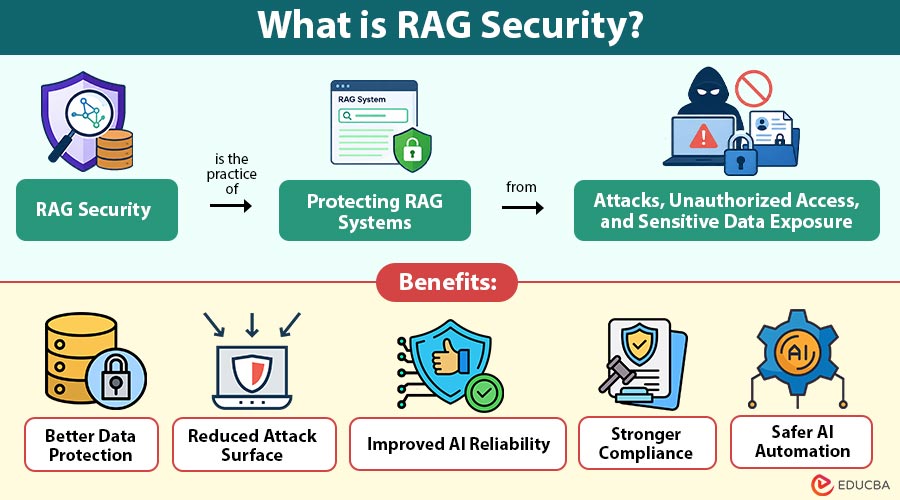
RAG Security is the practice of protecting RAG systems from attacks, unauthorized access, and sensitive data exposure.
A typical RAG system follows several stages:
User Query → Retrieval → Relevant Documents → Prompt Construction → LLM → Response
Apply security controls at each stage. For example, a user should retrieve only documents they are authorized to access, and retrieved documents should be treated as potentially untrusted content. RAG security therefore combines traditional cybersecurity, data security, identity management, application security, and AI security principles.
Table of Contents:
- Meaning
- Importance
- Risks
- How to Secure a RAG System?
- RAG Security for AI Agents
- Benefits
- Best Practices
Key Takeaways:
- RAG security protects sensitive information from unauthorized access, disclosure, and malicious manipulation throughout AI systems.
- Strong access controls ensure users retrieve only documents they are authorized to access.
- Treating retrieved content as untrusted helps defend against prompt injection and malicious documents.
- Continuous monitoring, validation, encryption, and security testing strengthen protection across the RAG pipeline.
Why is RAG Security Important?
The following points explain why RAG security is important for protecting AI systems, data, and users.
1. Protects Sensitive Data
RAG security prevents confidential, personal, financial, and business information from being exposed to unauthorized users through AI-generated responses.
2. Prevents Prompt Injection
RAG security helps block malicious instructions hidden in user queries or retrieved documents that could manipulate the language model’s behavior.
3. Prevents Data Poisoning
RAG security protects knowledge bases from malicious or inaccurate documents that could mislead AI responses.
4. Controls Unauthorized Access
RAG security enforces document-level permissions, ensuring users retrieve only information they are authorized to access within organizations.
5. Reduces Sensitive Information Disclosure
RAG security detects and prevents exposure of credentials, personal information, financial data, and intellectual property through generated responses.
6. Protects Vector Databases
RAG security protects embeddings and vector databases with encryption, authentication, authorization, monitoring, and network controls to prevent unauthorized access.
Common RAG Security Risks
Below are some of the most common risks that organizations should address when securing RAG systems.
1. Prompt Injection
Attackers insert malicious instructions into queries or documents, potentially causing the LLM to ignore rules or reveal information.
2. Data Poisoning
Attackers introduce inaccurate or malicious information into knowledge bases, causing RAG systems to generate misleading or harmful responses.
3. Unauthorized Data Access
Weak retrieval permissions may allow users to access confidential documents belonging to other departments, customers, or authorized groups.
4. Sensitive Information Disclosure
RAG systems may accidentally expose personal information, credentials, financial records, intellectual property, or other confidential data through responses.
5. Vector and Embedding Weaknesses
Poorly protected embeddings and vector databases may face unauthorized access, manipulation, inversion attacks, or cross-context information leakage risks.
6. Retrieval Manipulation
Attackers can manipulate document rankings or content, causing RAG systems to retrieve malicious information instead of trusted sources.
How to Secure a RAG System?
Below are practical steps organizations can follow to secure RAG systems against common security threats.
1. Secure the Data Ingestion Pipeline
Allow only trusted sources, authenticate data, validate documents, scan malicious files, and maintain metadata covering ownership, provenance, permissions, sensitivity, and history.
2. Implement Strong Access Controls
Apply identity-based access controls so users retrieve only authorized documents, using RBAC and ABAC to enforce permissions throughout the pipeline.
3. Protect Embeddings and Vector Databases
Protect embeddings like source data using encryption, authentication, authorization, network segmentation, API controls, audit logging, and continuous query monitoring.
4. Treat Retrieved Content as Untrusted
Treat retrieved documents as untrusted data, separate them from system instructions, establish trust boundaries, and detect potential prompt-injection attempts.
5. Validate Model Outputs
Check AI responses for sensitive data, harmful content, rule violations, or unsafe actions, especially in high-risk applications.
6. Monitor RAG Activity
Continuously monitor queries, retrieved documents, authorization failures, document changes, embeddings, responses, tool calls, and administrative activity for suspicious behavior.
7. Perform Regular Security Testing
Regularly test prompt injection, data poisoning, unauthorized retrieval, information extraction, cross-tenant access, malicious documents, and vector database security across system changes.
RAG Security for AI Agents
Below are key security measures for protecting AI agents that use RAG to retrieve information and perform actions.
1. Implement Independent Authorization
Verify user and agent permissions independently before allowing sensitive actions based on information retrieved from the RAG knowledge base.
2. Use Tool Allowlists
Restrict agents to approved tools to prevent unauthorized access to external systems, sensitive resources, or potentially dangerous operations.
3. Validate Agent Actions
Evaluate proposed agent actions against predefined security policies before executing emails, modifying records, triggering workflows, or accessing systems.
4. Require Human Approval
Require human confirmation before agents perform high-risk actions that could create financial, operational, privacy, or security consequences.
5. Enforce Tool-Level Security
Apply authorization controls directly within tools and services rather than relying solely on the AI agent to enforce permissions.
Benefits of RAG Security
Strong RAG security provides several benefits.
1. Better Data Protection
Security controls help protect confidential company information from being exposed through AI systems.
2. Reduced Attack Risk
Security measures protect data, prompts, retrieval, embeddings, and outputs from different security threats.
3. Improved AI Reliability
Checking data sources helps prevent false, changed, or unsafe information from affecting AI responses.
4. Stronger Compliance
Access controls, encryption, and monitoring help organizations follow data protection and privacy rules.
5. Safer AI Automation
Strong security controls help prevent AI agents and tools from taking actions without proper permission.
RAG Security Best Practices
Organizations can strengthen RAG security by following several practices:
1. Classify Data
Sort information as public, private, sensitive, or regulated before adding it to the RAG knowledge base.
2. Verify Data Sources
Use documents only from trusted sources and check that they are safe and unchanged before adding them.
3. Apply Least Privilege
Give users and apps only the access they need to complete their allowed tasks.
4. Enforce Document-Level Authorization
Make sure users can retrieve only documents they are allowed to access for every query.
5. Encrypt Sensitive Data
Protect documents, embeddings, databases, and network traffic by using encryption to stop unauthorized access.
6. Monitor Retrieval
Watch for unusual searches, repeated data requests, strange access patterns, and attempts to retrieve sensitive information.
7. Validate Outputs
Check responses for sensitive data, harmful content, rule violations, and unsafe actions before showing or using them.
Final Thoughts
RAG connects LLMs with enterprise knowledge but introduces security risks across ingestion, permissions, embeddings, retrieval, outputs, and tools. Organizations should use least privilege, trusted sources, encryption, authorization, prompt-injection defenses, monitoring, validation, and continuous testing. NIST and OWASP guidance can support secure, responsible RAG deployment.
Frequently Asked Questions (FAQs)
Q1. Can RAG systems expose information a user should not see?
Answer: Yes. If retrieval does not properly enforce permissions, a system may return information from documents that the requesting user is not authorized to access.
Q2. How does data provenance improve RAG security?
Answer: Data provenance helps organizations track where information originated, who modified it, and how it entered the knowledge base, making suspicious or unreliable content easier to identify.
Q3. Should every document in a RAG knowledge base be considered trustworthy?
Answer: No. Retrieved content should be treated as potentially untrusted because documents may contain inaccurate information, hidden instructions, malicious content, or compromised data.
Q4. What role does identity management play in RAG security?
Answer: Identity management connects each request to a verified user or service identity, allowing the RAG system to apply appropriate permissions before retrieving protected information.
Recommended Articles
We hope that this EDUCBA information on “RAG Security” was beneficial to you. You can view EDUCBA’s recommended articles for more information.


