


Introduction
Quantum computing sounds exciting, but for most businesses, it feels out of reach. High costs, complex systems, and limited access make it seem like something only big tech companies can afford. For many business owners, this creates a problem: how can they stay competitive if they are left behind in the market? Quantum Cloud Services are helping bridge this gap by making quantum computing more accessible to businesses of all sizes.
Here’s the positive news: Quantum Cloud Services are helping remove these obstacles, making quantum computing more accessible through easy-to-use platforms. In this blog, we will explore how these services create new opportunities for progress while tackling challenging issues along the way.
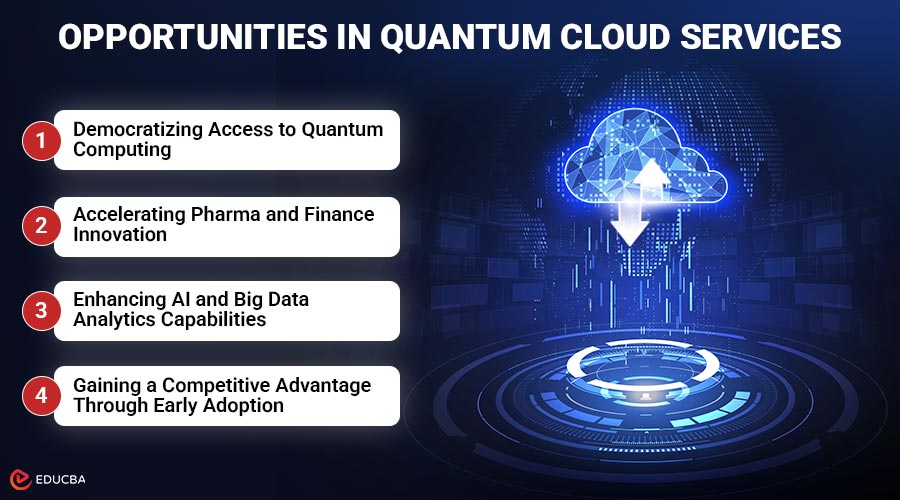
Opportunities in Quantum Cloud Services
Quantum cloud services promise a new era of computing power. Businesses can address challenges once considered impossible with remarkable speed.
1. Democratizing Access to Quantum Computing
Smaller companies often find advanced technology out of reach. Cloud computing changes this situation, offering access to quantum systems without expensive hardware investments. Businesses can now experiment with highly capable quantum algorithms using shared resources. For organizations exploring these opportunities, managed IT services play a vital role in integration. Interested businesses can learn more at BSWI about practical support models.
This reduces barriers and brings industries like healthcare, finance, and logistics closer to advancements. Managed IT services can guide these efforts by integrating these tools smoothly into current operations.
2. Accelerating Pharma and Finance Innovation
Quantum cloud services accelerate drug development by running complex quantum algorithms at extraordinary speed. Pharmaceutical companies use this to simulate molecular interactions, reducing research time from months to days. Faster results mean quicker paths to treatments for diseases that were once too costly or difficult to address. These advances improve the chances of success in clinical trials and cut costs for manufacturers.
Finance firms apply quantum computing power for portfolio optimization and fraud detection. Quantum systems process vast datasets faster than traditional methods, identifying market patterns in real time. As cybersecurity becomes even more critical in these scenarios, businesses can browse Cantey online to see how specialized providers are preparing for these challenges today.
This enhanced analysis allows financial institutions to predict trends with greater precision, minimizing risks during unpredictable market changes. Exact calculations provide businesses with a considerable advantage over competitors who rely solely on classical tools.
3. Enhancing AI and Big Data Analytics Capabilities
Processing quantum data improves AI algorithms. Faster computations help train models in less time. Businesses can predict trends more accurately by analyzing huge datasets.
These services enable companies to manage intricate tasks effortlessly, and industries like healthcare benefit by identifying patterns in patient data quickly. Finance sectors gain insights from market behavior analysis, enhancing decision-making power significantly.
4. Gaining a Competitive Advantage Through Early Adoption
Adopting quantum cloud services earlier helps businesses distinguish themselves. Early users gain access to advanced computational capabilities that address problems traditional systems struggle with, such as improving supply chains or analyzing massive datasets promptly. This leads to quicker product development and more precise decision-making.
Industries like finance and pharmaceuticals gain by outperforming slower competitors. For example, they can create better drugs or improve risk modeling for investments before others follow suit. Preparation for challenges ensures easier integration into current workflows, laying the foundation for long-term growth within your enterprise.
Challenges in Quantum Cloud Services
Navigating technical hurdles and security risks in quantum cloud services requires clever solutions. Read on to explore the complexities.
1. Addressing Qubit Stability and Error Correction
Qubits are incredibly sensitive. Changes in temperature, vibrations, or electromagnetic interference can cause errors. Business leaders should understand that maintaining qubit stability is a significant challenge for quantum computing within cloud services. Companies working on quantum algorithms invest heavily in error-correction methods to address this instability.
Error correction involves identifying and fixing issues without disturbing the qubits themselves. For example, fault-tolerant systems use additional qubits to monitor and correct problems. This solution increases costs but ensures accurate results for complex computations like financial modeling or drug discovery simulations.
2. Integrating Quantum with Cloud Infrastructures
Quantum cloud services require smooth interaction with classical cloud environments. This involves developing hybrid infrastructures where quantum and traditional computing can work together. Businesses need to focus on compatibility between quantum algorithms and current cloud platforms like AWS, Azure, or Google Cloud.
Existing data pipelines must adjust to handle quantum cloud services workloads without interrupting normal operations. IT teams should allocate resources for workforce training to manage hybrid setups. Tackling latency issues will also be essential as these systems process vast amounts of data. Solving these challenges creates opportunities to enhance encryption methods, discussed next under mitigating risks to current encryption systems.
3. Mitigating Risks to Current Encryption Methods
Hackers are always on the lookout for weak spots, and quantum cloud services might expose more of them. Current encryption methods, such as RSA, rely on complex problems that classical computers struggle to solve. However, a highly advanced quantum computer could crack these codes faster than anyone would expect. This creates a major concern for industries relying on secure communications.
Businesses must act now by researching post-quantum cryptography solutions. These algorithms are built to resist attacks from both traditional and quantum computers. Partnering with cloud providers that prioritize data security in quantum cloud services can help mitigate risks and prepare for future challenges. Investing early in these measures protects valuable customer data and sensitive business information from possible breaches.
4. Overcoming Hardware Limitations and Noise Issues
Quantum computers encounter challenges such as overheating and interference. These problems interrupt calculations, resulting in unreliable outcomes. Engineers are now concentrating on improved materials that maintain system stability and minimize errors in quantum cloud services.
External environmental noise makes computations even more complicated. Protective methods, including cryogenic cooling and vacuum chambers, assist in isolating quantum processors. This avoids unwanted disruptions during essential data processing tasks in sectors such as finance or artificial intelligence, which utilize quantum cloud services.
The Future of Quantum Cloud Services
Businesses must prepare for a world where quantum and classical systems coexist. Adapting to this shift can create opportunities for immense computational possibilities.
1. Importance of Scalable Hybrid Infrastructures
Combining quantum computing with traditional cloud systems creates a powerful hybrid infrastructure. This setup enables businesses to distribute workloads between classical and quantum systems, thereby improving performance and cost efficiency. Hybrid infrastructures can handle massive data processing while preparing for future advances in computational power through quantum cloud services.
Flexible designs ensure growth without requiring overhauls of existing frameworks. Industries such as finance and healthcare gain an advantage as their requirements evolve and grow rapidly. Such infrastructures also simplify integration into current IT environments, reducing disruptions during transitions.
2. Need for Standardized Protocols and APIs
Building hybrid infrastructures is only part of the puzzle for quantum cloud services. Creating standardized protocols and APIs ensures compatibility between systems, making integration more efficient for businesses. Without clear guidelines, developers face challenges when combining traditional tools with quantum platforms.
Standardized APIs simplify communication between different software and hardware setups. This method reduces development time and costs while expanding adoption across various industries, including finance and pharmaceuticals. Businesses can then concentrate on applying quantum algorithms rather than addressing incompatible systems.
Final Thoughts
Quantum Cloud Services are unlocking the future of computing by making advanced technology accessible beyond big tech. They open doors for industries like healthcare, finance, and logistics to innovate faster, solve complex challenges, and stay competitive in a rapidly evolving market.
While hurdles such as integration, stability, and security remain, businesses that embrace these services early will be better positioned to adapt and thrive. The road ahead may be complex, but the opportunities of Quantum Cloud Services make the journey worthwhile.
Recommended Articles
We hope this guide on Quantum Cloud Services was helpful. Explore related articles on quantum computing applications, cloud infrastructure strategies, and advancements in post-quantum cryptography to gain deeper insights into building a future-ready business in the digital era.


