


Updated June 15, 2026
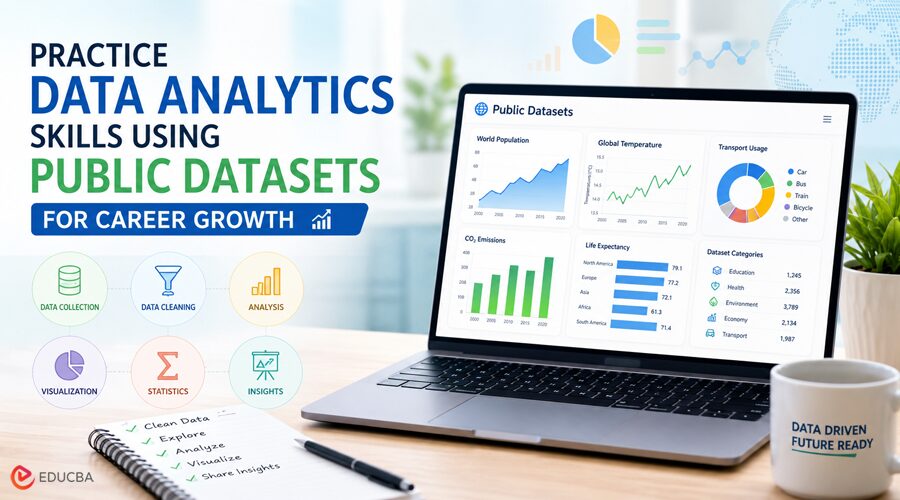
Data analytics is a skill used across many sectors, including finance, healthcare, retail, manufacturing, and technology. Organizations use data to identify trends, manage operations, and make evidence-based decisions. Courses and certifications provide theoretical knowledge, but practical experience helps professionals remain competitive in the labor market. Working with public datasets for data analytics practice is an effective method to obtain this experience.
Public datasets are collections of information from governments, research groups, businesses, and schools. They allow analysts to practice without using private company records. Individuals can improve their technical abilities and demonstrate their skills to employers by exploring these datasets and completing projects.
Benefits Of Using Public Datasets for Data Analytics Practice
Public datasets are realistic because they contain many of the difficulties found in professional data. Information is often incomplete, inconsistent, or exists in various formats. Analysts develop problem-solving skills valued by employers by learning to identify and fix these issues.
A wide range of topics is available to the public. There are datasets for healthcare, economics, transportation, sports, or the environment. This variety allows learners to select projects that align with their career goals as they gain experience.
Selecting Relevant Data Sources
Learning is more productive when datasets match professional goals. People interested in marketing can focus on consumer behavior, while those pursuing finance can analyze market reports. These projects help learners understand industry-specific metrics and questions.
Public repositories also contain data in different formats: some data is in spreadsheets, while other data is in databases or available via application programming interfaces. Working with many formats helps analysts become adaptable to different workplace environments.
Exploring Modern Analytics Tools
Public datasets provide chances to practice with common analytics tools. Analysts gain experience with spreadsheets, database systems, programming languages, and business intelligence software. Using these technologies increases confidence and readiness for work.
Many professionals also study the link between data analytics and artificial intelligence. Public datasets are a foundation for testing predictive models or automated analysis – this exposure helps learners understand new trends and improves their overall ability.
Improving Data Cleaning Skills
Data cleaning is a primary stage of an analytics project. Raw information often has missing values, duplicate records, and errors that degrade the quality of results. Public datasets are opportunities to practice resolving the issues.
Learners understand how data quality affects decisions as they spend time cleaning information. Analysis is only accurate if the information is reliable. Mastery of preparation techniques improves the value of findings and helps professionals manage large datasets efficiently.
Strengthening Analytical Thinking
Analysts are more effective when they ask questions and use evidence to reach conclusions. Public datasets allow learners to practice this by finding relationships and patterns in real data.
For example, an analyst can use transportation data to identify peak travel times or health statistics to track changes in disease rates. Asking questions encourages deep analysis and improves problem-solving abilities.
Creating Meaningful Visualizations
Visualization is a tool for sharing insights. Charts, dashboards, and graphs help people understand information and quickly identify trends. Public datasets offer many opportunities to create visual representations of complex information.
Testing different visualization methods helps learners find the best format for their data. Line charts show changes over time effectively, while bar charts make categories easy to compare. These activities improve both technical and communication skills.
Applying Statistical Methods
Statistics are important in modern analytics. Public datasets are places to apply concepts like averages, distributions, and forecasting. Learners can see how statistical methods support decisions rather than just learning formulas.
Large datasets also help analysts assess the strengths and limitations of their conclusions. They learn that the size of a sample, along with the quality of the data, affects results – this experience leads to better judgment and more accurate interpretations.
Building A Professional Portfolio
A portfolio of projects is an effective way to show analytics skills. Public datasets for data analytics practice enable the creation of original work that demonstrates technical ability and critical thinking. A portfolio is visible evidence of competence.
Every project can showcase different strengths, such as data preparation, visualization, or statistical analysis. Including summaries and explanations of methods allows employers to see how a candidate solves problems and discovers insights.
Developing Communication Skills
Communication is necessary to turn analysis into action. Findings are only useful if they are clear to those making decisions. Public projects provide practice in writing reports and summarizing complex information.
Effective communication requires changing technical findings into language that many people can understand. Aspiring analysts improve their ability to collaborate and influence decisions – documenting projects and presenting conclusions.
Final Thoughts
Using public datasets for data analytics is an effective way to build skills and prepare for career growth. These resources provide real information for developing expertise in cleaning, visualization, and statistics. Practical experience from projects is a helpful addition to formal education.
Regular practice helps individuals build confidence and develop portfolio projects; these experiences enhance professional credibility and create opportunities in a field where data is increasingly important for decision-making.
Recommended Articles
We hope this guide on public datasets for data analytics practice helps you build practical analytics skills and strengthen your portfolio for career growth. Explore these recommended articles for more insights on data visualization, business intelligence, statistical analysis, and analytics career development.


