


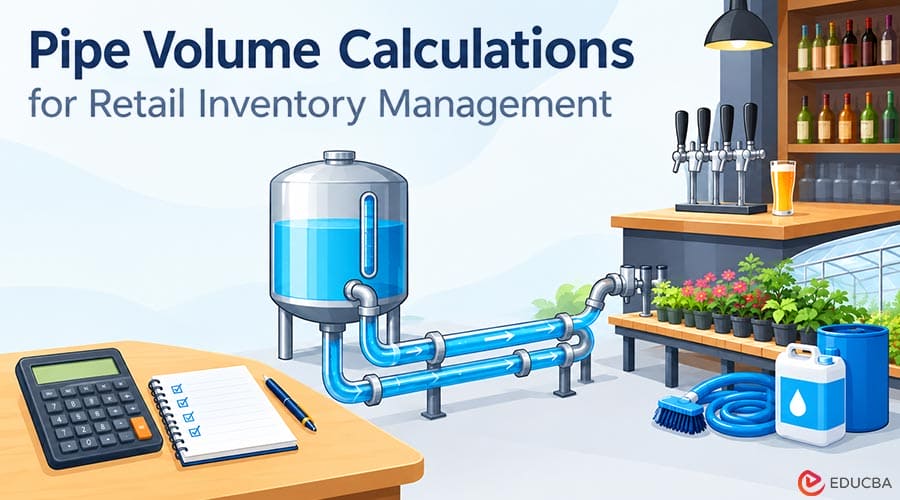
A store manager can pull a report if you ask how much inventory they have. You’ll typically receive a shrug when you ask how much is sitting inside the pipes.
For any store that sells liquids by the pour, the gallon, or the dosage, that difference is crucial. Pipe Volume Calculations help retailers determine how much product is sitting inside those lines, so they can account for inventory that is otherwise easy to overlook. Car washes, refill shops, bars, and garden centers all move merchandise through lines that contain more than most people realize. This guide covers the arithmetic, the tools, and a straightforward ledger that reveals those hidden gallons.
What Are Pipe Volume Calculations In Retail?
Pipe volume calculations in retail refer to working out how much liquid sits inside the pipes, hoses, and lines that connect storage tanks to the point of sale. It is stock you paid for, cannot see, and rarely count.
For example, a taproom with twelve draft handles may hold more than three gallons of beer inside its lines at any moment. That beer is not in the keg or in a glass. On most stock sheets, it simply does not exist.
Key Takeaways:
- Liquid stored inside pipes is real inventory, and ignoring it skews variance reports, cleaning costs, and reorder points.
- The correct math uses the pipe’s inside diameter, not the size printed on it.
- A simple three-bucket ledger (stored, in-line, dispensed) closes most of the gap.
Why Liquid Inventory Is Harder To Count Than Boxes
A carton on a shelf gets scanned. Liquid moves from tank to line to tap, and every stage holds product.
The broader cost of bad counts is not small. IHL Group’s research puts the global cost of out-of-stocks and overstocks at $1.77 trillion in 2025, and the same firm reports that 78% of retailers deal with inventory inaccuracies weekly or monthly.
Retailers who already follow solid inventory management practices for dry goods often skip liquids entirely. That is where the missing pints, gallons, and liters hide.
Where Pipe Volume Shows Up In Retail
1. Bars, Taprooms, And Beverage Counters
Draft beer, cold brew, soda, and wine-on-tap systems all push product through long runs. The Brewers Association’s Draught Beer Quality Manual sets the industry standard for cleaning lines every two weeks, and each cleaning cycle flushes the full line contents down the drain.
2. Garden Centers And Nurseries
Fertigation lines carry diluted fertilizer to benches. Staff often forget that the first few dozen gallons after a dosing change are still the old mix.
3. Car Washes And Refill Stores
Soap concentrates, bulk oils, and refill-station cleaners all travel through hoses. Priming a new line eats stock that never reaches a customer.
Pipe Volume Calculations: Get The Inside Diameter Right
The formula itself is simple:
Volume = π × radius² × length
The mistake almost everyone makes is using the nominal size. A pipe labeled 1 inch is not 1 inch inside. Wall thickness varies by material, so a 1-inch PEX line has a much smaller bore than a 1-inch copper line. Plug the nominal number straight into the formula, and PEX gets overstated by close to 40%.
Two conversions help when you are working by hand:
- 1 US gallon = 231 cubic inches
- 1 gallon = 128 fluid ounces
For anyone who doesn’t want to look up inside diameters by material and schedule, a pipe volume calculator built for the trades, like the one Dalton Mills offers, handles the lookup for copper, PVC, PEX, and steel and returns gallons, liters, and cubic feet together. These tools speed up pipe volume calculations when retailers need to check multiple lines.
Omni Calculator and Engineering ToolBox are also reliable free options, though you’ll usually need to enter the inside diameter yourself.
Worked Example: A 12-Tap Bar
These pipe volume calculations become particularly useful when a retail operation has multiple lines with different diameters and lengths.
Take a realistic long-draw setup. Each tap has 45 feet of 3/8-inch trunk line plus a 6-foot, 3/16-inch choker line.
- Per tap: about 34 fluid ounces sitting in the line
- Across 12 taps: roughly 410 ounces, or about 25.6 pints
- At 26 cleanings per year: around 666 pints flushed
At $7 a pint, that’s about $4,661 a year in beer bought, stored, and poured down the drain. Nobody stole it. It just never showed up on the variance report.
(No, the answer isn’t cleaning less often. It’s budgeting for it, and not blaming bar staff for a “shortage” that’s really plumbing.)
Worked Example: A Garden Center Fertigation Line
A nursery runs 240 feet of 1-1/2 inch Schedule 40 PVC as its main and 180 feet of 1-inch Schedule 40 as bench feeders.
- Main line: about 25.4 gallons
- Feeders: about 7.8 gallons
- Total: roughly 33.2 gallons
At 6 gallons per minute, it takes about five and a half minutes for the new fertilizer mix to reach the plants. Walk away after two minutes, and you are watering with the old mix.
Best Tools For Managing Liquid Inventory And Storage Capacity
1. Free Online Calculators And Spreadsheets
Fine for one-off checks or a single store. The catch: most assume you know the inside diameter, and spreadsheets rarely get updated after a remodel.
2. Trade-Built Calculators
Tools made for plumbers and HVAC techs bake in material tables, removing the most common error and making pipe volume calculations easier across different materials and pipe sizes. Dalton Mills, for instance, builds these as part of a wider AI platform for home service businesses, so the calculators are designed around how field crews actually measure.
3. Inventory And Tank Monitoring Systems
Flow meters, tank-level sensors, and draft monitoring systems log what leaves the tank in real time. Coruzant has a useful breakdown of how real-time locating systems cut audit downtime and improve stock visibility, and the same logic applies to sensor-fed liquid counts.
4. POS And ERP Integration
Enter known line volumes as a fixed “in-line” quantity so POS depletion matches physical stock more closely.
A Simple Framework: The Three-Bucket Liquid Ledger
This is the part most retailers skip, and it’s the part that fixes variance.
- Stored: Product in tanks, kegs, totes, and drums. Count by weight or level.
- In-Line: Product sitting in pipes and hoses. Calculate once per layout, then treat it as a constant.
- Dispensed: Product sold, poured, or used. Pull from POS.
If the buckets don’t add up, you have a real loss. If they do, you’ve stopped chasing phantom shrinkage. It also makes your retail store management routines easier, because staff can see exactly where each unit went.
What Not To Over-Engineer
Not every hose needs a calculation. A 3-foot run holds almost nothing. Focus on runs over 20 feet, scheduled line flushes, and pricier products.
How To Get Started This Week
- List every line: material, nominal size, and length.
- Calculate once, confirming the tool uses inside diameter.
- Add one in-line figure per system to stock sheets.
- Budget flushing as line volume times cleaning frequency.
- Recheck after any remodel.
Multi-site stores can fold these figures into their distribution management plans so replenishment counts what’s already in the lines.
Final Thoughts
Pipe Volume Calculations help retailers account for inventory that often goes unnoticed. Even a small amount of liquid left in each line can add up over time, especially when systems are cleaned or flushed regularly. Using the correct inside diameter, calculating the volume once, and recording in-line inventory can make stock counts more accurate and easier to manage.
Whether you use a free calculator, spreadsheet, or trade-built tool such as the one from Dalton Mills, the key is to apply the same method consistently. By including liquid stored inside pipes in regular inventory records, retailers can better understand product usage, plan replenishment, and reduce unexplained inventory variance.
Recommended Articles
This guide to pipe volume calculations helps retailers understand liquid inventory, storage capacity, and the tools used to manage products moving through pipes and hoses. Readers can explore these recommended articles for more insights into inventory management, retail operations, measurement tools, and storage capacity.

