
What is a PEST Analysis?
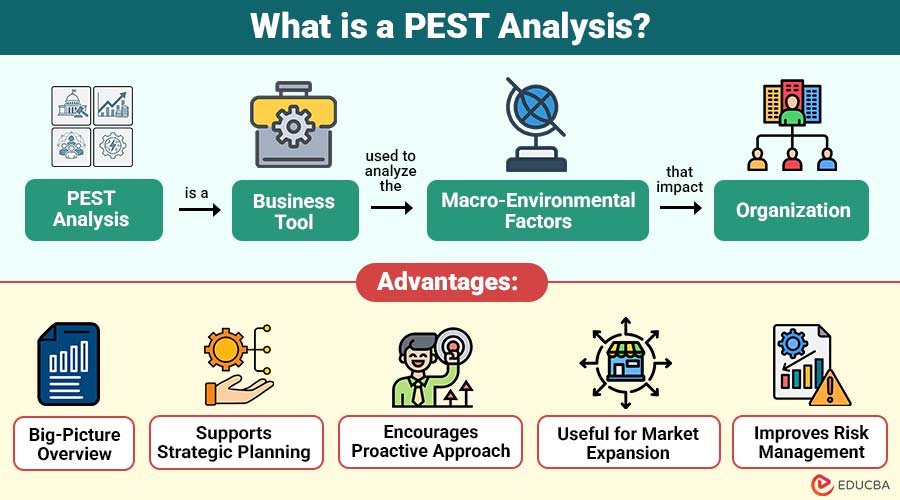
PEST analysis is a business tool used to analyze the macro-environmental factors that impact organization.
The acronym PEST stands for:
- Political Factors – Government policies, regulations, and political stability that influence business operations.
- Economic Factors – Economic conditions, such as inflation, interest rates, GDP growth, and unemployment rates.
- Social Factors – Societal trends, demographics, cultural aspects, and consumer behaviors.
- Technological Factors – Technological innovations, automation, R&D, and digital transformation are impacting business practices.
Sometimes, the analysis is expanded to PESTLE or PESTEL, adding legal and environmental factors for a more comprehensive view. The main goal of PEST analysis is to understand the external environment, which is outside the organization’s control, and leverage opportunities while mitigating threats.
Table of Contents:
- Meaning
- Importance
- Steps to Conduct a PEST Analysis
- Advantages
- Limitations
- Use Cases
- Real-World Examples
- Difference
Key Takeaways:
- PEST analysis evaluates political, economic, social, and technological factors to understand the external environment affecting business decisions.
- It helps organizations identify opportunities and threats early, enabling proactive planning and effective long-term strategic management.
- The framework supports better decision-making by analyzing market trends, risks, and external influences beyond organizational control.
- Regularly updating the PEST analysis ensures that strategies remain relevant amid changing economic, political, social, and technological conditions.
Importance of PEST Analysis
PEST analysis is important because it helps organizations understand external factors that influence business performance and strategic planning.
1. Identifies Opportunities and Threats
Helps businesses recognize potential opportunities and detect external threats early, allowing proactive planning and timely strategic responses.
2. Supports Strategic Planning
Provides clear information about external factors, helping organizations create long-term plans that align with market trends and changes.
3. Enhances Decision-Making
By understanding political, economic, social, and technological conditions, managers can make informed decisions about investments, marketing, and business operations.
4. Risk Management
Helps identify external risks in advance, allowing organizations to prepare contingency plans and reduce the impact of uncertainties.
5. Competitive Advantage
Organizations using PEST analysis can anticipate environmental changes earlier, adapt quickly, and gain a strong competitive advantage in the market.
Steps to Conduct a PEST Analysis
Conducting a PEST analysis involves a structured approach:
1. Define the Scope
Define the scope of analysis by selecting the industry, target market, region, or country relevant to business objectives and planning.
2. Collect Data
Gather reliable information about political, economic, social, and technological factors from reports, government sources, research studies, and industry publications that are available.
3. Identify Trends
Analyze collected data to identify current trends, patterns, and changes in the external environment that may influence business growth or risks.
4. Evaluate Impact
Assess how each political, economic, social, and technological factor carefully affects the organization’s performance, profitability, operations, and long-term strategic business decisions.
5. Develop Strategies
Create effective strategies to capitalize on opportunities and mitigate risks by aligning business plans with external environmental conditions and trends.
6. Review Regularly
Regularly update the PEST analysis because external factors change frequently, ensuring business strategies remain relevant, flexible, and responsive to environmental changes.
Advantages of PEST Analysis
The following are the key advantages:
1. Big-Picture Overview
Organizations can better understand the key elements affecting overall performance and growth potential by using PEST analysis, which offers a comprehensive picture of the external business environment.
2. Supports Strategic Planning
By taking into account political, economic, social, and technological aspects that impact long-term business objectives and stability, it assists managers in making well-informed strategic decisions.
3. Encourages Proactive Approach
By analyzing external trends in advance, businesses can anticipate changes and adapt strategies proactively to reduce risks and maximize opportunities.
4. Useful for Market Expansion
Supports market entry decisions by evaluating external conditions across different countries, helping businesses plan global expansion with lower risk.
5. Improves Risk Management
Identifies external risks early, helping businesses prepare plans to reduce uncertainty and minimize potential negative impacts.
Limitations of PEST Analysis
The following are the key limitations:
1. Ignores Internal Factors
Focuses solely on external environmental factors and does not consider internal strengths, weaknesses, resources, or organizational capabilities that affect performance.
2. Time-Consuming Process
Conducting a detailed PEST analysis requires extensive research, data collection, and evaluation, making the process time-consuming and sometimes costly for organizations.
3. Uncertain Predictions
The analysis relies on current trends and assumptions that may change unexpectedly, making predictions less accurate and sometimes unreliable for decision-making.
4. Needs Continuous Updating
External environments change rapidly, so PEST analysis must be updated regularly to remain useful, requiring continuous monitoring of political, economic, social, and technological factors.
5. Can Lead to Information Overload
May produce excessive external data, making it difficult to identify relevant information for effective decision-making.
Use Cases of PEST Analysis
The following are common use cases of PEST analysis, which help organizations understand external factors and make effective strategic decisions.
1. Market Entry Strategy
Helps businesses evaluate political, economic, social, and technological conditions of new markets before expansion to reduce risks and uncertainties.
2. Product Launch
It helps organizations analyze external environmental factors that may influence demand, acceptance, regulations, and the success of a new product in the market.
3. Risk Assessment
Identifies external threats, such as policy changes, economic instability, social shifts, and technological disruptions, to support effective risk management planning.
4. Strategic Business Planning
Organizations use PEST analysis to align long-term business strategies with macro-environmental conditions, ensuring better decision-making, stability, and sustainable growth in competitive markets.
Real-World Examples
The following examples show how different companies analyze political, economic, social, and technological factors to understand their external business environment and make strategic decisions.
1. Tesla
- Political: Government incentives for electric vehicles increase demand.
- Economic: Economic downturns may reduce consumer spending on high-value EVs.
- Social: Growing environmental awareness drives interest in sustainable transport.
- Technological: Advances in battery technology and self-driving systems strengthen competitive advantage.
2. Starbucks
- Political: Regulations on food safety and labor laws affect operations.
- Economic: Inflation may increase operational expenses, impacting pricing.
- Social: Shift toward healthier lifestyles and ethical sourcing influences product offerings.
- Technological: Mobile ordering apps and AI for customer experience improve service efficiency.
Difference Between PEST Analysis and PESTEL Analysis
The table below highlights the key differences between PEST analysis and PESTEL analysis.
| Feature | PEST Analysis | PESTEL Analysis |
| Definition | Focuses on Political, Economic, Social, and Technological factors | Includes Environmental and Legal factors, along with PEST |
| Scope | Macro-level external factors influencing business | Broader scope covering environmental and regulatory aspects |
| Use | Suitable for preliminary analysis | Used for in-depth analysis of the business environment |
| Advantage | Simple and easy to use | Comprehensive and detailed |
Final Thoughts
PEST analysis is strategic tool for understanding the external business environment by evaluating political, economic, social, and technological factors. It helps organizations identify risks, opportunities, and trends for better decision-making. When paired with other frameworks, it facilitates efficient planning and keeps companies competitive in a global market that is ever evolving.
Frequently Asked Questions (FAQs)
Q1. How often should a PEST analysis be conducted?
Answer: Ideally, PEST analysis should be reviewed annually or whenever significant changes occur in external environment.
Q2. Can PEST analysis be used for small businesses?
Answer: Yes, small businesses can use PEST to understand market conditions and make informed strategic decisions.
Q3. Who should use PEST analysis in an organization?
Answer: Business managers, strategic planners, marketing teams, and analysts commonly use PEST analysis to understand external factors affecting decisions.
Q4. Is PEST analysis qualitative or quantitative?
Answer: PEST analysis is mainly qualitative because it focuses on understanding external trends and conditions, although quantitative data may support the evaluation.
Recommended Articles
We hope that this EDUCBA information on “PEST Analysis” was beneficial to you. You can view EDUCBA’s recommended articles for more information.


