


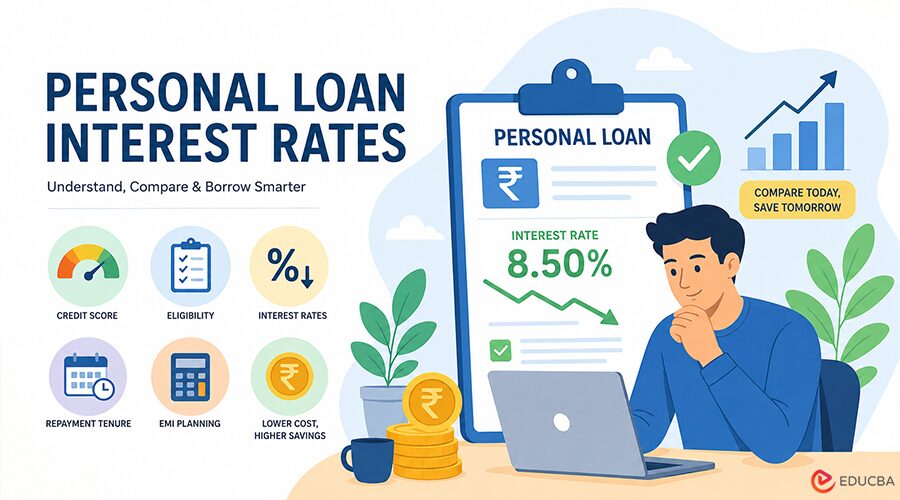
Many borrowers focus on getting their loan approved quickly, but very few spend enough time understanding what actually determines the total cost of borrowing. From credit scores and loan eligibility to repayment tenure and personal loan interest rates, small decisions made before applying can save or cost thousands over the life of a personal loan.
Why Understanding Personal Loan Interest Rates Matters Before You Apply?
When Rohan, a marketing professional with six years of work experience, decided to renovate his home office, he was confident the borrowing process would be straightforward. His salary had steadily increased, he had never missed a major bill payment, and he assumed that all lenders would offer nearly identical terms.
Within a day, he had an approved loan.
Only after making repayments for several months did he realize that another lender had offered a lower interest rate, more flexible repayment options, and lower processing charges. The difference was not obvious during the application process, but over the full tenure, it translated into significantly higher borrowing costs.
Stories like Rohan’s are increasingly common.
Many borrowers compare only the monthly EMI or the speed of approval, while overlooking one of the biggest factors affecting the total repayment amount: personal loan interest rates.
A lower interest rate does not simply reduce monthly payments; it can substantially decrease the overall cost of borrowing over several years.
Before submitting an application, it is worth understanding personal loan interest rates and the factors that influence them, rather than focusing only on quick approvals.
How Credit Score Influences Personal Loan Interest Rates?
One of the biggest misconceptions among first-time borrowers is that salary alone determines whether they will receive a competitive loan offer.
Income certainly matters because it demonstrates repayment capacity. However, lenders also evaluate how responsibly you have managed credit in the past.
This is where your credit score becomes important.
Think of it as a financial report card built over time.
Instead of looking at a single month’s income, lenders often evaluate long-term borrowing behavior, including:
- Whether previous EMIs were paid on time
- Credit card repayment history
- Existing loan obligations
- Credit utilization levels
- Recent credit inquiries
- Overall repayment consistency
Imagine two professionals earning ₹80,000 per month.
The first has consistently paid all EMIs before the due dates and has kept credit card utilization low.
The second earns the same salary but has missed several payments and frequently uses most of their available credit limit.
Although their incomes are identical, they may receive very different loan offers because their financial behavior tells two different stories.
This is why maintaining a healthy credit score is often just as important as increasing your income. A stronger credit profile may also improve your chances of receiving more competitive personal loan interest rates.
Personal Loan Eligibility: What Lenders Actually Evaluate
Many applicants believe personal loan eligibility depends only on age and salary.
In reality, lenders usually evaluate a combination of financial factors to estimate repayment risk.
Some of the most common considerations include:
| Eligibility Factor | Why It Matters |
| Monthly Income | Indicates repayment capacity |
| Credit Score | Reflects financial discipline |
| Existing EMIs | Shows current debt obligations |
| Employment Stability | Suggests income consistency |
| Debt-to-Income Ratio | Measures affordability |
| Repayment History | Indicates long-term borrowing behavior |
Looking at these factors together helps lenders assess not just whether someone can borrow today, but whether they are likely to repay comfortably throughout the loan tenure.
For borrowers, understanding these criteria before applying can improve both approval chances and the likelihood of receiving favorable personal loan interest rates.
Online Personal Loan India: Convenience Should Not Replace Comparison
The rise of online personal loan platforms in India has transformed the borrowing experience.
Applications that once involved multiple branch visits and paperwork can now be completed digitally within minutes.
This convenience has made access to credit easier than ever before.
However, it has also created a new challenge.
Many borrowers now compare lenders based primarily on:
- Approval speed
- Minimal documentation
- Instant disbursal
- Promotional offers
These features are certainly valuable, but they should not be the only factors influencing a borrowing decision.
Experienced financial planners usually recommend comparing:
- Interest rates
- Processing fees
- Repayment flexibility
- Loan tenure
- Prepayment conditions
- Total borrowing cost
A few extra minutes spent comparing options before applying can often lead to meaningful savings over the entire repayment period.
A Practical Example of Two Borrowers
Consider these two scenarios.
Borrower A applies immediately after seeing an advertisement promising instant approval. They accept the first offer without comparing repayment terms or personal loan interest rates.
Borrower B spends an evening reviewing interest rates, checking eligibility requirements, understanding repayment flexibility, and evaluating the total cost of borrowing.
Both receive a personal loan.
However, Borrower B is more likely to choose a loan that aligns with their financial goals rather than simply the fastest available option.
The lesson is simple:
The quality of your borrowing decision often matters more than the speed of your loan approval.
Common Borrowing Mistakes That Can Increase the Cost of a Personal Loan
Most repayment challenges do not begin after the loan is disbursed – they begin before the application is submitted.
In conversations with financial advisors, one pattern appears repeatedly: borrowers often spend considerable time comparing products like smartphones or insurance plans, but very little time understanding how different loan features affect their finances over the next three to five years.
Here are some of the most common mistakes that can make a personal loan more expensive than necessary.
1. Applying Without Checking Your Credit Score
Many borrowers review their credit score only after a lender asks for it.
By then, the lending decision is already underway.
Checking your credit profile in advance allows you to identify errors, understand your financial standing, and improve your borrowing position before submitting an application. This can also help you qualify for better personal loan interest rates.
2. Looking Only at the EMI
A lower monthly EMI may appear attractive, but it does not always mean the loan is cheaper.
A longer repayment tenure can reduce monthly payments while increasing the total interest paid over the life of the loan.
Instead of comparing EMIs alone, evaluate:
- Total repayment amount
- Interest paid across the tenure
- Processing fees
- Prepayment conditions
- Repayment flexibility.
This broader perspective helps you understand the actual cost of borrowing.
3. Ignoring Loan Eligibility Requirements
Many people apply to multiple lenders without checking loan eligibility criteria.
Each rejected application may lead to additional credit inquiries, which can influence future lending decisions.
A better approach is to understand your eligibility before applying and shortlist lenders whose requirements align with your financial profile.
4. Borrowing More Than Necessary
Receiving approval for a higher loan amount does not automatically mean you should borrow it.
A larger loan often results in:
- Higher EMIs
- Increased interest costs
- Reduced monthly financial flexibility.
Borrowing based on genuine need rather than maximum eligibility is usually the more sustainable choice.
5. Choosing Convenience Over Comparison
Digital lending has made borrowing remarkably simple, but convenience should not replace research.
Borrowers who spend a few extra minutes understanding their personal loan options before applying are often better equipped to compare repayment structures, borrowing costs, and loan features rather than choosing the first available approval.
A Simple Checklist Before Applying for a Personal Loan
Whether you are applying for your first loan or have borrowed before, asking a few practical questions can help you make a better financial decision.
- Why do I need this loan?
- Can I comfortably manage the EMI alongside my existing expenses?
- Have I compared personal loan interest rates across multiple lenders?
- Is my credit score in good shape?
- Do I fully understand the total borrowing cost – not just the monthly EMI?
- Will this repayment still fit my budget if my priorities change over the next few years?
This short checklist can often prevent long-term financial stress.
Quick Comparison: Informed Borrower vs. Reactive Borrower
| Decision Area | Informed Borrower | Reactive Borrower |
| Research | Compares multiple lenders | Accepts the first offer |
| Credit Score | Reviews before applying | Checks after applying |
| Interest Rate | Evaluates total borrowing cost | Focuses only on EMI |
| Loan Eligibility | Understands requirements first | Applies to several lenders at once |
| Repayment Planning | Considers future financial goals | Focuses only on immediate needs |
The difference is not just knowledge – it is the quality of the financial decisions that follow.
Final Thoughts
A personal loan can be an effective financial tool when used responsibly, but the total borrowing cost depends on much more than approval speed.
Understanding how credit scores, loan eligibility, and personal loan interest rates interact helps borrowers make informed decisions rather than costly ones.
As digital lending continues to simplify access to credit, financial awareness becomes even more valuable. Borrowers who carefully compare lenders, evaluate the full cost of borrowing, and plan repayments before applying are often better positioned to achieve their financial goals without placing unnecessary pressure on their monthly budgets.
Ultimately, the smartest borrowing decision is not always the fastest one – it is the one that supports your long-term financial well-being while giving you the flexibility to manage life’s changing priorities with confidence.
Frequently Asked Questions (FAQs)
Q1. Why does my credit score affect personal loan interest rates?
Answer: A credit score helps lenders understand your borrowing history and repayment behavior. While every lender has its own assessment process, a stronger credit profile generally reflects lower lending risk and may improve your chances of receiving more favorable loan terms.
Q2. How can I improve my personal loan eligibility?
Answer: Some practical ways include maintaining a stable income, paying EMIs and credit card bills on time, keeping existing debt under control, avoiding unnecessary loan applications, and monitoring your credit score regularly.
Q3. Is applying for an online personal loan in India safe?
Answer: Applying through reputable and regulated lenders can provide a secure and convenient borrowing experience. Even with digital applications, it is important to review loan terms carefully before accepting an offer.
Q4. Should I always choose the lowest interest rate?
Answer: Not necessarily.
The best borrowing decision considers the complete picture – including repayment flexibility, processing charges, tenure, customer support, and the overall cost of the loan – not just the advertised interest rate.
Recommended Articles
Explore more personal finance guides to understand how credit scores, EMIs, and loan eligibility can affect your borrowing decisions. Learn practical ways to compare loan offers, reduce repayment costs, and manage debt with confidence.


