


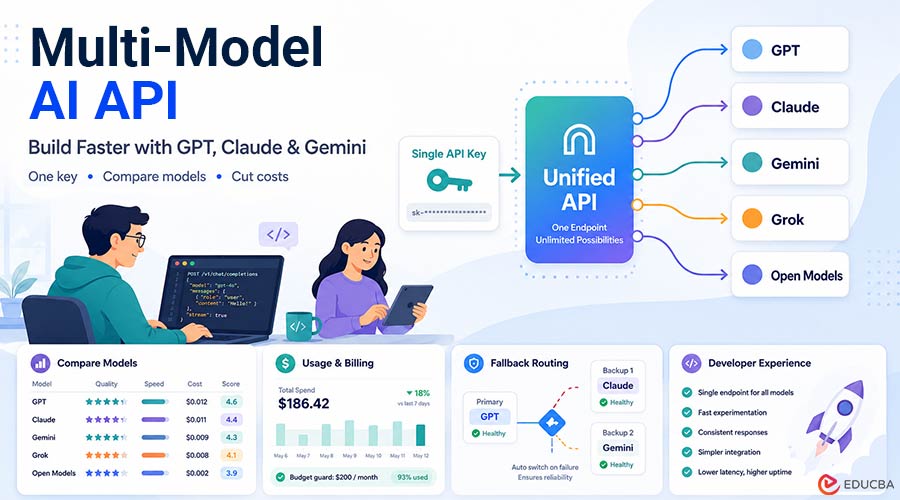
Learning to build with artificial intelligence used to mean picking one provider, reading its documentation, and hoping you chose well. Today, the landscape looks completely different. Between OpenAI’s GPT models, Anthropic’s Claude, Google’s Gemini, xAI’s Grok, and a fast-growing list of open-source alternatives, developers are no longer asking “how do I call an AI model?” but “how do I manage ten of them at once?”
For students, indie developers, and engineering teams alike, this fragmentation has become a real productivity tax. Every provider ships its own SDK, authentication scheme, rate limits, and billing dashboard. A developer who wants to compare GPT and Claude on the same task ends up maintaining two accounts, two API keys, two invoices, and two slightly different request formats before writing a single line of application logic.
The Rise of the Multi-Model AI API
A Multi-Model AI API solves this problem by providing a single, consistent interface to many model providers. Instead of integrating each vendor separately, you send requests to a single endpoint, usually in the OpenAI-compatible format that has become the industry’s de facto standard, and specify which model you want by name. Switching from GPT to Claude becomes a one-line change rather than a refactoring project.
This approach has three practical benefits that matter enormously when you are learning or prototyping.
1. Faster Experimentation
The best way to understand the strengths of different models is to run the same prompt against several of them. With a Multi-Model AI API, an A/B test across five models takes minutes, not days. You learn quickly that one model excels at structured extraction while another writes better long-form explanations, knowledge you simply cannot get from reading marketing pages.
2. Simpler Cost Control
Token pricing varies by an order of magnitude across models. A Multi-Model AI API with unified billing lets you see exactly which models consume your budget, route routine tasks to cheaper options, and reserve premium models for work that genuinely needs them.
3. Built-in Resilience
Production applications need fallbacks. When one provider has an outage or returns a rate-limit error, a Multi-Model AI API makes it trivial to retry the request against an alternative model instead of showing your users an error page.
What to Look For in a Multi-Model AI API Platform?
Not all aggregation platforms are equal. When evaluating a Multi-Model AI API platform, check the model catalog first: does it cover the frontier models you actually want, and how quickly are new releases added?
Then look at pricing transparency, reputable platforms publish per-model token prices and let you pay as you go rather than locking you into subscriptions. Finally, test latency yourself; a thin, well-engineered proxy layer should add only milliseconds to each request.
Platforms such as APIMart illustrate what this model looks like in practice: a single OpenAI-compatible endpoint that provides access to GPT, Claude, Gemini, Grok, and dozens of other models under a single API key, with pay-as-you-go billing, so developers can compare and combine models without juggling multiple vendor accounts.
Why a Multi-Model AI API Is a Better Way to Learn AI Development?
There is also a pedagogical argument for the Multi-Model AI API approach. Developers who learn against a single vendor’s SDK tend to absorb that vendor’s abstractions as if they were universal truths. Working through a provider-agnostic interface teaches the concepts that actually transfer prompts, tokens, context windows, temperature, and streaming independent of any one company’s implementation details.
The AI ecosystem will keep fragmenting before it consolidates. New models will launch monthly, prices will keep shifting, and today’s leader may be next quarter’s laggard. Building your skills and your applications on a Multi-Model AI API layer is the most practical hedge: you keep full access to the frontier while writing code that survives whatever the market does next.
By integrating the keyword naturally into headings and body text, this version improves SEO relevance for the Multi-Model AI API without keyword stuffing.
Recommended Articles
We hope this guide helps you understand how Multi-Model AI APIs simplify AI development and enable developers to experiment with multiple AI models more efficiently. Explore these recommended articles for more insights into AI APIs, multi-model integration, prompt engineering, AI development tools, and building scalable AI applications.

