


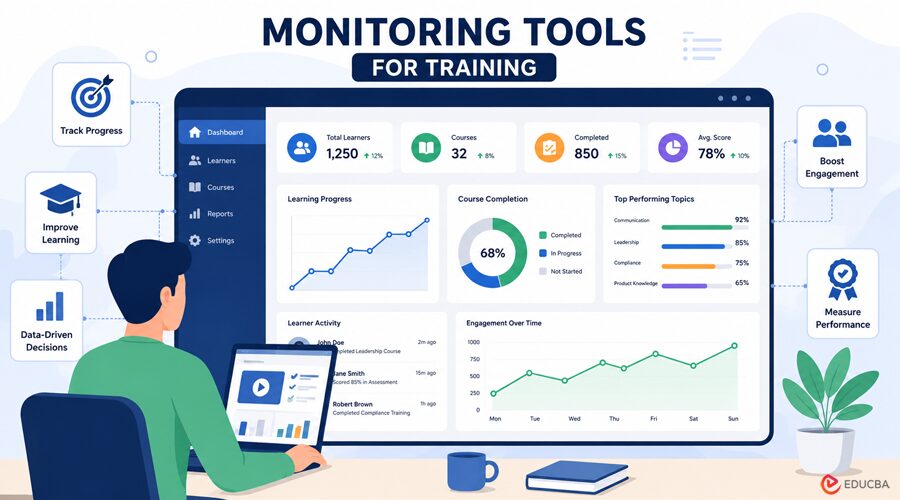
Why do some training programs change how people work, and others just get completed and forgotten? That gap is not about effort. It is about visibility. Most training programs still operate like a one-way system. The content is uploaded to the system, and we assume learning happens. But in reality, without knowing what is working and what is not, it is all guesswork. This is where monitoring tools for training make a significant difference. They help you see what is actually happening inside your training programs. Continue reading to find out how monitoring tools improve training efficiency.
What Monitoring Tools Mean in Training Efficiency?
At a basic level, monitoring tools track learners’ progress through training. But reducing them to a mere “tracking tool” misses the bigger picture. They act more like a live feedback system. The click a user makes, the pause taken, the retry, or the skipped section clearly shows how someone is learning. When you start measuring users’ learning metrics this way, the training stops being static content and becomes something you can improve over time. Just think about how you learn outside of work? When you are trying to pick up a new skill, you adjust as you start learning. If something feels confusing, you revisit it. If it is too easy, you move ahead. Monitoring tools bring that same adaptability into structured training environments.
They capture details like time spent on modules, assessment performance, and engagement patterns. But more importantly, they help answer questions that are often overlooked. Are learners encountering the same obstacle throughout the training? Which sections are they moving through too quickly? Most importantly, are their skills and performance improving over time? Some of the leading employee monitoring tools today go a step further by connecting learning behavior with productivity patterns. That combination gives organizations a clearer picture of how effectively they develop skills, not just what employees complete. So, in practice, monitoring tools are less about control and more about clarity. They help you understand what is really happening beneath the surface.
How Monitoring Tools for Training Improve Efficiency?
Here are the key ways they improve training efficiency:
1. Identifying Learning Gaps Early
In many organizations, training issues only surface at the end, often through poor results. By then, fixing them takes more effort than it should. Monitoring tools bring those issues forward at the right time. You start noticing various learning patterns as training progresses. For example, if a large group of learners is revisiting the same concept or quiz scores decline at a specific point, these issues are highlighted in a monitoring tool.
Similarly, there is a compliance training program. If most employees struggle with a particular regulation scenario, that is not something to ignore until the final assessment. With monitoring tools, that signal appears early, thereby giving trainers time to adjust the explanation or add context. When you catch problems early, you improve outcomes and reduce rework later.
2. Personalizing Learning Paths
When you have data at your fingertips, you know that everyone’s way of learning is different. Some people complete the training quickly but make mistakes, while others might take longer to learn but are more retentive. When this data is stored and accessible via internal knowledge base software, trainers can reference past patterns to make faster, better decisions. Monitoring tools make it easier to understand these differences, and accordingly, trainers can adjust their teaching.
Instead of pushing everyone through the same structure and pace, training can adapt based on how individuals perform. Take a practical case. A marketing professional might quickly understand strategy concepts but struggle with analytics tools. With monitoring insights, the system can recommend additional analytics practices without forcing them to repeat everything else. That balance makes training feel more relevant. When training feels relevant, people are more likely to engage seriously, and completion rates often improve.
3. Improving Engagement Levels
Low learner engagement is hard to detect manually because it manifests in subtle behaviors. Skipping sections, rushing through content, or leaving modules unfinished are red flags. But monitoring tools help you detect those signals. And once you see them, it becomes easier to understand what is going wrong.
For example, if employees consistently leave the longer video sessions, it might indicate fatigue rather than a lack of interest. In these cases, switching to more dynamic formats, such as interactive video, can significantly improve engagement and retention. Therefore, as a solution, you can break that content into smaller, more interactive parts to completely change the experience. Engagement naturally improves when training feels manageable and useful.
4. Enabling Data-Driven Decisions
Many training decisions are based on assumptions rather than evidence. Organizations often continue to use the same methods because they worked in the past, even when learners’ needs have changed. However, monitoring tools take a different approach. They have the data and show patterns that are hard to notice manually.
Maybe interactive modules lead to better retention, or maybe shorter assessments improve completion rates. Instead of guessing, organizations can adjust training based on what the data reveals. Over time, this will lead to a more refined training process where changes are intentional.
5. Tracking Real Progress, Not Just Completion
Whether a learner has completed a course or not is easy to measure, but it does not tell the full story. Someone can finish a course without fully comprehending it. Monitoring tools solve this problem, too. They track how consistently someone performs, how they improve over time, and how well they apply what they learn.
For example, an employee completes a training module on a topic within 2 hours. But for the same topic, others took 4 hours. And the employee who completed the module early continues to make the same mistakes on assessments, indicating a gap that needs attention. Without monitoring, that detail would likely go unnoticed. This shift from completion to comprehension makes training more meaningful.
6. Providing Instant Feedback
Feedback works best when it is immediate. When learners have to wait too long, it often disconnects the feedback from the learning moment. With monitoring tools, learners receive feedback as they progress. Whether it is a quiz result or a simulation outcome, they know right away what needs improvement, if any.
In a technical training scenario, this can make a big difference. Immediate correction reinforces the right approach before mistakes turn into habits. Platforms like Pointerpro support this by automatically generating personalized feedback reports the moment a training assessment is completed. It keeps the learning process active instead of delayed.
7. Enhancing Trainer Effectiveness
Trainers usually rely on observation and feedback, but these capture only part of the situation. Monitoring tools add another layer by showing how learners respond across different sessions. Maybe one trainer’s approach leads to higher engagement, or another’s sessions result in better assessment performance.
These insights help identify what works best. Instead of giving the same training sessions to everyone, organizations can tailor their training to employees’ learning patterns. Trainers also have the opportunity to refine their approach using clear, actionable data.
Turn Training Into Measurable Growth
Training works best when it does not feel like a routine task. It should improve the way people learn and perform. Monitoring tools make that shift possible by providing visibility into all a learner’s activities. Monitoring tools for training make this possible by providing visibility into every stage of the learning journey. These tools help organizations transform their approach from assumptions to understanding, from static content to continuous improvement, and from completion metrics to real outcomes. When you start paying attention to how learning happens, small changes begin to make a big difference. If you are looking to strengthen your employee development initiatives, consider combining structured learning programs with insights from training monitoring tools.
Recommended Articles
We hope this guide on monitoring tools for training helps you improve learning efficiency and outcomes. Check out these recommended articles for more insights on employee training and development.

