
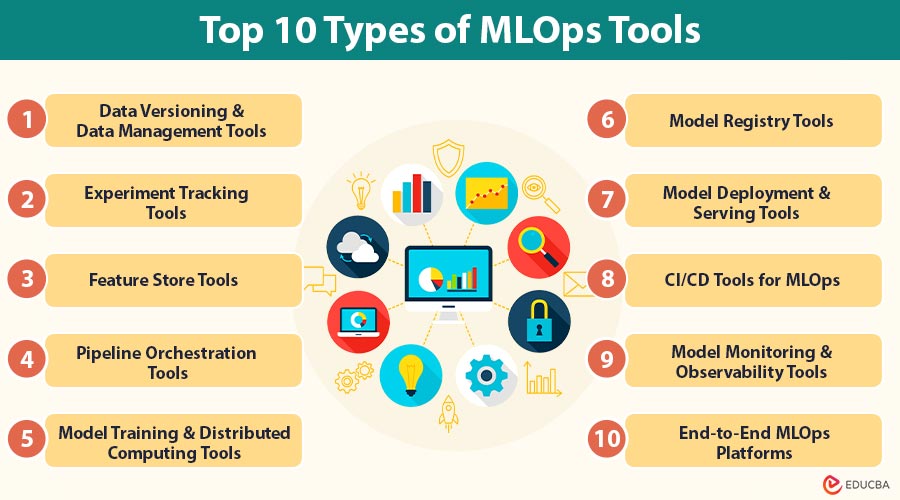
Introduction to MLOps Tools
MLOps (Machine Learning Operations) Tools are technologies that support the end-to-end management of machine learning workflows, from data preparation and model training to the deployment, monitoring, and governance. They help companies build and run machine learning smoothly by automating tasks, making results repeatable, helping teams work together, and keeping models accurate after deployment. In this article, we outline 10 essential MLOps tool types that support the full machine learning lifecycle.
Top 10 Types of MLOps Tools
To begin with, there are ten major categories of MLOps tools that support the complete machine learning lifecycle. These tools cover every stage, ranging from data management to production monitoring.
#1. Data Versioning and Data Management Tools
Popular Tools:
- DVC (Data Version Control): DVC enables version control for large datasets and ML models by integrating with Git. It tracks changes in data and pipelines without storing bulky files in Git.
- Pachyderm: Pachyderm tracks data, manages versions, and reproduces workflows via containers.
- LakeFS: LakeFS gives data lakes Git-like version control with branching, commits, and rollbacks.
Role of These Tools:
- Ensure dataset reproducibility
- Track data lineage and changes
- Enable rollback and experimentation with confidence
#2. Experiment Tracking Tools
Experiment tracking tools record parameters, metrics, artifacts, and outcomes of machine learning experiments, helping teams compare results, collaborate efficiently, and avoid repeating failed or redundant experiments.
Popular Tools:
- MLflow Tracking: MLflow Tracking saves experiments, settings, results, and files in one place.
- Weights & Biases (W&B): W&B lets ML teams see results live, compare experiments, and work together easily.
- Neptune.ai: Neptune offers metadata logging and experiment comparison with strong support for large-scale teams.
Role of These Tools:
- Compare experiments easily
- Improve collaboration
- Reduce redundant experimentation
#3. Feature Store Tools
Feature stores centralize and manage ML features, ensuring they are reused correctly. This helps prevent mistakes, data leaks, and redundant work during both training and prediction.
Popular Tools:
- Feast: Feast stores and manages features for offline and online use.
- Tecton: Built on top of Feast, Tecton is an enterprise-grade feature platform for real-time machine learning applications.
- Hopsworks Feature Store: Hopsworks is a tool for storing and managing machine learning features. It tracks versions, monitors usage, and ensures compliance with rules.
Role of These Tools:
- Ensure feature uniformity
- Reduce training-serving skew
- Accelerate model development
#4. Pipeline Orchestration Tools
Popular Tools:
- Apache Airflow: Airflow schedules and monitors complex ML pipelines using Directed Acyclic Graphs (DAGs).
- Kubeflow Pipelines: Scalable, container-native machine learning processes on Kubernetes are offered via Kubeflow Pipelines.
- Prefect: Prefect is a modern tool for running and managing workflows that makes everyday tasks easier. When compared to older schedulers, it helps users track progress and fix problems more quickly and easily.
Role of These Tools:
- Automate repetitive tasks
- Improve reliability
- Enable scalable ML workflows
#5. Model Training and Distributed Computing Tools
- Apache Spark MLlib: Spark MLlib helps run machine learning on big data by spreading tasks across many computers.
- Ray: Ray lets you run machine learning work on many computers together. It makes training models, trying different settings, and reinforcement learning faster and simpler.
- Horovod: Horovod accelerates deep learning by training models in parallel across multiple GPUs or machines.
Role of These Tools:
- Reduce training time
- Enable large-scale model training
- Optimize resource utilization
#6. Model Registry Tools
Model tools track machine learning models and manage their versions throughout development. In addition, they monitor the entire model lifecycle to ensure reliability and performance. Most importantly, these tools help teams safely move models from development to production in a controlled and secure manner.
Popular Tools:
- MLflow Model Registry: Offers versioning, stage transitions, and metadata for centralized model storage.
- SageMaker Model Registry: AWS-native registry that integrates with training, deployment, and approval workflows.
- Azure ML Model Registry: Supports model lifecycle management within Azure’s ML ecosystem.
Role of These Tools:
- Track model versions
- Control promotion to production
- Improve governance and compliance
#7. Model Deployment and Serving Tools
Popular Tools:
- KServe (formerly KFServing):KServe enables serverless, self-scaling machine learning model inference on Kubernetes.
- Seldon Core: Seldon helps put machine learning models into real use safely. It can send traffic smartly, test different versions (A/B testing), and slowly release updates (canary rollouts).
- TensorFlow Serving: Optimized serving system for TensorFlow models with high throughput and low latency.
Role of These Tools:
- Enable real-time and batch inference
- Support scalable deployments
- Simplify model serving infrastructure
#8. CI/CD Tools for MLOps
Popular Tools:
- Jenkins: A popular tool that automates the build, testing, and deployment of machine learning workflows from start to finish.
- GitHub Actions: It automatically handles model training, testing, and deployment whenever certain events happen.
- GitLab CI/CD: Offers integrated version control and CI/CD pipelines for ML projects.
Role of These Tools:
- Reduce manual errors
- Enable faster releases
- Automate model confirmation and deployment
#9. Model Monitoring and Observability Tools
Monitoring and observability tools track model performance, data quality, drift, and overall system health in production. Moreover, continuous analysis of these factors helps teams detect potential issues early. As a result, teams can maintain reliable systems and ensure accurate predictions over time.
Popular Tools:
- Evidently AI: An open-source tool for monitoring data drift, concept drift, and model performance.
- Arize AI: ML explainability and observability via an enterprise monitoring system.
- WhyLabs: It keeps watching your data to find mistakes or unusual patterns.
Role of These Tools:
- Detect model degradation
- Maintain prediction quality
- Ensure reliability in production
#10. End-to-End MLOps Platforms
End-to-end MLOps platforms are all-in-one systems that help companies handle machine learning projects. They manage data, train models, deploy them, monitor performance, and ensure compliance with rules. This reduces the need for multiple tools and enables companies to adopt machine learning more quickly.
Popular Tools:
- Kubeflow: Open-source ML platform built on Kubernetes, covering training, pipelines, and deployment.
- AWS SageMaker: It is a fully managed service for machine learning model deployment, training, monitoring, and automation.
- Azure Machine Learning: End-to-end ML platform with strong management and enterprise integration.
Role of These Tools:
- Reduce tool separation
- Simplify enterprise adoption
- Accelerate production preparedness
Final Thoughts
MLOps tools facilitate the smooth functioning of machine learning processes. At the same time, they take care of deployment and monitoring, making sure models work smoothly and run as expected. For example, they track data, experiments, and models, and also handle the process of deploying and monitoring them. Additionally, handling these tasks efficiently helps ensure smooth, reliable machine learning operations. Using the right tools helps teams work faster, prevent errors, and build better machine learning solutions.
Frequently Asked Questions (FAQs)
Q1. Are all MLOps tools required for every project?
Answer: No. Tool selection depends on project size, team maturity, and production complexity.
Q2. Can open-source tools replace managed platforms?
Answer: Yes, but they require higher working expertise and infrastructure management.
Q3. What is the most critical MLOps tool category?
Answer: Experiment tracking and model monitoring are often considered foundational.
Recommended Articles
We hope that this EDUCBA information on “MLOps Tools” was beneficial to you. You can view EDUCBA’s articles for more information.

