


Updated October 18, 2025
What is Machine Reasoning?
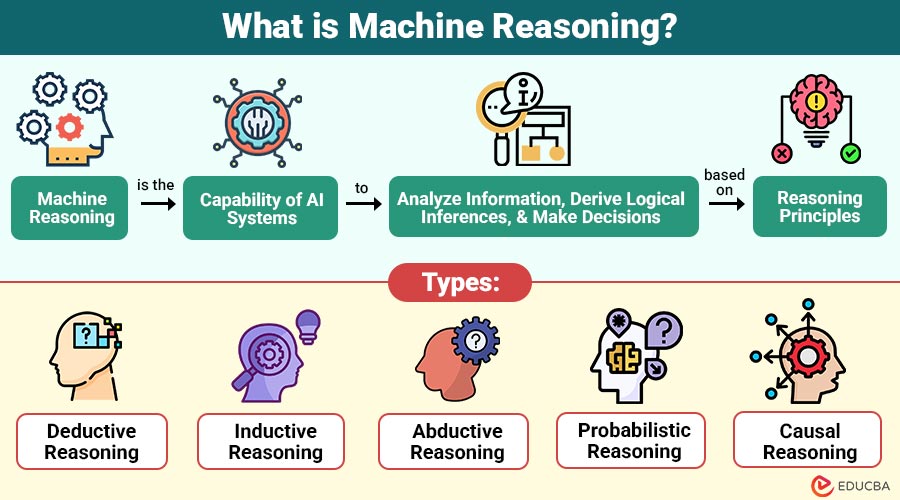
Machine reasoning is the capability of AI systems to analyze information, derive logical inferences, and make decisions based on reasoning principles. While machine learning focuses on identifying patterns from large datasets, machine reasoning emphasizes understanding relationships between entities, drawing conclusions, and solving problems based on logic and rules.
Table of Contents:
- Meaning
- Key Components
- Types
- Machine Reasoning vs Machine Learning
- Real-World Applications
- Advantages
- Disadvantages
- Future Trends
Key Takeaways:
- Machine reasoning enables AI to make informed decisions by applying logic, rules, and structured knowledge effectively.
- Integrating reasoning with learning systems improves adaptability, prediction accuracy, and context-aware problem-solving across domains.
- Reasoning-based AI enhances transparency, allowing humans to understand decision-making processes and verify logical inference chains.
- Despite challenges in knowledge creation and computational demands, reasoning empowers AI to solve complex, dynamic real-world problems.
Key Components of Machine Reasoning
Machine reasoning typically relies on the following components:
1. Knowledge Representation
Machines need a structured way to store information. Knowledge representation frameworks include semantic networks, ontologies, logic-based models, and probabilistic graphs.
2. Inference Engines
These are algorithms that allow systems to derive new information from existing knowledge. Common inference methods include forward chaining, backward chaining, and abductive reasoning.
3. Logical Frameworks
Logic forms the backbone of reasoning. Systems often employ propositional logic, predicate logic, and modal logic to evaluate truth values and relationships.
4. Uncertainty Handling
Real-world data is often incomplete or noisy. Probabilistic reasoning, Bayesian networks, and fuzzy logic help machines make informed decisions despite uncertainty.
5. Learning Mechanisms
Machine reasoning can integrate with machine learning to improve reasoning over time. For instance, learning relationships between variables can enhance the accuracy of future inferences.
Types of Machine Reasoning
Machine reasoning can be classified based on the type of logic or inference used:
1. Deductive Reasoning
Derives specific conclusions from general rules or premises using strict logic, ensuring findings are necessarily true if premises hold.
2. Inductive Reasoning
Infers general rules or patterns from multiple specific observations, predicting trends while accepting possible uncertainty or exceptions.
3. Abductive Reasoning
Generates the most plausible explanation for incomplete or limited data, forming hypotheses to explain observed evidence best.
4. Probabilistic Reasoning
Uses probability and statistical models to make informed decisions under uncertainty, estimating likelihoods rather than absolute certainties.
5. Causal Reasoning
Finds what causes what, telling real effects apart from simple connections, to make better predictions and understanding.
Machine Reasoning vs. Machine Learning
The following table compares the main differences:
| Feature | Machine Reasoning | Machine Learning |
| Focus | Logical inference, decision-making | Pattern recognition, predictions |
| Data Dependence | Can work with limited, structured knowledge | Requires large datasets |
| Output | Logical conclusions or decisions | Statistical predictions |
| Flexibility | Requires explicit rules or knowledge | Learns from experience |
| Use Case | Medical diagnosis, legal reasoning, troubleshooting | Image recognition, speech translation |
Real-World Applications of Machine Reasoning
Here are some practical areas where machine reasoning is applied:
1. Healthcare
Machine reasoning powers AI systems that diagnose diseases, recommend treatments, and predict patient outcomes. For instance, IBM Watson uses reasoning to analyze medical literature and patient records, assisting doctors in making evidence-based decisions.
2. Autonomous Vehicles
Self-driving cars rely on reasoning to predict pedestrian movements, interpret traffic rules, and avoid accidents. Beyond recognizing objects, reasoning systems evaluate context and consequences.
3. Finance and Risk Management
In banking and insurance, machine learning identifies fraudulent activities, assesses creditworthiness, and predicts financial risks by analyzing transaction histories and contextual clues.
4. Legal and Compliance Systems
Reasoning AI can analyze legal documents, identify regulatory breaches, and provide recommendations, helping lawyers and compliance officers navigate complex legal frameworks.
5. Robotics
Robots with reasoning skills can adjust to changing situations, make their own decisions, and work more efficiently. Examples are warehouse robots and disaster-response robots.
6. Customer Support
Intelligent chatbots use reasoning to understand queries, infer user intent, and provide accurate solutions, surpassing simple scripted responses.
Advantages of Machine Reasoning
Here are some advantages of using machine reasoning:
1. Enhanced Decision-Making
Machine reasoning allows AI systems to make accurate, informed decisions in complex, uncertain environments by applying logical analysis and structured inference.
2. Explainability
Reasoning-based AI provides clear, understandable logic and inference chains, making decisions transparent and interpretable compared to black-box machine learning models.
3. Adaptability
Systems using reasoning can generalize learned knowledge to new, unseen situations, solving problems effectively without requiring extensive retraining or manual adjustments.
4. Error Detection
Logical reasoning enables AI to identify inconsistencies, validate information, and detect potential errors, improving overall accuracy and reliability in decision-making processes.
Disadvantages of Machine Reasoning
Here are some notable disadvantages of machine reasoning:
1. Knowledge Acquisition Challenge
Building complete knowledge bases for reasoning systems takes a lot of time and effort and needs experts to provide accurate information for each field.
2. Computational Complexity
Advanced reasoning algorithms need a lot of computer power and memory, so doing large or real-time calculations can be slow and costly
3. Limited Creativity
Machine reasoning strictly follows logical rules, which can restrict its ability to handle ambiguous, innovative, or highly creative problem-solving tasks effectively.
4. Integration with Unstructured Data
Reasoning systems struggle to process unstructured data like text, images, or multimedia without integrating additional machine learning or natural language techniques.
Future Trends
Here are some emerging trends shaping the future of machine reasoning:
1. Integration with Machine Learning
Mixing machine learning’s pattern-finding with logical reasoning creates hybrid AI, which makes predictions more accurate, adaptable, and easier to understand in context.
2. Explainable AI (XAI)
Future reasoning systems will focus on transparency, providing clear, interpretable logic and inference chains to enhance trust and accountability.
3. Causal AI
Shifting from correlation-focused analysis to cause-and-effect reasoning allows AI to generate actionable insights, improve predictions, and support effective interventions.
4. Autonomous Decision Systems
Advanced reasoning will help smart machines make their own safe and accurate decisions in areas like transportation, healthcare, and finance.
5. Knowledge Graph Expansion
Making large knowledge graphs bigger gives AI more context, helping it reason better, connect information, and solve specific problems.
Final Thoughts
Machine reasoning advances AI beyond pattern recognition, enabling intelligent decision-making, problem-solving, and human-like cognition. By combining knowledge representation, logic, and uncertainty handling, it addresses challenges across healthcare, finance, and autonomous systems. Integrating reasoning with machine learning, knowledge graphs, and causal AI enhances adaptability, transparency, and intelligence, establishing machine reasoning as a central driver of the next AI revolution.
Frequently Asked Questions (FAQs)
Q1. Is machine reasoning the same as AI?
Answer: Machine reasoning is a subset of AI focused on logical inference, decision-making, and understanding relationships between entities.
Q2. Can machine reasoning work without machine learning?
Answer: Yes, rule-based reasoning systems can function independently, but combining with machine learning enhances flexibility and accuracy.
Q3. Which programming languages are frequently utilized in machine reasoning applications?
Answer: Python, Prolog, and Lisp are popular due to their support for logic programming and AI libraries.
Q4. What distinguishes inductive reasoning from deductive reasoning?
Answer: Deductive reasoning starts from general rules to derive specifics, while inductive reasoning generalizes from specific observations.
Recommended Articles
We hope that this EDUCBA information on “Machine Reasoning” was beneficial to you. You can view EDUCBA’s recommended articles for more information.

