


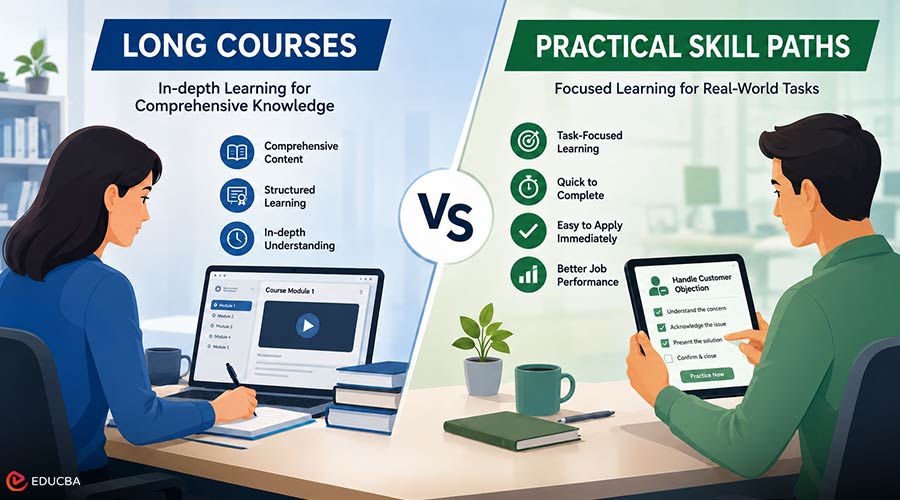
A lot of workplace training starts with the same problem. People need to learn something, but they do not have much time. A new hire needs to understand company processes, a sales representative must explain a new pricing model, a support agent has to answer customer questions accurately, and a manager may need guidance before a difficult conversation. This is why organizations are increasingly evaluating long courses vs practical skill paths. The real question is whether the chosen training method helps employees perform their jobs more effectively.
Long Courses Are Still Useful
Long courses are not bad. They work well when the topic needs time to develop. Onboarding often needs a full course. Compliance training may need clear records. Technical training may need to progress from beginner to advanced levels. Finance, Excel, project management, and software skills can all need proper structure.
ATD defines employee training and development as helping people improve the knowledge and skills they need for work, which is why more in-depth courses still matter for broader topics. The problem starts when every small training need becomes a course. A product update does not always need 40 slides. A new sales script does not need a long module. A manager who needs help with one feedback meeting may not need a full leadership program.
Practical Skill Paths Focus on Real Work
A support agent may need to calm down an angry customer. A sales rep may need to explain one feature. A new employee may need to follow one process. A manager may need to practice one difficult sentence before a meeting. A skill path does not need to cover the whole topic. It needs to help with the next real task. ATD also notes that structured on-the-job training works best when learning is framed in real job contexts, which aligns with the move toward smaller skill paths.
That can mean a short lesson, a quick example, a checklist, and one practice activity. Simple, but useful. This is why companies are also changing how they build training. The best knowledge is often with the people doing the work. Product teams know the product. Sales leads know the objections. HR knows the policy. Compliance knows the risk. An AI course builder for practical workplace training can help turn that internal knowledge into useful learning without starting from scratch every time.
Feature Comparison of Long Courses vs Practical Skill Paths
A lot of companies mix up training tools. An LMS is good for hosting and tracking learning. A slide deck is good for quick information. A video is good when people need to see a process. An authoring tool is used to build courses, quizzes, lessons, and learning paths.
Here is the simple version:
| Training Need | Best Approach |
| Employee onboarding | Long course |
| One process update | Practical skill path |
| Compliance record | Long course |
| Sales conversation practice | Practical skill path |
| Software walkthrough | Video + practice activity |
| Product fundamentals | Combination of both |
The format should fit the problem. Not every topic needs the biggest option.
Choosing the Right Training Authoring Tool
The success of either approach depends not only on the learning strategy but also on the tools used to create the training.
1. Easygenerator
Easygenerator is useful when the training knowledge is spread across the company. A product manager may know the feature best. HR may know the policy. A sales coach may know the common objections. A compliance lead may know the parts that people cannot get wrong. None of them should need to become full training designers just to share what they know. With Easygenerator, those teams can turn notes, decks, and process knowledge into e-learning that can be published to an LMS or exported as SCORM. It can suit onboarding, compliance updates, product lessons, sales training, and the internal knowledge that usually sits in someone’s head for too long. It fits practical skill paths because teams can build shorter learning around real work. A product update can become a lesson. A sales objection can become a practice task. A policy change can become a short course.
2. Articulate 360
Articulate 360 is strong for polished e-learning. It suits teams that often build detailed courses. It provides greater control over design, structure, and interaction in large training programs, which can be helpful. A polished course can be valuable, but it may not be the fastest way to make a small update. If a team needs a full learning program, Articulate can make sense. If they need quick job-based training, it may feel heavy.
3. iSpring Suite
iSpring Suite is useful when a company already has PowerPoint training. Many teams do. Old onboarding decks. Product slides. Compliance files. Manager training notes. iSpring can help turn those into online courses and quizzes. But a converted deck is still not always good training. If people only click through slides, they may finish the course and still feel unsure. It works best when teams add real examples, short checks, and practice.
4. Adobe Captivate And Elucidat
Adobe Captivate is often used for more advanced e-learning. It can help with software simulations and step-by-step digital training. Larger companies often use Elucidat. It can help with templates, brand control, and team collaboration. Both tools have a place. But they may not be the best fit for every small training need. The real questions are who will build the training, how quickly it must change, and how closely it is tied to the job.
Practice is The Main Difference
A customer service course can explain how to handle complaints. A practice task makes the employee choose what to say. A leadership course can explain feedback. Roleplay makes the manager practice the first line. That is why practice matters in sales, support, management, onboarding, and product training. These are not just topics. They are tasks people have to do.
Long Courses vs Practical Skill Paths: Which is Better?
Long courses and skill paths both matter. Use a long course when the topic needs depth, records, or a full learning journey. Use a skill path when someone needs to do a task soon. A long course gives the foundation. A short skill path helps people apply it. A video can show the process. A checklist can support the person later. A practice task can build confidence before the real moment. Workplace learning is not completely moving away from courses. It is moving away from training that feels too far from the work.
Final Thoughts
The discussion around long courses vs practical skill paths is not about replacing one approach with another, it is about selecting the right learning method for the right situation. Long courses continue to provide the depth needed for onboarding, compliance, and technical education. Practical skill paths, meanwhile, enable employees to solve immediate workplace challenges through concise, task-oriented learning. As businesses continue to embrace agile learning strategies, combining foundational courses with practical, job-focused skill paths will help teams learn faster, retain knowledge more effectively, and perform with greater confidence.
Recommended Articles
We hope this guide on long courses vs practical skill paths helps you choose the right training approach for your team. Check out these recommended articles for more insights and strategies on workplace learning.


