
Updated September 2, 2026
What is LLMOps?
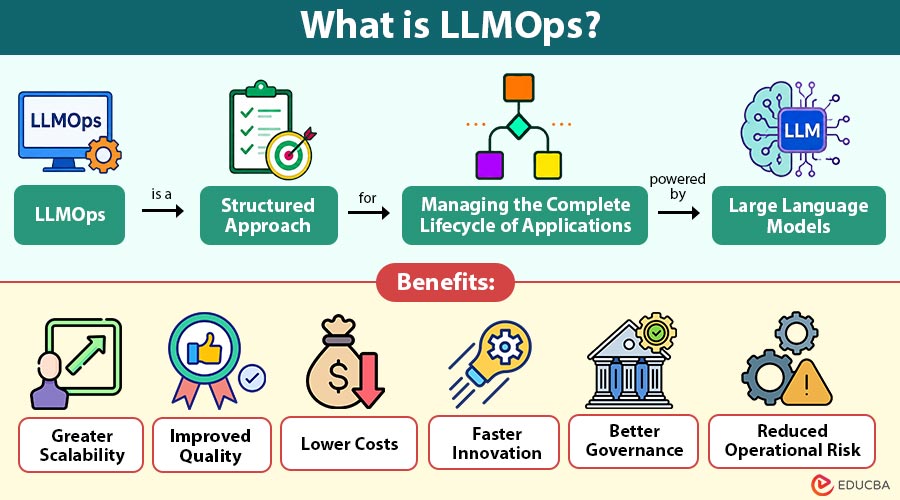
LLMOps (Large Language Model Operations) is a structured approach for managing the complete lifecycle of applications powered by large language models. It covers activities from selecting or fine-tuning a model to deploying it in production and continuously evaluating its performance.
Traditional machine learning operations focus heavily on training datasets, model versions, deployment, and prediction accuracy. LLMOps adds additional concerns such as prompts, embeddings, retrieval systems, context windows, token usage, model behavior, and human feedback.
For example, an organization developing an AI customer-support chatbot may use LLMOps to manage prompts, monitor response quality, track token consumption, detect hallucinations, evaluate answers, and update the underlying model when requirements change.
Table of Contents:
Key Takeaways:
- LLMOps manages the complete lifecycle of LLM applications, from development and deployment to continuous monitoring.
- Prompt management, model evaluation, observability, and version control improve LLM application reliability and performance.
- LLMOps helps organizations control inference costs, strengthen security, and manage unpredictable model outputs effectively.
- Continuous evaluation and monitoring enable teams to improve LLM applications while maintaining quality, scalability, and governance.
Why is LLMOps Important?
LLM applications can behave differently from traditional software because they generate outputs dynamically. A small change in a prompt, model version, context, or retrieved document can affect the final response. LLMOps helps organizations maintain reliability and consistency while controlling operational costs.
Key reasons for adopting LLMOps include the following:
1. Improved Reliability
Continuous monitoring helps teams identify poor responses, system failures, inconsistencies, and unexpected LLM behavior before they affect users.
2. Better Model Performance
Regular evaluation enables teams to compare models, prompts, and configurations using defined quality, accuracy, relevance, and performance metrics.
3. Cost Control
Tracking token usage, API calls, and infrastructure consumption helps organizations identify waste and reduce unnecessary LLM inference and operational expenses.
4. Faster Deployment
Standardized LLMOps workflows help teams efficiently test, validate, deploy, and manage LLM applications across development and production environments.
5. Enhanced Security
LLMOps helps organizations detect prompt injection, sensitive data exposure, unauthorized access, malicious inputs, and other AI-specific security threats.
6. Continuous Improvement
User feedback, monitoring data, and evaluation results help teams continuously improve prompts, retrieval systems, model performance, and overall application quality.
How Does LLMOps Work?
LLMOps generally follows a lifecycle that connects development, deployment, monitoring, evaluation, and improvement.
1. Data Preparation
Teams collect, clean, and prepare data for training, fine-tuning, RAG, or evaluation. For RAG, documents are often chunked, converted into embeddings, and stored in vector databases.
2. Model Selection
Organizations choose models based on performance, cost, latency, context window, privacy, and deployment needs. LLMOps helps compare and select suitable models.
3. Prompt Management
Teams create, test, version, and compare prompts using evaluation datasets to improve output quality and make prompt engineering more systematic.
4. Fine-Tuning
Organizations train models with their own data when prompts are not enough. LLMOps manages data, settings, model versions, and tests. Techniques like LoRA can also reduce the resources needed to train models.
5. Evaluation
LLM applications are evaluated for relevance, accuracy, factuality, helpfulness, toxicity, bias, hallucinations, latency, and cost. Automated testing can be combined with human feedback.
6. Deployment
Tested applications are deployed using APIs, cloud infrastructure, containers, or model servers. LLMOps helps manage versions and standardize deployments.
7. Monitoring
Teams continuously monitor token usage, latency, errors, costs, quality, user feedback, and hallucinations to identify issues and improve production performance.
Key Components of LLMOps
An effective LLMOps environment usually includes several interconnected components.
1. Model Management
Model management involves tracking model versions, configurations, fine-tuned models, providers, and deployment environments. It helps teams reproduce experiments and understand which model generated a particular response.
2. Prompt Management
Prompt management allows teams to version, test, compare, and optimize prompts. It is especially useful when applications depend on complex system instructions or multiple prompt templates.
3. Data and Dataset Management
LLMOps requires reliable datasets for training, fine-tuning, evaluation, and retrieval. Data pipelines help ensure that information remains accurate, relevant, and properly structured.
4. Experiment Tracking
Teams frequently test different models, prompts, parameters, and datasets. Experiment tracking records these changes and their results, making successful configurations easier to reproduce.
5. Observability
LLM observability provides visibility into the complete request lifecycle. Teams can inspect prompts, retrieved context, model responses, latency, token consumption, and errors while following appropriate privacy and security controls.
6. Evaluation Frameworks
Evaluation systems help determine whether an LLM application is meeting business and technical requirements. They can combine automated metrics, benchmark datasets, model-based evaluation, and human review.
7. Cost Management
LLM inference can become expensive at scale because many providers charge based on tokens or usage. LLMOps helps organizations monitor consumption, optimize prompts, select suitable models, and implement caching or routing strategies.
Difference Between LLMOps vs MLOps
Below is a comparison highlighting the key differences between LLMOps and MLOps.
| LLMOps | MLOps |
| Focuses heavily on generative AI and LLM applications | Focuses on machine learning models |
| Prompting, inference, and evaluation are also central | Model training is central |
| Quality, factuality, relevance, and safety are important | Traditional accuracy metrics are common |
| Adds prompt, context, embedding, and retrieval management | Dataset and model management |
| Monitors generated language and application behavior | Prediction monitoring |
| Often handles unpredictable natural-language outputs | Usually structured outputs |
Benefits of LLMOps
Implementing LLMOps can provide several business and technical benefits.
1. Greater Scalability
Standardized workflows help organizations efficiently manage growing numbers of users, models, applications, and workloads without compromising performance or reliability.
2. Improved Quality
Continuous testing, monitoring, and evaluation help organizations maintain consistent, accurate, relevant, and reliable responses across different applications and use cases.
3. Lower Costs
Monitoring token consumption, model usage, and infrastructure expenses helps organizations identify inefficiencies and optimize resources to reduce overall operational costs.
4. Faster Innovation
Controlled development workflows allow teams to quickly experiment with different models, prompts, and configurations while maintaining quality, consistency, and reliability.
5. Better Governance
Versioning, logging, monitoring, access controls, and documentation help organizations establish effective governance practices for managing models, data, and AI applications.
6. Reduced Operational Risk
Continuous monitoring helps detect model failures, security vulnerabilities, performance issues, and unexpected behavior early, reducing potential operational risks and disruptions.
Common LLMOps Challenges
Despite its benefits, LLMOps introduces several challenges.
1. High Inference Costs
Frequent LLM requests can drive up costs, especially when applications use large context windows or powerful models. Organizations need strategies such as model routing, prompt optimization, caching, and efficient context management.
2. Unpredictable Outputs
LLMs may produce different responses for similar inputs. This makes testing and quality assurance more complicated than conventional software testing.
3. Hallucinations
Models can generate information that sounds convincing but is incorrect. RAG, better prompts, evaluation systems, and grounding techniques can help reduce this risk.
4. Data Privacy
LLM applications may handle private or sensitive information. Organizations should use strong access controls, safe data practices, encryption, and clear rules for using AI providers.
5. Complex Evaluation
No single metric captures the quality of every LLM response. Businesses often need multiple evaluation methods depending on the application’s purpose.
6. Rapid Model Changes
New models and versions appear frequently. It helps organizations test alternatives and manage model changes without disrupting production applications.
LLMOps Use Cases
LLMOps is useful across industries and AI applications.
1. Customer Service
Organizations can monitor chatbot responses, detect inaccurate answers, evaluate performance, and improve prompts or retrieval systems for better customer support.
2. Content Generation
Marketing teams can manage prompt versions, evaluate AI-generated content, and maintain consistent brand messaging, quality, tone, and communication standards.
3. Software Development
AI coding assistants can be monitored for response quality, security risks, latency, accuracy, usage patterns, and potential code-generation errors.
4. Healthcare and Research
LLMOps supports controlled deployment, continuous evaluation, auditability, monitoring, and governance of specialized AI applications used in healthcare and research.
5. Financial Services
Financial organizations can monitor AI systems supporting document analysis, customer interactions, financial research, risk assessment, and workflow automation.
6. Enterprise Knowledge Management
LLMOps helps organizations manage RAG applications that retrieve relevant information from internal documents, databases, knowledge bases, and enterprise systems.
Final Thoughts
LLMOps provides a structured approach to managing LLM applications across their lifecycle, combining model management, prompt engineering, evaluation, deployment, monitoring, security, and cost optimization. Effective LLMOps practices help organizations continuously test, govern, and improve AI systems, making them more scalable, reliable, secure, cost-efficient, and production-ready.
Frequently Asked Questions (FAQs)
Q1. Who typically uses LLMOps?
Answer: Data scientists, ML engineers, software developers, DevOps teams, AI engineers, security professionals, and business teams can use LLMOps practices.
Q2. Is LLMOps required for every LLM application?
Answer: Not always. Small experimental applications may need minimal operational practices, while large-scale or business-critical applications benefit significantly from a structured LLMOps approach.
Q3. How does LLMOps help with model selection?
Answer: LLMOps enables teams to systematically compare models using factors such as response quality, speed, reliability, context capacity, privacy requirements, and overall suitability.
Q4. What role does version control play in LLMOps?
Answer: Version control helps teams track changes to models, prompts, datasets, configurations, and application code, making it easier to identify issues and reproduce previous results.
Recommended Articles
We hope that this EDUCBA information on “LLMOps” was beneficial to you. You can view EDUCBA’s recommended articles for more information.


