


Updated August 21, 2026
What is an LLM (Large Language Model) Router?
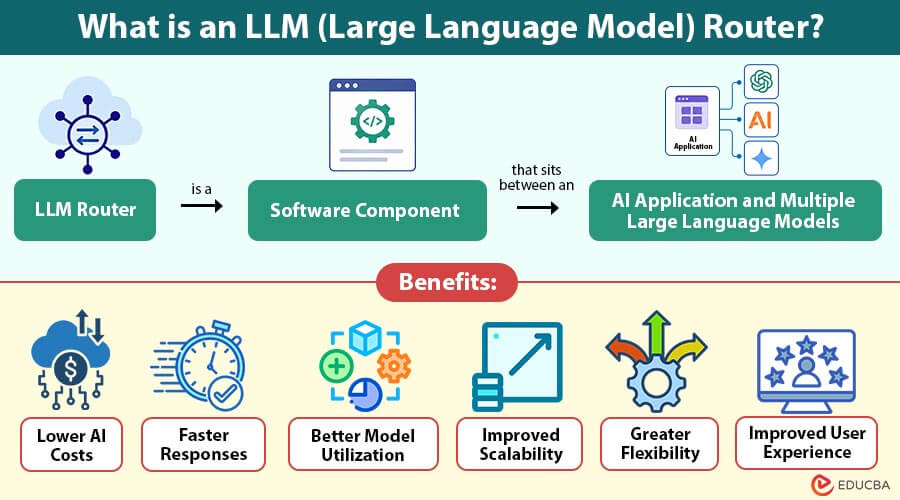
An LLM Router is a software component that sits between an AI application and multiple large language models. It receives a user’s request, analyzes its requirements, and decides which model should process it.
For example, an organization may use three different models:
- A small model for simple questions
- A specialized model for programming tasks
- A powerful reasoning model for complex analysis
The router determines the right model instead of requiring the application to decide manually. An LLM router can use predefined rules, machine learning, semantic analysis, model performance data, or a combination of these approaches.
Table of Contents:
Key Takeaways:
- LLM routers optimize model selection by balancing task complexity, quality, cost, and response latency.
- Routing enables organizations to use specialized models for coding, reasoning, summarization, translation, and customer support.
- Effective LLM routing improves scalability, flexibility, resource utilization, response speed, and overall AI infrastructure efficiency.
- Continuous monitoring and fallback strategies help organizations maintain reliable routing performance as models and requirements change.
Why is LLM Routing Important?
Organizations often have access to several LLMs with different strengths. Some models provide high-quality reasoning but require more computational resources, while smaller models can process straightforward tasks faster and at lower cost.
Using most expensive model for every request can therefore increase infrastructure expenses without providing meaningful improvements for simple workloads.
LLM routing addresses this problem by matching requests to models based on their requirements. Research and production implementations show that routing can create useful trade-offs between model quality, inference cost, and latency.
For example, an organization could create the following routing policy:
- Simple questions → smaller model
- Summarization → efficient general-purpose model
- Programming tasks → coding-specialized model
- Complex reasoning → advanced reasoning model
- Multimodal requests → multimodal model
This allows AI infrastructure to use model capacity more efficiently.
How Does an LLM Router Work?
An LLM routing system generally follows several stages.
1. User Sends a Request
The user submits a question, instruction, or task through an AI application, which forwards the request for processing.
2. Router Receives the Request
The routing layer receives the request and determines which available language model should handle the user’s specific requirements.
3. Request Analysis
The router analyzes task type, complexity, language, context, reasoning needs, required capabilities, expected quality, and response speed.
4. Model Selection
Based on the analysis, the router compares available models and selects the one that best matches the request requirements.
5. Request Processing
The selected LLM receives the request, processes the provided information, performs required reasoning, and generates an appropriate response.
6. Response Delivery
The router returns the generated response to the AI application, where it is presented to the user.
7. Performance Monitoring
The router tracks latency, model usage, token consumption, costs, errors, and feedback to improve future routing decisions.
Types of LLM Routing
LLM routers can use different types to decide which model should handle a request.
1. Rule-Based Routing
Rule-based routing uses predefined conditions to direct specific request types to appropriate models based on simple, clearly defined rules.
2. Capability-Based Routing
Capability-based routing selects models according to their specific strengths, ensuring tasks are handled by models with the required capabilities.
3. Cost-Based Routing
Cost-based routing selects models according to processing costs, using affordable models for simple tasks and expensive models when necessary.
4. Latency-Based Routing
Latency-based routing selects models according to expected response speed, making it useful for applications where quick responses are especially important.
5. Semantic Routing
Semantic routing analyzes the meaning and intent of requests rather than relying only on keywords to determine the appropriate model.
6. Quality-Based Routing
Quality-based routing evaluates expected response requirements and selects models that can deliver suitable accuracy, reasoning, and overall response quality.
7. Cascade Routing
Cascade routing processes requests through multiple models, escalating them to stronger models when initial responses fail quality requirements.
Benefits of an LLM Router
An LLM Router offers several benefits that help organizations optimize AI performance, costs, scalability, and user experience.
1. Lower AI Costs
LLM routers reduce AI costs by directing simple requests toward smaller, affordable models instead of expensive models for every task.
2. Faster Responses
Routing straightforward requests to faster models reduces processing time, improves responsiveness, and helps users get answers faster.
3. Better Model Utilization
LLM routers improve model utilization by assigning tasks to models based on their strengths, capabilities, and performance.
4. Improved Scalability
A routing layer makes AI infrastructure more scalable by allowing organizations to add, remove, or replace models without major architectural changes.
5. Greater Flexibility
LLM routers support multiple model providers and internally hosted models, giving organizations flexibility when capabilities, availability, or pricing changes.
6. Improved User Experience
It balances response speed and quality by providing quick answers for simple requests and powerful processing for complex tasks.
LLM Router Use Cases
LLM routing applies to many AI applications.
1. Customer Service
LLM routing directs basic customer questions to lightweight models while sending complex complaints and technical issues to stronger models.
2. AI Coding Assistants
Coding assistants route simple explanations to efficient models while directing complex debugging and code-generation tasks to advanced models.
3. Enterprise Chatbots
Enterprise chatbots use routing to handle routine employee questions with lightweight models and complex business queries with stronger models.
4. Document Processing
LLM routers assign document classification, extraction, summarization, and analysis tasks to models best suited for each processing requirement.
5. AI Agents
AI agents use routing to select suitable models for different workflow stages, including classification, planning, reasoning, and decision-making tasks.
6. Content Generation
Organizations route basic content tasks to efficient models while using advanced models for specialized writing, editing, and complex content creation.
Challenges of LLM Routing
Although LLM routing provides several advantages, implementing it also introduces challenges.
1. Routing Errors
The router may select an unsuitable model, causing complex requests to receive lower-quality responses from models lacking required capabilities.
2. Additional Processing
Analyzing requests before model selection requires extra computation, which can increase latency and affect overall application response times.
3. Complex Management
Managing multiple models requires additional effort for handling APIs, authentication, monitoring, rate limits, failures, updates, and performance.
4. Measuring Quality
Comparing responses across different models can be difficult and may require evaluation datasets, automated testing, feedback, and quality metrics.
5. Changing Model Performance
Model updates, pricing changes, and infrastructure modifications can affect routing performance, requiring organizations to regularly review and adjust routing policies.
Best Practices for LLM Routing
Organizations can follow several practices when implementing an LLM router.
1. Define Routing Goals
Organizations should establish clear routing goals, such as reducing costs, improving quality, minimizing latency, or balancing these objectives.
2. Categorize Requests
Create meaningful categories for requests, including coding, summarization, reasoning, translation, customer support, and general questions.
3. Start Simple
Organizations can begin with straightforward rule-based routing and gradually adopt advanced machine-learning approaches as requirements increase.
4. Test Different Models
Evaluate different models using real-world workloads to understand their performance instead of relying solely on benchmark results.
5. Monitor Routing Decisions
Track selected models, costs, latency, response quality, and failure rates to identify performance issues and improve routing strategies.
6. Create Fallback Options
Configure fallback models so requests can be redirected to suitable alternatives when the preferred model becomes unavailable.
7. Continuously Improve Routing
Use production data to identify effective and ineffective routes, then regularly update routing logic to improve overall performance.
Final Thoughts
An LLM Router intelligently manages multiple large language models by matching requests with suitable models based on complexity, capabilities, cost, and latency. It routes simple tasks to efficient models and complex tasks to powerful ones, helping organizations improve resource utilization, scalability, flexibility, response quality, and overall AI efficiency.
Frequently Asked Questions (FAQs)
Q1. Can an LLM Router work with models from different providers?
Answer: Yes. An LLM Router can connect different providers and internally hosted models, allowing applications to use a diverse model ecosystem through a common routing layer.
Q2. Does an LLM Router require a separate AI model?
Answer: Not necessarily. Routing can be implemented using rules, classifiers, embeddings, scoring systems, or a dedicated routing model, depending on the application’s requirements.
Q3. How does an LLM Router decide between two similar models?
Answer: It can compare factors such as historical performance, estimated cost, response time, task requirements, availability, and expected output quality before selecting a model.
Q4. Can LLM routing help prevent service disruptions?
Answer: Yes. A router can redirect requests when a model hits a rate limit, becomes unavailable, fails, or has temporary capacity constraints.
Recommended Articles
We hope that this EDUCBA information on “LLM Router” was beneficial to you. You can view EDUCBA’s recommended articles for more information.


