


Learn Stock Market for Beginners: A Guide to Investing Confidently
The stock market provides significant opportunities to build wealth, yet for beginners, it can seem complex and overwhelming due to its many terms, strategies, and risks. Terms like equity, derivatives, market capitalization, volatility, and portfolio diversification often discourage first-time investors. This is where stock market courses play a crucial role. Structured learning programs simplify complex financial concepts and provide the foundation for investing confidently. Before taking the first step to open a demat account, gaining clarity about market fundamentals can significantly reduce costly mistakes. This guide will help you learn stock market for beginners, providing a foundation to invest confidently and avoid common pitfalls.
The Reason Why Beginners Struggle in the Stock Market
Social media trends, recommendations from friends, or other short-term gains, attract most new investors. They can:
- Fail to analyze the market trends.
- Trade volatility on the overtrade.
- Ignore risk management
- Invest without understanding a company’s fundamentals.
- Premature exit investment.
Emotional decision-making is also a common problem caused by a lack of education, and this may negatively affect long-term returns.
What Are Stock Market Courses?
Stock market courses are educational programs that are organized in a manner that educate individuals on:
- Basic stock market concepts
- Technical analysis
- Fundamental analysis
- Risk management
- Portfolio allocation
- Trading psychology
The courses can be offered online or offline and can serve a range of qualification levels, from total novices to highly experienced traders.
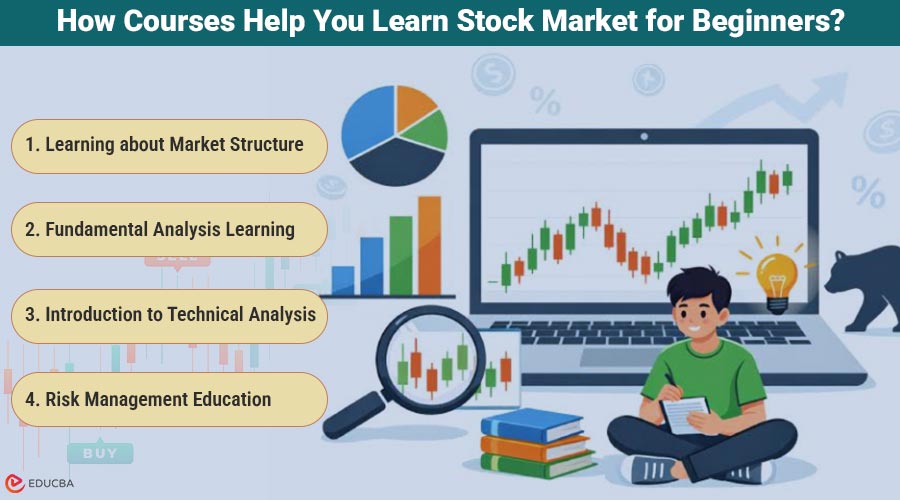
How Courses Help You Learn Stock Market for Beginners?
The following points highlight how these courses help you learn stock market for beginners effectively.
1. Learning about Market Structure
Education covers the operation of stock exchanges, the trade of shares, and the determination of prices depending on demand and supply. This clarity helps prevent confusion among beginners about price variations over the day.
2. Fundamental Analysis Learning
Fundamental analysis is one of the most significant skills taught in stock market classes. This encompasses the knowledge:
- Financial statements of the company.
- Revenue growth
- Profit margins
- Debt levels
- Valuation ratios
Novices learn how to analyze businesses rather than act on trends.
3. Introduction to Technical Analysis
The other courses taught include chart reading, indicators, support levels, resistance levels, and trend identification. While long-term investors may not need technical analysis, it can help them determine the best times to enter or exit positions.
4. Risk Management Education
Beginners do not pay much attention to risk management. Stock market courses on quality focus on:
- Position sizing
- Stop-loss strategies
- Diversification
- Capital preservation
These principles protect investors from incurring significant losses.
Why Learning Before Opening a Demat Account Matters?
The significance of real-life knowledge before opening up an account.
Most people jump into opening a demat account without knowing how to invest. Although it is easy to set up an account, to be successful in investing, one needs knowledge. By pursuing stock market courses before the opening of a demat account, you receive:
- Belief in decision-making.
- Understanding of investment objectives.
- Awareness of trading costs
- Grasping the taxation regulations.
- Education reduces fear and uncertainty.
Advantages of Structured Learning
- Step-by-Step Approach: Courses deliver knowledge gradually, introducing the easier parts first, followed by the more complex ones.
- Real-World Examples: Many programs rely on examples and markets to demonstrate the ideas.
- Interactive Learning: Some courses include quizzes, simulations, and practice to reinforce knowledge.
- Long-Term Skill Development: Educated investors form their own opinions rather than relying on market tips.
Common Mistakes to Avoid
Stock market classes help investors avoid such common mistakes as:
- Buying momentum stock blindly.
- Investing based on rumors
- Ignoring diversification
- Using excessive leverage
- Selling in volatile markets.
Being instructed by those who have done it successfully can help beginners avoid learning the same lessons twice.
Different Stock Market Courses
1. Beginner-Level Courses
Focus on basics such as:
- What is a stock?
- How markets operate
- How to open a demat account
- Simple investing strategies.
2. Intermediate-Level Courses
Cover deeper topics such as:
Financial statement analysis.
- Technical indicators
- Sector analysis
- Portfolio construction
3. Advanced-Level Courses
Per Traders and experienced investors, including:
- Derivatives trading
- Options strategies
- Advanced chart patterns
- Algorithmic trading basics
Selecting an appropriate degree is a guarantee of successful learning.
Mental Readiness to the Market Volatility
The stock market is inherently unstable. Even strong companies experience price fluctuations. Courses in the stock market teach emotional discipline, such as:
- Remaining composed when making corrections.
- Avoiding panic selling
- Sustaining the long-term view.
- Controlling greed and fear
To be a successful investor, a person needs to be psychologically aware.
The Shift Between Learning and Investing
Having completed the stock market coursework, the next step is to open demat account and start investing slowly.
However, experts recommend:
- Starting with small amounts
- Diversification of portfolios.
- Periodic review of investments.
- The next step involves continued learning and investing.
- Learning is a lifelong process.
Technology in the Contemporary Learning Process
Current stock market classes are usually covered by:
- Recorded video lectures
- Live webinars
- Mobile learning apps
- Discussion forums at a community level.
Such characteristics render financial education affordable and open.
How to Select the Right Stock Market Course?
When choosing courses in the stock market, take into consideration:
- Instructor credibility
- Course content depth
- Student reviews
- Focus on practical application.
- Cost vs value
Stay away from programs that assure high returns. Authentic education focuses on knowledge, not idealistic beliefs.
Long-Term Benefits of Financial Education
Knowledge investment does not end at stock selection. It improves:
- Financial planning
- Retirement preparation
- Wealth creation strategies
- Risk assessment skills
- Budgeting discipline
Education about markets fosters broader financial literacy.
Final Thoughts
Entering the stock market without proper knowledge is like navigating unknown territory without a map. Stock market courses help you learn by providing a map that guides you through essential concepts, strategies, and risk management principles. Before opening a demat account, investing time in structured learning can significantly improve confidence and decision-making. Financial markets reward patience, discipline, and informed strategies not speculation. By building a strong educational foundation, beginners can move from uncertainty to clarity and from emotional reactions to strategic investing. Taking the step to learn stock market for beginners is one of the most valuable decisions you can make in your wealth-building journey.
Recommended Articles
We hope this comprehensive guide helps you build a strong foundation in investing. Check out these recommended articles to further learn stock market for beginners and enhance your financial knowledge and investment strategies.

