


Leadership in the AI Era: Overview
Learn how leadership in the AI era is transforming traditional management roles. Learn why managers are moving toward system architect roles instead of traditional task management, creating smart workflows that help businesses grow and generate new ideas. Not too long ago, being a leader meant keeping an eye on people, giving them to-do lists, checking in on their progress, running meetings, and making sure everyone met their deadlines. Power came from the top, and results went back up. But now that AI, automation, and data platforms are everywhere, things are changing quickly.
Leaders today do more than manage tasks. They are putting together the systems that finish those jobs. Automation has handled routine tasks. AI makes more decisions every day. The strongest leaders now design smart systems that allow people and technology to work together seamlessly. The focus has changed. It is no longer about supervising tasks; it is about building systems that allow those tasks to happen almost automatically. Leading now means something completely different. Adaptable leaders can help their businesses grow and recover from disruption. Those who resist change risk falling behind.
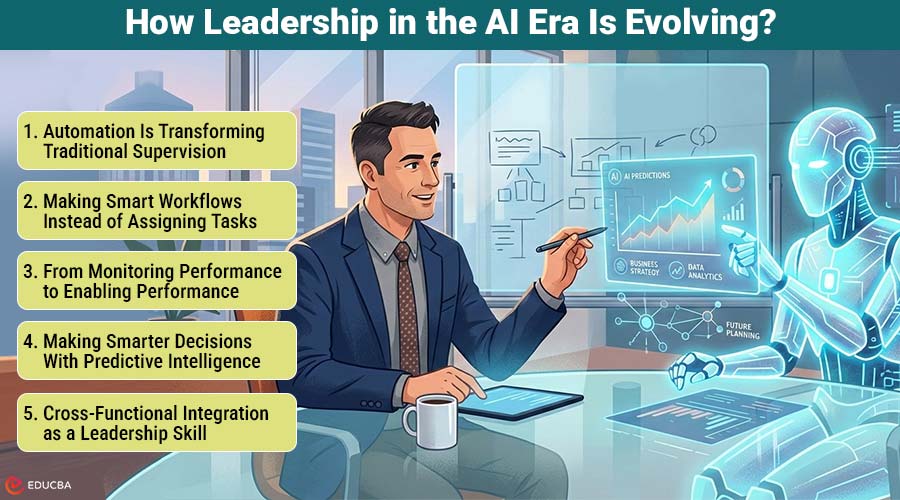
How Leadership in the AI Era is Evolving?
Here are the key ways leaders are adapting to AI-driven workflows, systems, and decision-making.
1. Automation is Transforming Traditional Supervision
Supervision used to be the center of management. Leaders reviewed spreadsheets, held long meetings, and manually tracked metrics. Today, dashboards update in real time. Predictive analytics flag risks before they escalate. Workflows operate automatically. Supervision is no longer the primary responsibility.
AI-powered project management tools monitor progress and highlight delays. CRM systems automatically score and segment leads. HR platforms identify disengagement trends or retention risks. Leaders are no longer watching over shoulders; they are designing the systems that monitor performance. The question has shifted. Instead of asking, “Are people doing their jobs?” leaders now ask, “Did we build the right system so the work gets done effectively on its own?” The focus moves from daily oversight to system-level design.
2. Making Smart Workflows Instead of Assigning Tasks
In the environment, leadership is less about delegating tasks and more about designing workflows that function independently. Marketing automation funnels guide customers from the first interaction to purchase without manual intervention. AI-powered supply chains adjust inventory in response to demand fluctuations. Executive dashboards automatically update with real-time data. These developments require leaders to develop system literacy. Nancy Zafrani, General Manager at Oz Moving & Storage, notes that leaders need to understand how AI applications communicate, how APIs connect platforms, and how automation impacts overall business operations. They may not write code, but they must understand how the pieces fit together.
Nicky Zhu, AI Interaction Product Manager at Dymesty, adds that leadership in the AI era centers on designing effective human–AI collaboration models rather than managing individual outputs. He explains that successful leaders build interaction frameworks where AI enhances decision-making without eliminating human oversight. According to Nicky, the real advantage emerges when leaders create feedback loops between users and AI systems, ensuring that workflows continuously improve rather than remaining static automation pipelines. Companies that implement well-designed automation systems often experience measurable gains in productivity and accuracy. Leadership now requires strategic planning, systems thinking, and technological fluency.
3. From Monitoring Performance to Enabling Performance
In the past, managers evaluated performance only after completing the work. Today, AI automatically tracks outputs, allowing leaders to focus on creating environments where high performance becomes natural. This involves equipping teams with appropriate tools, documenting clear processes, integrating AI assistants into daily workflows, and linking incentives to real-time data.
Leaders no longer act primarily as evaluators. They build structures that enable strong results. Studies indicate that organizations combining employee development with automation experience increased engagement and enhanced innovation. When machines handle repetitive tasks, employees can focus on strategic and creative responsibilities. This improves morale while strengthening business performance.
4. Making Smarter Decisions With Predictive Intelligence
AI analytics platforms have introduced predictive intelligence into executive decision-making. Leaders no longer rely solely on historical data and intuition. Machine learning models forecast trends, risks, and opportunities. Revenue forecasting tools, churn-prediction models, workforce optimization systems, and scenario-analysis dashboards enable leaders to evaluate potential outcomes before committing resources. Sain Rhodes, Customer Success Manager at Clever Offers, explains that predictive intelligence has transformed how organizations manage customer relationships. Rather than reacting to churn or declines in engagement, leaders can design proactive systems that identify friction points early.
Leaders who integrate these insights across departments create more cohesive customer journeys and stronger long-term growth. In this environment, leaders must understand probabilistic forecasts, recognize model limitations, and translate insights into coordinated action. Organizations that adopt predictive analytics consistently outperform competitors in revenue growth and operational efficiency. Leadership has shifted from decision authority to intelligence orchestration.
5. Cross-Functional Integration as a Leadership Skill
As AI systems connect marketing, finance, operations, HR, and product development, siloed structures become less effective. Leaders must design ecosystems that enable seamless data flow across departments. Wyatt Mayham, founder of Northwest AI Consulting, explains that traditional leaders focused on optimizing performance within their own departments. In AI-driven ecosystems, leaders are responsible for optimizing performance across interconnected functions.
Marketing data can influence product design. Customer service insights can guide pricing strategy. HR engagement metrics can inform innovation initiatives. Leaders act as integration architects, ensuring platforms communicate effectively and departments align around shared intelligence. Studies in organizational behavior show that companies using integrated data ecosystems experience stronger collaboration and faster innovation cycles. Integration has become a defining leadership capability.
6. Designing Systems That Enable High Performance
Chris Yang, Marketing Head at Link Building Agency, emphasizes that the most effective leaders in the AI-driven environment are those who design systems that free their teams to focus on creativity and strategy.
He explains that leaders who build flexible, continuously monitored workflows aligned with business goals enable both humans and AI to operate at peak efficiency. In his words, leadership is no longer about micromanagement; it is about orchestrating ecosystems that make high performance inevitable.
Final Thoughts
The transition from manager to system architect marks a major shift in leadership in the AI era. Leaders no longer need to oversee every operational detail. Automation handles routine execution. Smart workflows manage delegation. Predictive analytics reshapes decision-making. Cross-functional integration breaks down silos. Leadership now centers on designing systems that operate intelligently and ethically. When something fails, it reflects system design rather than individual performance alone. Organizations that train leaders to think architecturally become more adaptable, innovative, and resilient as technology evolves. The future of leadership does not depend on tighter control. It depends on a stronger system design.
Recommended Articles
We hope this guide on leadership in the AI era helps you understand modern management strategies. Explore these articles for more insights on leading effectively in an AI-driven world.


