


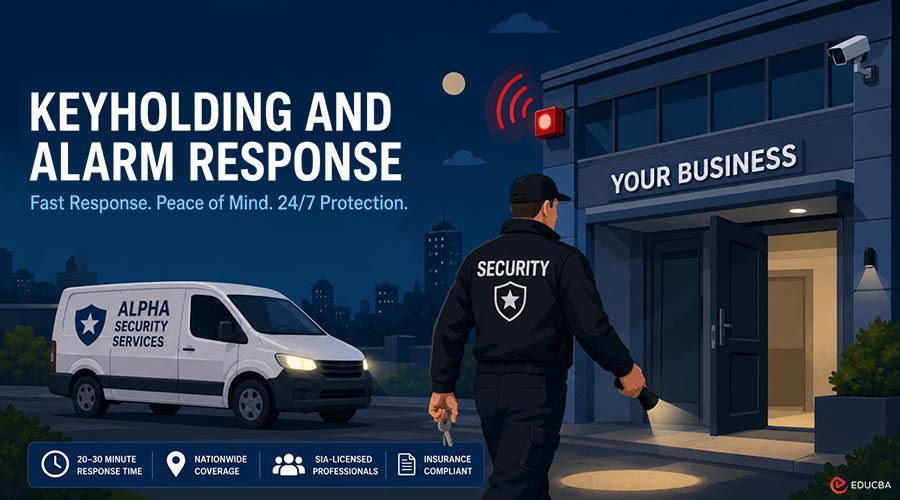
Imagine receiving an alarm notification at 2 am for your business premises. As a business owner, your options are far from ideal. You can drive to the site yourself and face an unknown situation alone, send an employee to investigate, or ignore the activation and hope it was a false alarm. Each option carries risks, ranging from personal safety concerns to insurance complications. This is the exact problem keyholding and alarm response solve, and it is why businesses across the UK hand the job to a provider like Alpha Security Services. A professional keyholder holds a secure copy of your premises key, answers the activation on your behalf, reads the situation on the ground, and acts on it, while you stay in bed. For most commercial premises, that is the cheapest reliable security cover going.
What does a Keyholding and Alarm Response Service Cover?
A keyholding and alarm response service covers four situations:
- Alarm activations
- Emergency access due to operational issues
- Scheduled lock-up and unlock services
- Post-incident site securing following break-ins or damage
The first is the obvious one. The other three are why most businesses keep the service even in years when the alarm never sounds. A burst pipe at 1 am, a power cut that drops the alarm panel, a fire door propped open by the last person out: each is an operational call-out rather than a crime, and each still needs a trained person on site quickly. The operative who attends is SIA-licensed, assesses the scene, mitigates any immediate risks, liaises with the police or fire service if they are involved, and writes up what happened. You get the report. You attend in person only when the situation genuinely requires the business owner to be there, which is rare.
Why Does Response Time Decide the Outcome?
Police rarely prioritize a commercial alarm activation when no crime is confirmed. In many areas, an unconfirmed activation sits in a queue, and the realistic wait ranges from 45 minutes to several hours. By then, an intruder has been in, taken what they came for, and gone. A contracted alarm response operative works to a fixed window, usually 20 to 30 minutes between activation and arrival on site.
That gap matters for three reasons. It is short enough to catch an intruder still inside, it deters the opportunist who trips an alarm on purpose to time the response before coming back, and it stops a non-criminal problem (water spreading from a burst pipe, smoke from a failing circuit) from turning into a far bigger repair bill. We treat the 30-minute mark as a contractual maximum, not an average, because insurers and owners need a guaranteed limit.
How Does Keyholding Protect Your Insurance Cover?
Many commercial insurance policies carry a response condition: a named keyholder and documented attendance within a set time. A run of activations that nobody attended or recorded can void that cover. Most owners learn this after a claim, not before.
A keyholding contract clears the condition for you. Every activation after sign-up produces a written report covering the arrival time, the on-site assessment, the action taken, and a timestamped close. That report is ready the moment a claim or an audit requests it. You do nothing to generate it. Hand it over on request, and you have your proof. Skip the documentation, and the policy that felt like protection becomes an argument you lose at claim time.
Keyholding vs Personal Response: The Real Cost
Compare the full cost of both options, and keyholding comes out cheaper, faster, and safer for most premises. A UK keyholding contract runs £40 to £80 a month, plus a call-out fee of £30 to £60 each time the alarm goes off. Now, price the alternative honestly. An owner who answers four activations a year pays in fuel and in lost sleep, and at least once, there is a night they cannot go, so the alarm goes unattended.
Put a staff member on it, and the bill adds overtime, possible out-of-hours rates, and the health and safety exposure of sending one employee alone to a site that might have someone in it. Two costs are left out of most comparisons: the night when nobody can attend, and the morning after a lone worker walks into trouble. Keyholding removes both.
Keyholding Across Multiple Sites
Multi-site businesses get one contract, one provider, and one set of reports through a single keyholding service, with no branch manager dragged into a midnight call. Retail chains, hospitality groups, and managed property portfolios benefit most.
At the multi-site level, the record is worth as much as the response. Every site logs its activations in a single system. You read one report, not twelve. You can see which location triggers most often and why, which pays off at renewal when an insurer asks for the security history, and again after a serious incident when someone has to reconstruct what happened and when. A site that throws nightly false alarms shows up in that data, so you fix the sensor instead of paying for the call-outs.
Keyholding and Mobile Patrols Together
Patrols and keyholding split the work cleanly. Patrols watch; keyholding responds. A mobile patrol runs random and scheduled checks through the high-risk overnight and weekend hours, and keyholding picks up whatever those checks flag, plus whatever the alarm flags between visits.
Together, the two give you steady, visible deterrence and a fast response on the same sites, for a good deal less than a static guard posted at the gate all night. That fits most low- to medium-risk commercial premises, where on-site 24/7 guard cover is more than the risk warrants. You can compare patrols, alarm response, and keyholding services by risk level on the Alpha Security Services site.
How to Set Up a Keyholding and Alarm Response Service?
Setting up a keyholding and alarm response contract is straightforward. Most providers require:
- A secure copy of your premises keys
- Alarm codes and system information
- Emergency contact details
- Written authorization to access the property when required
Once these details are in place, businesses can typically receive active cover within 48 hours. Professional providers use secure key storage, clear reporting procedures, and defined response times to manage every activation efficiently.
Final Thoughts
For modern businesses, keyholding and alarm response offer far more than alarm attendance. It provides rapid emergency response, insurance compliance support, operational assistance, and enhanced peace of mind. Whether managing a single office, retail store, warehouse, or a portfolio of commercial properties, professional keyholding services reduce risk, save time, and often cost significantly less than alternative security arrangements. By ensuring trained security professionals are always available, businesses can focus on growth while their premises stay protected around the clock.
Recommended Articles
We hope this guide to keyholding and alarm response helps you improve your business security. Explore these recommended articles for more insights and practical strategies to strengthen your commercial security and safeguard your premises.

