


Updated September 22, 2026
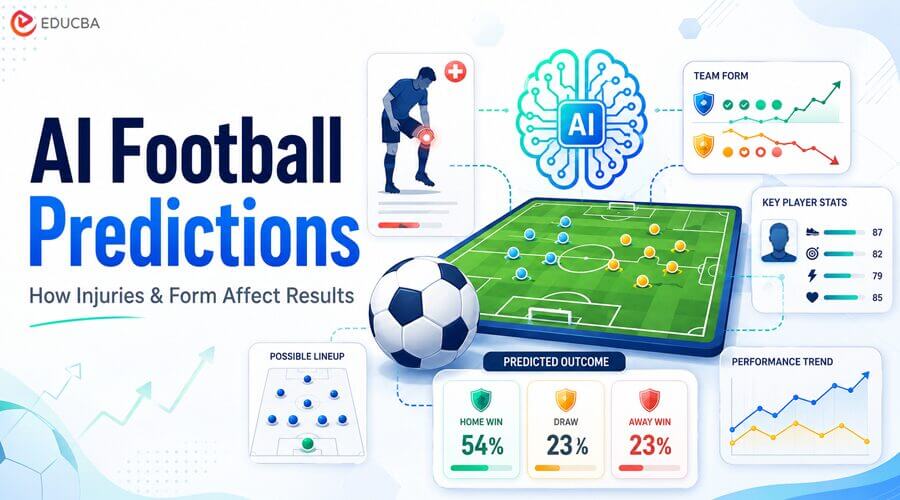
Predicting a football match is no longer based only on league position or a team’s last few results. Modern football analysis can combine a much wider range of information, including player statistics, recent form, injuries, suspensions and expected lineups.
Artificial intelligence can process these different data points and use historical patterns to estimate the probability of possible match outcomes. This makes AI football predictions more detailed than simply asking which team has been winning recently. It also highlights an important point: a prediction’s strength depends heavily on the quality and relevance of the information going into the model.
Why Team Form Matters in AI Football Predictions?
Recent team form is one of the most obvious indicators of how a club is performing.
A prediction model can look beyond wins and losses. It may consider:
- Goals scored and conceded
- Expected goals (xG)
- Shots and chances created
- Defensive performance
- Strength of recent opponents
- Home and away results
- Changes in performance over time.
For example, a team that has won four of its last five matches may appear to be in excellent form. However, if those victories came against weaker opponents, the results may not provide as much evidence of strength as they initially suggest.
AI can combine several indicators to put a team’s recent results into context. This allows AI football predictions to consider not only what happened but also the conditions behind those results.
Injuries Can Change AI Football Predictions
Player availability is one of the most important variables that can change a pre-match assessment.
Losing a key striker can affect a team’s attacking threat, while the absence of an important central defender may change expectations about goals conceded.
An AI model can potentially incorporate information about:
- Injured players
- Suspensions
- Returning players
- Expected starters
- Minutes played
- Player workload
- Recent availability.
Football research has also explored machine learning for injury prediction using factors such as training load, player characteristics and tracking data. Studies have found that machine-learning techniques can be used to investigate football injury prediction, although limitations in data quality, methodology, and sample size remain important considerations.
For match prediction, the important point is that an injury is not simply a piece of news. It can change a team’s expected strength and, consequently, influence AI football predictions.
Player Data Adds More Detail
Two teams can have similar overall statistics while having very different individual player profiles.
Player-level data can help reveal those differences.
Depending on the model, information may include:
| Player Data | What It Can Indicate |
| Goals | Finishing contribution |
| Assists | Chance creation |
| Shots | Attacking involvement |
| Key passes | Creative contribution |
| Tackles and interceptions | Defensive activity |
| Minutes played | Availability and importance |
| Recent performances | Current contribution |
This information can be particularly useful when a team depends heavily on a small number of influential players.
If one of those players is unavailable, the model may need to adjust its assessment. This is one reason player-level information can add useful context to AI football predictions.
How AI Combines Injuries With Team Form?
AI’s real advantage is not simply collecting more statistics. It is the ability to evaluate several variables together.
Imagine a team has:
- Strong recent form
- High attacking output
- Good home performance.
At first, those factors might suggest a favorable prediction.
However, then the team’s main striker is ruled out, and its starting goalkeeper is unavailable.
A model that incorporates player availability can potentially produce a different assessment from one that only considers recent results.
This illustrates why AI football predictions can change when new information becomes available.
Home and Away Form Can Reveal Hidden Differences
Overall team form does not always reflect how a club performs in a specific setting.
Some teams are significantly stronger at home, while others perform well both home and away.
For an upcoming fixture, an AI system can compare the home team’s home statistics with the away team’s away statistics.
For example:
- Home goals scored
- Home goals conceded
- Home xG
- Away goals scored
- Away goals conceded
- Away xG.
This creates a more relevant comparison than simply looking at each club’s overall league record and can improve the context used in AI football predictions.
Player Performance Can Affect More Than Goals
When people think about influential players, they often focus on goals and assists.
However, AI models can potentially consider many other aspects of player performance.
A midfielder’s ball progression and chance creation may influence attacking performance. A defender’s interceptions and positioning can contribute to defensive stability. A goalkeeper’s performance can also affect the probability of conceding.
This broader approach lets AI football predictions account for the contributions of players who may not appear prominently on the scoresheet.
Why Recent Player Form Matters?
A player’s season average does not always reflect their current form.
A striker who scored 20 goals earlier in the season may be performing differently over the last five matches. Similarly, a midfielder who had a slow start may have become increasingly influential.
AI can analyze recent player performance alongside longer-term statistics.
This can help distinguish between Season-long performance and Current performance.
The distinction can become especially important during congested periods when fatigue, rotation, and workload may affect player availability and performance.
Injuries and Workload Are Connected
Player availability is not always random.
Training and competition workloads can indicate physical demands and potential injury risk. Machine-learning research in professional football has used GPS-derived training workloads to forecast injuries. More recent research continues to investigate how player load, acceleration, position, and other variables contribute to injury prediction.
This creates an interesting connection to match prediction.
A team playing several demanding matches in a short period may face greater selection and performance challenges than a team with more recovery time.
However, these relationships are complex, and injury-risk models should not be treated as perfect predictors.
How Does AI Convert These Factors Into Probabilities?
After processing the available information, a prediction model can estimate the probability of different match outcomes.
For example:
| Outcome | Example Probability |
| Home win | 54% |
| Draw | 26% |
| Away win | 20% |
These numbers are only an illustration.
The 54% figure does not mean that the home team will definitely win. It means the model considers a home victory more likely than the alternatives based on the information it has processed.
This distinction matters because football includes many unpredictable events. Therefore, AI football predictions should generally be understood as probability-based assessments rather than certain outcomes.
Why Current Information is Important?
A prediction made one week before kickoff may be different from a prediction made shortly before the match.
During that period, several things can change:
- A player may suffer an injury
- A suspension may be confirmed
- A manager may change tactics
- The expected lineup may change
- A player may return to training
- New team information may emerge.
That is why fans should not rely entirely on an old prediction.
Checking the latest soccer news can help provide additional context when evaluating whether the information behind a forecast is still current.
AI Football Predictions Are Not Guaranteed Results
Even with extensive player and team data, a model cannot account for every event on the pitch.
A red card, penalty, deflection, or individual mistake can change the outcome of a match within seconds.
This means the correct way to interpret AI football predictions is as a probability assessment, not a guarantee.
A model can identify the outcome it considers most likely while another result still has a meaningful chance of occurring.
Why Data Quality Matters?
AI is only as useful as the information it receives.
If injury information is outdated, player statistics are incomplete, or team data does not accurately represent current performance, the resulting prediction may be affected.
There is also a risk of overvaluing information simply because it is available.
More data does not automatically produce better predictions. Models need relevant features and appropriate validation.
Recent research on football injury prediction has highlighted issues including differences in datasets, limited multi-season data, class imbalance and methodological variation.
These limitations demonstrate why AI predictions should be interpreted carefully rather than treated as infallible.
How Can Fans Use AI Football Predictions More Effectively?
Fans can get more value from an AI prediction by looking at the reasoning behind it.
Instead of asking only:
“Who will win?”
Consider asking:
- Which team has the better recent form?
- Which key players are unavailable?
- How important are the missing players?
- Which team has stronger home or away statistics?
- Does xG support recent results?
- How strong were the previous opponents?
- Has anything changed since the original prediction?
This approach turns AI from a simple prediction tool into a way of organizing football information.
For fans exploring AI-powered football predictions, the biggest benefit is often the ability to bring multiple factors together and examine how they may influence the expected outcome.
Final Thoughts
Injuries, team form, and player data can all meaningfully influence AI football predictions.
- Team form helps establish current performance.
- Player data provides information about individual contribution.
- Injuries and suspensions can change a lineup’s expected strength.
- Current football information helps ensure that the analysis reflects the latest circumstances.
AI can bring these factors together and convert them into probability-based forecasts, but it cannot remove the uncertainty that makes football unpredictable.
The most useful approach is therefore to treat AI as an analytical tool rather than a crystal ball. By understanding the data behind the forecast and tracking key changes before kickoff, fans can form a more informed view of what might happen when the match begins.
Recommended Articles
We hope this guide helps you understand how AI football predictions use injuries, team form, player data, and current information to assess match outcomes. Explore these recommended articles for more insights into AI football predictions, match analysis, player statistics, team form, football injuries, and sports analytics.


