
What is Haircut in Finance?
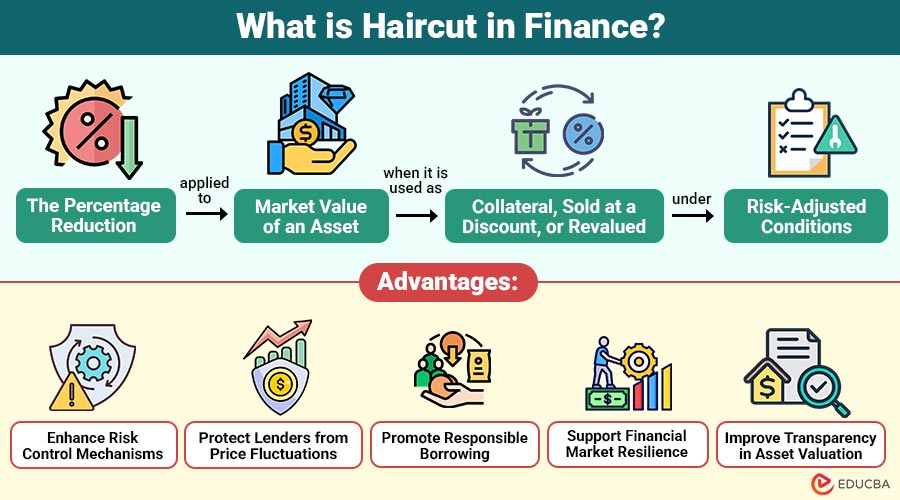
A haircut in finance is the percentage reduction applied to market value of an asset when it is used as collateral, sold at a discount, or revalued under risk-adjusted conditions.
In simple terms, a haircut reflects difference between an asset’s current market value and the value assigned to it for financial transactions. This reduction accounts for potential losses arising from price fluctuations, credit risk, or illiquidity.
For example, if a bond has a market value of $100,000 and a 10% haircut, its collateral value is $90,000.
Table of Contents:
- Meaning
- Importance
- Types
- How is Haircut Calculated?
- Factors that Influence Haircut Levels
- Real-World Examples
- Advantages
- Limitations
Key Takeaway:
- Haircuts reduce collateral values to effectively manage market, credit, and liquidity risks across global financial transactions.
- They limit excessive leverage, protecting lenders and promoting stability during volatile or stressed market conditions.
- Haircuts vary by asset quality, liquidity, maturity, and regulations, increasing conservatism under uncertainty for financial institutions.
- Understanding haircuts is essential for decision-making in banking, investing, compliance, and risk management across modern financial systems.
Why are Haircuts Important in Finance?
Haircuts serve as a vital risk management tool across financial markets. Their importance can be understood through the following perspectives:
1. Risk Mitigation
Haircuts protect lenders by absorbing losses arising from sudden declines in collateral asset values.
2. Market Stability
By limiting excessive leverage, haircuts help reduce systemic risk during periods of market volatility.
3. Credit Protection
Haircuts ensure collateral values sufficiently cover credit exposure, protecting lenders against borrower default risks.
4. Liquidity Management
They account for difficulties in quickly liquidating assets without significant price impact during stressed conditions.
Types of Haircuts in Finance
Haircuts vary depending on the financial context. Below are the most common types used in practice.
1. Collateral Haircut
A collateral haircut reduces the market value of pledged assets to protect lenders against price volatility and credit risk.
2. Repo Haircut
A repo haircut represents the discount applied to securities in repurchase agreements to manage counterparty, market, and liquidity risks.
3. Valuation Haircut
A valuation haircut reduces an asset’s appraised value to reflect conservative pricing under uncertain or distressed conditions.
4. Debt Restructuring Haircut
A debt restructuring haircut reduces the principal amount owed, allowing financially distressed borrowers to regain stability while creditors absorb losses.
5. Regulatory Haircut
A regulatory haircut is a mandated reduction in asset values applied for capital adequacy and risk-weighted asset calculations.
How is Haircut Calculated?
The haircut calculation is straightforward and expressed as a percentage.
Formula:
Example Calculation:
- Asset market value: $200,000
- Haircut percentage: 15%
- Haircut value: $30,000
- Adjusted collateral value: $170,000
Lenders use the adjusted value for lending or risk assessment purposes.
Factors that Influence Haircut Levels
Several factors determine the size of a haircut applied to an asset:
1. Asset Volatility
Assets with high price fluctuations require larger haircuts to protect lenders from sudden valuation losses.
2. Liquidity
Assets that are difficult to sell quickly receive higher haircuts to compensate for potential delays and price impact.
3. Credit Quality
Securities with lower credit ratings attract larger haircuts due to higher default risk and lower recovery expectations.
4. Market Conditions
During periods of financial stress or uncertainty, haircuts increase to manage heightened systemic and counterparty risks.
5. Maturity Period
Long-term assets generally have higher haircuts because extended durations increase exposure to interest rate and market risks.
Real-World Examples of Haircuts
Below are practical examples that illustrate how financial institutions apply haircuts across different financial scenarios.
1. Stock Collateral Loan
An investor pledges $100,000 in equity shares. The bank applies a 25% haircut.
- Loan value approved: $75,000
- Risk buffer: $25,000
2. Sovereign Debt Crisis
During a financial crisis, bondholders agree to a 40% haircut on government bonds to support debt sustainability.
3. Repo Market Transaction
A $1 million treasury bill is used in a repo transaction with a 2% haircut, resulting in a loan of $980,000.
Advantages of Haircuts in Finance
Haircuts offer multiple benefits to financial systems:
1. Enhance Risk Control Mechanisms
Haircuts reduce exposure to market volatility by adjusting asset values, helping institutions manage credit and liquidity risks effectively.
2. Protect Lenders from Price Fluctuations
By lowering collateral value, haircuts cushion lenders against sudden market price drops and unexpected asset devaluations.
3. Promote Responsible Borrowing
Haircuts limit excessive leverage, encouraging borrowers to maintain healthier balance sheets and realistic borrowing practices.
4. Support Financial Market Resilience
They strengthen financial stability by preventing asset overvaluation and reducing systemic risk during market stress.
5. Improve Transparency in Asset Valuation
Haircuts provide a standardized method to reflect true asset risk, improving clarity and trust in financial transactions.
Limitations of Haircuts
Despite their importance, haircuts have certain drawbacks:
1. May Restrict Access to Credit
Higher haircuts reduce borrowing capacity, making it difficult for businesses or individuals to secure adequate financing.
2. Can Amplify Liquidity Stress during Crises
Rising haircuts in volatile markets may worsen liquidity shortages and intensify financial stress during crises.
3. Subject to Subjective Assessment
Haircut levels often depend on judgment, leading to inconsistencies and potential bias in asset valuation.
4. May Disadvantage Smaller Borrowers
Smaller borrowers face higher effective costs as limited collateral value reduces their financing options.
Final Thoughts
A haircut in finance is a key risk management tool that protects markets by adjusting asset values for volatility, liquidity, and credit risk. Used in collateralized lending, repo markets, debt restructuring, and regulation, haircuts reduce exposure to losses. Understanding haircuts is essential for banking, investment, corporate finance, and compliance professionals.
Frequently Asked Questions (FAQs)
Q1. Why are haircuts higher during market crises?
Answer: Market volatility and liquidity risk increase during crises, requiring lenders to apply higher haircuts to protect themselves.
Q2. Are haircuts mandatory?
Answer: Haircuts are not always mandatory, but are often required under regulatory frameworks and institutional policies.
Q3. Who decides the haircut percentage?
Answer: Haircuts are determined by banks, financial institutions, regulators, or counterparties based on risk assessment.
Q4. Is a haircut the same as a discount?
Answer: While similar, a haircut is primarily a risk-adjustment tool, whereas a discount may be driven by pricing or promotional factors.
Recommended Articles
We hope that this EDUCBA information on “Haircut in Finance” was beneficial to you. You can view EDUCBA’s recommended articles for more information.


