


Updated August 26, 2026
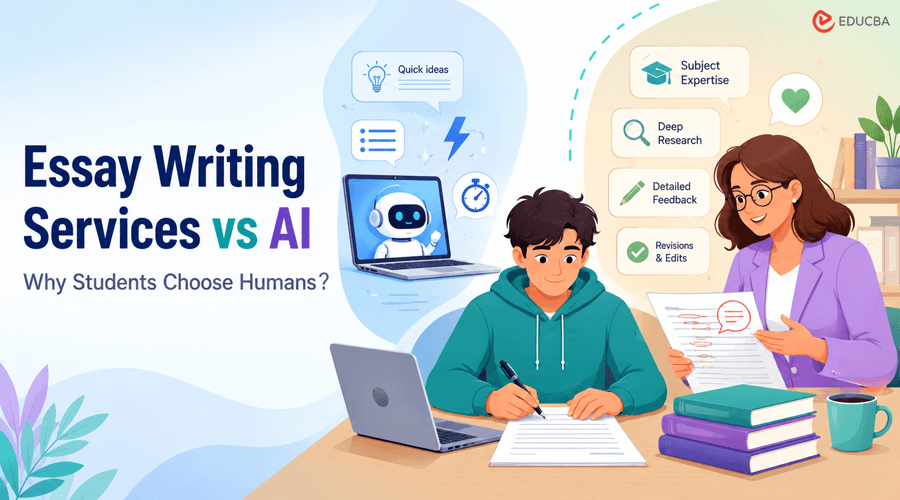
Generative AI has become ordinary student technology.
The Higher Education Policy Institute’s 2026 Student Generative AI Survey found that 95% of surveyed UK undergraduates used AI in at least one way, while 94% used generative AI to support assessed work. Almost half said AI had improved their student experience.
Those figures make the current situation interesting. Students clearly use AI. However, essay writing services and human essay writers continue to attract students who need academic support.
Students are becoming more selective about the type of help they need.
AI can explain a difficult concept in seconds, suggest an outline, generate practice questions, or help organize ideas. More complicated assignments introduce problems that depend on context, research judgment, subject expertise, revision, and individual feedback.
The question in 2026 is increasingly about choosing the right form of assistance for the task. This is where essay writing services vs AI becomes a useful comparison. Rather than asking which option is universally better, students need to understand which type of support fits their specific academic situation.
Students Have Already Made AI Part of University Life
The debate around AI essay writing does not always reflect how students study today. AI has become a regular part of university life, helping students handle everything from difficult concepts to research and essay planning.
HEPI’s 2026 survey of 1,054 full-time UK undergraduates found that students frequently used generative AI to explain concepts, summarize study materials, suggest ideas, and support assessed work. Students who reported positive experiences often highlighted two key benefits: saving time and improving their understanding.
AI is particularly useful for quick, everyday academic tasks. A student struggling with an economics concept can ask AI for a simpler explanation. Someone starting an essay can use it to brainstorm research questions or explore possible arguments. Students can also turn their notes into practice questions, identify areas they need to revise, or experiment with different ways to structure their ideas.
UNESCO has similarly promoted a human-centered approach to generative AI in education, rather than viewing the technology as something institutions should reject.
There are therefore good reasons for students to continue using AI. However, its convenience can become a limitation when a quick response replaces the deeper research, critical thinking, and subject expertise a complex assignment requires.
This is why the essay writing services vs AI discussion is becoming more nuanced. Students are not necessarily choosing one over the other. Instead, some are recognizing that AI can handle quick, routine tasks. At the same time, human academic support may be more useful when an assignment requires detailed research, personalized feedback, expert judgment, or substantial revision.
Producing Text Is Only Part of Academic Writing
Generative AI can produce polished text within seconds, making it tempting to think that the hardest part of writing an essay has already been completed. However, producing fluent paragraphs is only one part of academic writing.
The real challenge often begins when students compare the generated content with the actual assignment requirements.
A professor may expect specific course readings. A key argument may require stronger evidence. The methodology may need to align closely with the research question, while the grading rubric may include requirements that the AI-generated response has overlooked.
The student then has to identify these gaps, correct them, and often return to AI with additional prompts.
This distinction is central to the essay writing services vs AI comparison. Academic writing is not simply about creating grammatically correct sentences. It requires students to evaluate evidence, understand assignment instructions, develop a logical argument, follow academic and disciplinary conventions, and revise their work when an approach does not produce the desired result.
AI can assist with many of these tasks, but its effectiveness depends largely on the student’s ability to evaluate, verify, and improve its output. For complex assignments, that judgment can be just as important as the writing itself.
Complex Assignments Expose the Difference
The difference between AI and human academic support becomes clearer as assignments grow more complex.
Consider two scenarios. An undergraduate student may need a few possible arguments for a short introductory essay. AI can quickly generate ideas, suggest an outline, and help the student get started.
Now consider a graduate student working on a specialized literature review. The assignment may require comparing competing studies, identifying gaps in existing research, interpreting field-specific terminology, evaluating different research methodologies, and determining whether findings from different studies can reasonably be compared.
The second task requires far more than generating text. It requires research judgment, subject knowledge, critical analysis, and an understanding of academic context.
This is where human academic support can become particularly valuable. An experienced writer, editor, or subject specialist can help identify weaknesses in an argument, evaluate whether evidence genuinely supports a claim, and determine how different parts of the research fit together.
| Situation | Where Human Expertise Can Matter? |
| Complex Research | Evaluating sources in their academic context |
| Specialized Subject | Applying discipline-specific terminology and conventions |
| Professor Feedback | Interpreting what requested revisions actually require |
| Major Revision | Recognizing how one change affects the entire argument |
| Unusual Assignment | Adapting to requirements that do not fit a standard structure |
| Research Planning | Deciding which evidence deserves further investigation |
| Tight Deadline | Understanding detailed instructions without repeated prompting |
That difference sits at the center of the essay writing services vs AI debate. AI can generate content quickly, while human expertise can help students address the reasoning, research, and contextual decisions behind complex academic work.
Research Creates a Verification Problem
AI can generate information quickly and present it confidently and polished. However, a convincing response is not necessarily accurate or well supported. This becomes especially important when students use AI for academic research.
A well-written paragraph may include a questionable interpretation, an irrelevant reference, or a source that does not actually support the claim being made. The student must then verify the information before relying on it in an assignment.
UNESCO’s guidance on generative AI in education emphasizes critically evaluating AI-generated information rather than accepting it without verification.
This process requires subject knowledge and research skills. Checking a citation means locating the source and reviewing its findings. Evaluating an argument requires understanding the topic well enough to identify missing evidence or weak reasoning. Verifying a factual claim also means knowing which sources are reliable and appropriate for academic use.
The challenge becomes greater when an assignment involves a specialized subject. A student still learning the field may struggle to determine whether a technical interpretation is accurate or whether a particular study genuinely supports an argument.
Human expertise can provide a different level of support. An experienced researcher or subject specialist can assess why one source strengthens an argument while another weakens it, identify gaps in the evidence, and question interpretations that seem convincing but lack sufficient academic support.
This makes research verification an important consideration in the essay writing services vs AI comparison. AI can speed up research and help students explore ideas, but reliable academic work still depends on careful source evaluation, critical thinking, and sound research judgment.
Sometimes the Assignment Itself Is the Problem
University assignments are not always presented in a neat prompt.
A student may receive a rubric, required readings, lecture materials, formatting instructions, comments from a previous paper, and additional directions from the professor.
Understanding how those pieces fit together can take considerable time.
This is one reason students may seek human essay writers, tutors, editors, or other forms of individual academic support. They need someone to interpret the assignment’s context.
A human reader can notice that a professor repeatedly criticized the same issue in earlier feedback. An editor can identify a conflict between the thesis and the rubric. A subject specialist can ask for clarification when two instructions point in different directions.
AI systems can process increasingly large amounts of context. Human judgment still matters when the problem is deciding which details deserve attention.
Revision is Where Personal Feedback Matters
Academic writing rarely develops perfectly from outline to finished paper.
Research changes arguments. New evidence creates contradictions. Professor feedback can require rethinking an entire section.
Suppose an instructor comments that an essay contains interesting evidence but does not engage sufficiently with its theoretical framework.
That comment could require a stronger thesis, different evidence, a reorganized discussion, or a new interpretation of the theory.
Simply rewriting the problematic sentence may accomplish nothing.
An experienced editor or subject specialist can examine the relationship between the feedback and the whole paper. That continuity is difficult to replace with isolated suggestions.
Individual feedback also creates accountability. A human expert can tell a student that a research question is too broad, an argument is unsupported, or a source should be removed.
Useful academic assistance sometimes involves disagreement.
This is another important distinction in essay writing services vs AI. AI can suggest revisions and alternative wording, while human feedback can provide a broader assessment of how changes affect the overall argument and assignment requirements.
Institutional AI Policies Matter More in 2026
As AI becomes a regular part of student life, understanding university policies has become just as important as knowing how to use the technology.
HEPI’s 2026 survey found that 65% of students believed assessment had changed significantly because of AI, while 68% considered AI skills essential for succeeding in today’s world. These findings highlight a growing challenge: students are expected to understand AI while universities continue to develop appropriate rules for its use.
AI policies can vary between institutions, courses, instructors, and individual assignments. For example, one professor may allow students to use AI for brainstorming or generating study questions, while another may restrict its use for drafting or editing assessed work.
The most important question is therefore simple: What does the specific assignment allow?
The same consideration applies to human academic assistance. University policies may also restrict external writing assistance, editing, tutoring, research support, or other forms of outside help.
Students should always review the academic-integrity requirements for their course and assignment before using either AI tools or essay writing services.
This is an important part of the essay writing services vs AI discussion. Neither option should be viewed as a way to bypass academic-integrity rules. Students remain responsible for understanding how assistance is permitted and ensuring that their academic work complies with their institution’s requirements.
AI Detection Has Added Another Layer of Uncertainty
Students are also concerned about being incorrectly accused of inappropriate AI use.
HEPI’s 2026 research identified anxiety about false accusations among students. That concern can affect behavior even when students use AI legitimately.
Students may become more careful about keeping drafts, documenting their research process, and checking the AI rules attached to an assignment.
Following institutional policy and maintaining a transparent writing process is more useful than treating AI detection as a technical contest.
Human-written work does not remove a student’s responsibility to follow academic-integrity rules either. The relevant question remains how the assistance is being used.
In the broader essay writing services vs AI discussion, the focus should therefore remain on responsible academic support rather than simply trying to determine which option can avoid detection.
AI Still Solves Plenty of Real Problems
A balanced discussion of AI writing tools for students has to recognize where they genuinely work.
If someone needs a quick explanation of regression analysis late at night, AI offers an obvious advantage: immediate access.
It can also help students:
- brainstorm possible research directions;
- explain unfamiliar terminology;
- generate questions for revision;
- organize personal notes;
- identify topics requiring additional research;
- practice arguments by generating counterarguments.
These uses can save considerable time.
The problem begins when students assume that fluency guarantees expertise. A generated response can read smoothly without demonstrating strong research judgment.
AI works best when students can evaluate its output.
That is why the essay writing services vs AI comparison should not be viewed as a simple choice between old and new technology. AI remains useful for fast, accessible assistance, while human support may be more valuable when students need deeper interpretation, specialized knowledge, or personalized feedback.
Choosing Support According to the Task
The essay writing services vs AI comparison becomes more useful when it starts with the student’s problem.
| Student Need | AI Can Help With | Human Expertise Can Help With |
| Brainstorming | Producing ideas quickly | Identifying which ideas are defensible |
| Concept Learning | Giving immediate explanations | Addressing specialized questions |
| Research | Suggesting directions | Evaluating evidence and source relevance |
| Structure | Producing possible outlines | Adapting structure to unusual requirements |
| Revision | Suggesting wording changes | Interpreting professor feedback |
| Argumentation | Generating counterarguments | Identifying weaknesses across the full argument |
| Personalized Support | Responding to supplied prompts | Following context across research and revisions |
The two forms of assistance can solve different problems.
Knowing the difference may become one of the more important academic skills students develop around AI.
EssayPay’s Position on AI
EssayPay has established a clear position on the role of AI in its writing process, emphasizing human expertise rather than relying on AI-generated drafts.
According to the company’s published FAQ and other company information, EssayPay works with professional human writers and does not allow writers to replace their own research and writing with AI-generated content. The company also states that it does not use AI-generated drafts as the foundation for subsequent human editing.
This approach creates a clear distinction between how students may use AI as a learning or productivity tool and the type of human-led writing support EssayPay says it provides.
EssayPay reports more than 10 years in business and more than 200,000 customers served. Public information describes a process in which orders are matched with writers based on factors such as subject and deadline. The assigned writer researches the topic, develops the argument, prepares the paper, and reviews it against the provided requirements.
The company also provides editing and proofreading services, which can be relevant for students who already have a draft but need help improving its clarity, structure, grammar, or overall presentation.
EssayPay describes its completed papers as model papers and reference materials designed to help students understand academic structure, argumentation, research, and writing standards. Students remain responsible for ensuring that their use of any external academic assistance complies with their institution’s policies.
That distinction is important. Students should not use human academic assistance to circumvent university AI policies or academic-integrity requirements.
For students comparing essay writing services vs AI, EssayPay provides one example of a service that emphasizes human involvement, research, and subject-specific expertise rather than AI-generated writing.
Human Expertise Still Has a Role
AI has already changed academic work. Students can obtain explanations, ideas, structural suggestions, and basic feedback faster than previous generations could have imagined.
Those advantages are unlikely to disappear.
Neither are difficult research questions, ambiguous professor comments, specialized assignments, weak sources, major revisions, and arguments that look convincing until an expert starts asking questions.
This explains why demand for human academic support can exist alongside widespread AI adoption.
Students are learning where automation saves time and where expertise changes the quality of the decision.
The most useful distinction in 2026 may therefore be between assistance that produces an answer and assistance that understands why an answer works.
AI is becoming very good at the first.
For complex academic work, students may still value people who can do the second.
Ultimately, the essay writing services vs AI debate is less about replacing one technology with another and more about understanding the strengths and limitations of different forms of academic assistance. AI can provide speed and accessibility, while human expertise can offer context, research judgment, personalized feedback, and deeper revision support.
Students should choose assistance responsibly, use it according to their assignment requirements, and always follow their institution’s academic-integrity policies.
Recommended Articles
We hope this guide helps you understand the key differences between essay writing services vs AI and how each can support students in different situations. Explore these recommended articles for more insights into essay writing services, AI writing tools, academic writing, student productivity, research, and academic support.


