


Essay Writing in the Age of AI: Overview
Essay writing in the age of AI has become a growing concern. Artificial intelligence has transformed academics, giving students immediate access to tools that can produce explanations, summaries, and even complete essays. Such rapid development raises questions about the relevance of traditional writing skills. Despite these technological advances, essay writing remains central to intellectual growth. While some learners may sometimes rely on essay writers for hire during stressful school years, the writing process continues to shape thinking, communication, and perception. In fact, the emergence of AI makes mastering essay writing in the age of AI even more critical, as students must learn to navigate a world filled with automatically generated content thoughtfully.
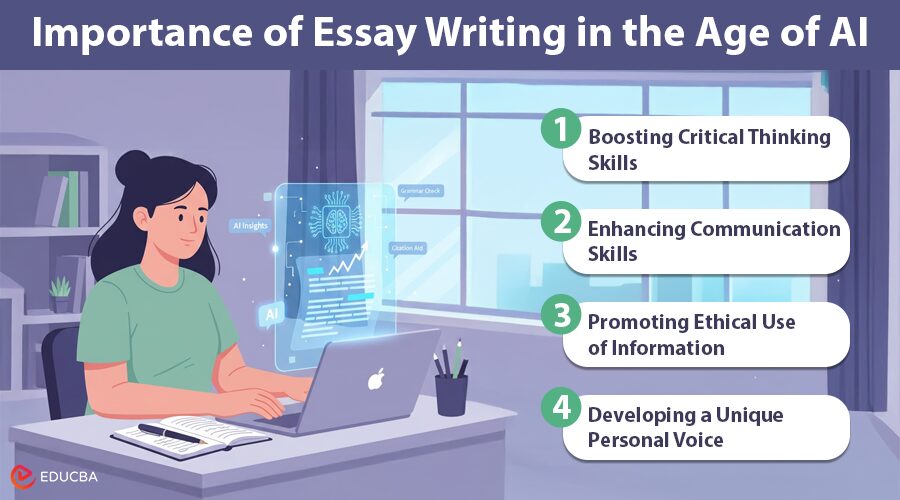
Importance of Essay Writing in the Age of AI
Here are some key reasons why essay writing remains essential even in the age of AI:
1. Boosting Critical Thinking Skills
The strongest argument supporting the relevance of essay writing in the age of AI is that it cultivates critical thinking. AI can process data and generate coherent sentences, but it cannot replicate the reasoning, questioning, and interpretive skills that humans possess. When students engage in essay writing, they learn to deconstruct complex topics, analyze evidence, and build well-supported arguments. Each step reinforces logical thinking and comprehension skills that automated tools cannot fully replace. Writing transforms passive learning into active participation, ensuring that students do not simply receive information but reflect on, question, and analyze it. By engaging deeply with content through essay writing, learners develop the intellectual discipline necessary to interpret information critically and make informed judgments in an AI-driven world.
2. Enhancing Communication Skills
Essay writing in the age of AI is important because it improves communication skills, which are essential in every career. Clear and effective communication is important for success in any career, including healthcare, engineering, business, law, or the arts. Writing, editing, and refining essays teaches students how to organize ideas, communicate their thoughts logically, and adapt their message to specific audiences. Even in technology-dependent workplaces, written documents, reports, proposals, and emails require human discretion and understanding. AI can help with formatting and technical tasks, but only humans can express ideas clearly and convincingly. By practicing essay writing, students strengthen their communication skills, preparing them to articulate ideas effectively in both professional and personal contexts.
3. Promoting Ethical Use of Information
With the rise of AI, essay writing in the age of AI takes on an ethical dimension. Writing essays requires students to reference sources correctly, critically evaluate the reliability of information, and differentiate between credible and untrustworthy content. AI tools can sometimes generate biased, outdated, or inaccurate information, making it vital for learners to verify facts independently. The essay-writing process fosters academic honesty, encourages accountability, and teaches students to engage responsibly with information. By developing these skills, learners cultivate the habits of ethical research and critical evaluation, laying the groundwork for responsible digital citizenship. Essay writing in this context becomes more than an academic exercise; it is a platform for ethical reasoning and intellectual integrity in an AI-dominated world.
4. Developing a Unique Personal Voice
A further reason why essay writing in the age of AI remains essential is that it helps students develop their unique personal voice. AI-generated text can be polished and grammatically correct, but it lacks emotional depth, subjectivity, and originality. Writing allows students to express their experiences, beliefs, and interpretations, providing a medium for authentic self-expression. This skill is particularly important when crafting personal statements, reflections, or scholarship essays, where individuality and sincerity are critical. The process of shaping one’s own voice through writing encourages personal growth, creativity, and the articulation of values and qualities that automated tools cannot replicate. Essay writing remains a deeply human exercise, promoting self-awareness and expressive confidence in a digital age.
5. Deepening Understanding
Essay writing in the age of AI contributes to deeper learning by requiring active engagement with academic content. Writing essays requires students to process information, organize it meaningfully, and articulate it clearly and structurally. This cognitive effort strengthens long-term retention and helps learners achieve mastery of the subject matter. AI can quickly generate summaries or explanations, but it cannot match the deep understanding that comes from thinking through ideas yourself. Through essay writing, students transform abstract concepts into concrete knowledge, developing critical thinking and intellectual confidence. “Active engagement helps students build a foundation for lifelong learning by encouraging them to think critically, organize ideas, and truly understand the material, something AI alone cannot do.
6. Developing Human Skills AI Cannot Replace
Beyond academics, essay writing in the age of AI nurtures human qualities such as empathy, creativity, moral judgment, and emotional intelligence. Writing prompts students to consider diverse perspectives, question their assumptions, and evaluate arguments critically. Machines cannot cultivate these traits.
7. Evolving Relationship Between AI and Writing
AI has not eliminated the need for essay writing; instead, it has transformed the writing paradigm. Students who master writing skills can use AI responsibly as a support tool. AI can assist with brainstorming, outlining, grammar checking, and refinement, but it cannot replace the creativity, reasoning, or insight of the human writer. When students combine their writing abilities with AI tools, the result is a more effective, efficient, and polished product. Human judgment remains irreplaceable, and essay writing, combined with AI, fosters a collaborative approach in which technology enhances rather than overshadows intellectual effort.
8. Essay Writing as a Foundation for Lifelong Learning
Finally, essay writing in the age of AI lays the groundwork for lifelong learning. Skills developed through essay writing, critical analysis, effective communication, ethical reasoning, and creativity extend far beyond the classroom. Adults who are adept at writing can engage with new information, participate in informed discussions, and evaluate the world critically. Even in a technologically advanced society, these human-centered skills remain indispensable. Mastery of essay writing equips students with intellectual autonomy and prepares them to navigate complex challenges thoughtfully and responsibly throughout their lives.
Final Thoughts
Essay writing in the age of AI has not lost its relevance; on the contrary, its significance has grown. While AI tools may offer convenience, they cannot replace the critical thinking, ethical judgment, creativity, and self-expression that come from writing essays. Students who continue honing their writing skills gain intellectual independence, a deeper understanding of the world, and the ability to communicate effectively. As technology evolves, human insight becomes even more valuable. Essay writing is still important for developing thinking, expressing ideas, and helping students handle challenges in a changing digital world.
Recommended Articles
We hope this article on essay writing in the age of AI helps you understand the importance of developing critical thinking, communication, and ethical skills. Check out our related articles to explore more tips on student learning, digital literacy, and effective academic practices.


