


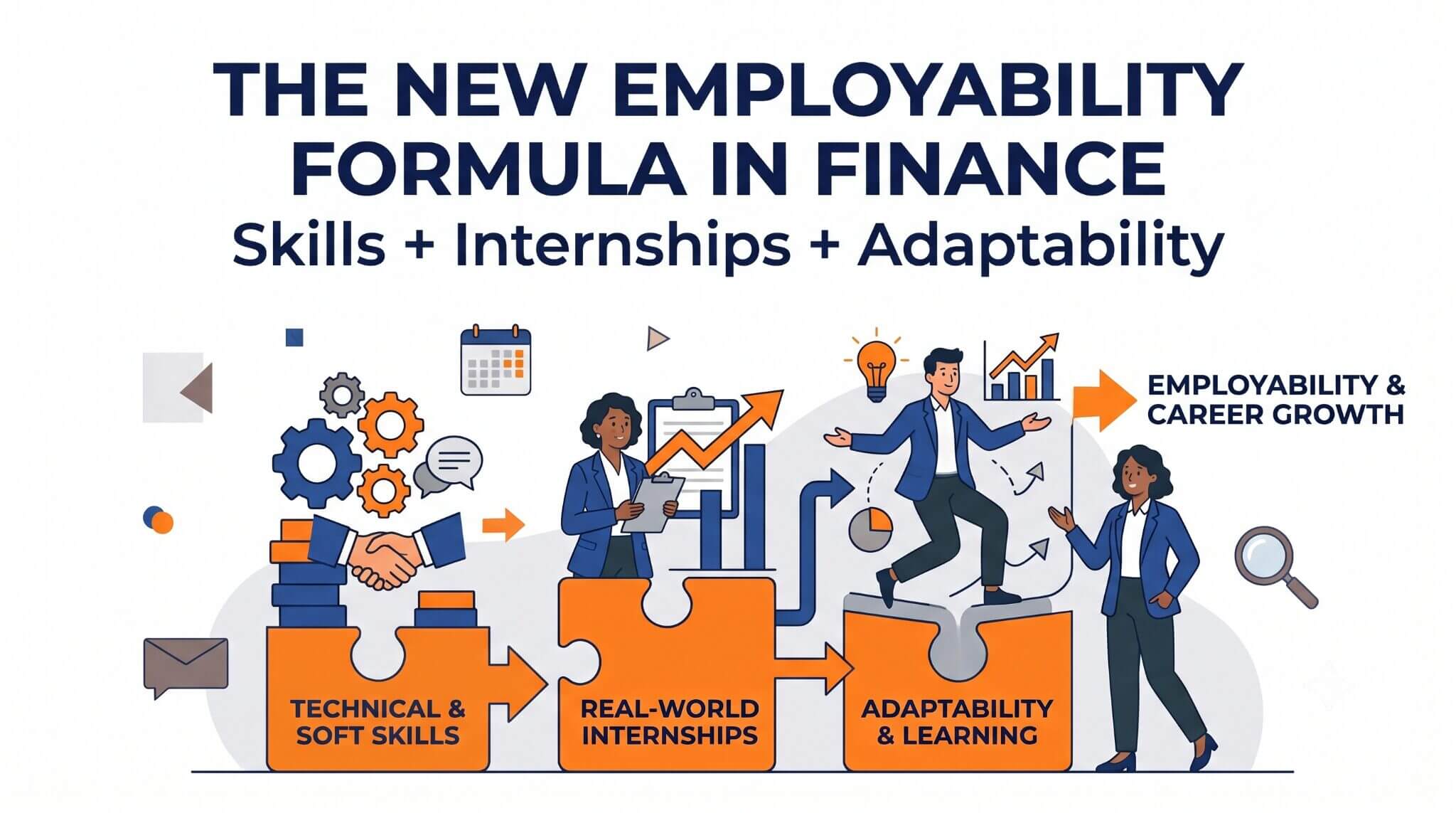
The employability formula in Finance no longer depends solely on the degree. According to the latest research by the CFA Institute, graduates today are building their careers in an increasingly competitive and AI-driven marketplace, where employers value work experience, skills, adaptability, and continuous learning alongside an academic degree.
The New Employability Formula in Finance
Despite economic uncertainty and rapid technological advancements, finance remains one of the most rewarding and resilient career paths worldwide. In CFA Institute’s Graduate Outlook Survey 2026, finance ranked as the most promising profession for the fourth consecutive year.
This confidence comes from several factors:
- Diverse career paths
- Global career mobility
- Strong long-term demand for financial expertise
- Opportunities to combine analytical and strategic thinking
- Increasing integration of technology and finance
However, students also recognize that entering the industry has become more competitive than ever. This has shifted the focus from simply obtaining a degree to becoming employable.
According to respondents to the CFA Institute’s survey, the following factors provide a competitive advantage in today’s job market. The top reasons are;
- Acquired skills (46%)
- Work experience (44%)
- Internships (34%) (CFA Institute)
Students themselves increasingly recognize that employability depends on demonstrating capability rather than simply completing academic requirements.
Skills That Improve Finance Employability
While academic qualifications open doors to Finance jobs, having the following skills delivers a competitive edge over your peers.
1. Technical Finance Skills
Technical competence remains the foundation of finance careers. Employers expect graduates to understand:
- Financial statement analysis
- Corporate finance fundamentals
- Valuation concepts
- Capital markets
- Investment analysis
- Portfolio management principles
- Risk management concepts
Technical skills demonstrate that a candidate can understand and analyze financial decisions rather than merely discuss them theoretically. Technical knowledge remains the starting point for most finance roles, but it is no longer the only requirement.
2. Communication and Interpersonal Skills
One of the most underrated yet interesting parts of the Finance employability is this. 84% of graduates prioritized interpersonal capabilities such as communication and collaboration. At this point, a finance professional needs to do the following on a day-to-day basis.
- Present recommendations
- Explain financial concepts
- Work across teams
- Interact with clients
- Influence decisions
The ability to communicate insights clearly often becomes as important as generating those insights.
3. AI Readiness and Technology Skills
AI is rapidly changing the finance profession. While many graduates initially viewed AI as a threat, CFA Institute research shows attitudes shifting toward seeing AI as a professional advantage. Nearly 72% of graduates reported confidence in using AI tools professionally.
Future finance professionals will increasingly need:
- AI literacy
- Data interpretation skills
- Technology awareness
- Ability to work alongside automation
The objective is not to compete with technology but to learn how to use it effectively.
4. Continuous Learning Skills
Knowledge and skills are becoming outdated faster than ever before. As industries evolve, technology advances, and new ways of working emerge, professionals must continuously learn to stay relevant. According to the CFA Institute, 95% of graduates believe that upskilling and post-graduate qualifications are important for long-term career success.
In this environment, employability is no longer defined solely by what you know today, but by your ability to continuously learn, adapt, and develop new capabilities throughout your career. As a result, learning agility has become one of the most valuable professional skills. The ability to embrace change, acquire new knowledge, and remain relevant in a rapidly evolving workplace is increasingly what separates long-term career growth from stagnation.
Why Internships Matter More Than Ever?
Many students underestimate the importance of internships. CFA Institute’s Graduate Outlook Survey identified internships as one of the strongest differentiators in the job market, ranking alongside skills and work experience. Internships provide benefits that classroom learning cannot fully replicate.
They help students:
- Understand workplace expectations
- Apply academic concepts to real situations
- Build professional confidence
- Develop communication skills
- Gain exposure to finance tools and processes
- Build industry networks
Most importantly, internships help employers evaluate whether a candidate can perform in a professional environment. For many freshers, internship experience becomes the first proof of employability.
How Students Can Build Relevant Finance Work Experience?
Work experience does not always require a full-time job. Students can build practical exposure through:
1. Academic Projects
- Equity research reports
- Industry analysis projects
- Company valuation exercises
- Financial modeling assignments
2. Student Organizations
- Finance clubs
- Investment societies
- Market research groups
3. Virtual Projects
- Investment simulations
- Financial case competitions
- Research competitions
4. Direct Internship Experience
- Investment firms
- Wealth management companies
- Corporate finance teams
- Financial services organizations
The objective is to demonstrate application, not just knowledge.
Adaptability: The Most Underrated Employability Skill
One of the strongest themes across CFA Institute research is adaptability. The finance profession is evolving because of:
- Artificial intelligence
- Automation
- Data-driven decision making
- Changing client expectations
- Regulatory developments
Graduates increasingly recognize that success depends on the ability to evolve alongside these changes. Adaptability includes:
- Learning new technologies
- Acquiring new skills
- Adjusting to changing roles
- Working across disciplines
- Embracing continuous development
This mindset often separates long-term career success from short-term employability.
Why Professional Certifications Continue to Matter?
CFA Institute’s research shows that 70% of graduates believe professional CFA certifications can improve career opportunities, earnings potential, and job satisfaction. Additionally, more than one-third plan to pursue further education or professional qualifications after graduation. Certifications help by:
- Demonstrating commitment
- Signaling professional competence
- Supporting continuous learning
- Strengthening career credibility
However, the research suggests that certifications are most effective when combined with practical skills and relevant experience, rather than when viewed as standalone solutions.
What Employers Expect from Finance Freshers Today?
Based on CFA Institute findings, employers increasingly value candidates who demonstrate:
- Strong finance fundamentals
- Practical application of knowledge
- Internship experience
- Communication skills
- Collaboration ability
- AI readiness
- Continuous learning mindset
- Adaptability to change
The ideal candidate is no longer simply academically qualified, but career-ready.
Final Thoughts
The employability formula in Finance has evolved significantly. According to CFA Institute’s latest research, the graduates most likely to succeed are not necessarily those with the highest grades or the longest list of qualifications. They are the ones who combine relevant skills, practical experience, internships, and adaptability. For finance students and freshers, the message is clear: focus on building capabilities, gaining real-world exposure, and developing the ability to learn continuously. In an increasingly competitive and AI-shaped job market, employability belongs to those who can demonstrate both competence and adaptability.
Recommended Articles
We hope this guide to the employability formula in Finance helps you build the skills and experience needed for a successful career in finance. Explore these recommended articles for more career insights and professional development tips.


