


What Is Empirical Process Control in Scrum?
Scrum is one of the most adopted and widely used frameworks in Agile project management. The projects come with unpredictable scenarios, especially in complex environments. Scrum is a powerful choice because it is built to work in those environments.
Instead of spending too much time on long-term plans and documentation, Scrum uses a powerful principle as a foundation called Empirical Process Control. This principle makes teams work in small steps, learn from results, and improve continuously.
It enables teams to navigate complexity, uncertainty, and constant change, continually adding value step by step. However, what does empirical process control in scrum actually mean, and how does it shape the way teams work in Scrum? Let us break it down in this article clearly.
What Does Empirical Process Control Mean?
The word “empirical” comes from the Ancient Greek “empeiria,” meaning “based on experience and observation, not just ideas.” Empirical process control in scrum means making choices based on what you know (evidence) rather than what you think or guess.
Scrum applies this idea by using short cycles called Sprints. At the end of each Sprint, the team creates a working piece of the product (product Increment). This demonstrates real progress for both the team and stakeholders, moving beyond reliance on predictions. By using the product, everyone can see what works, what does not, and what needs to change next.
Role of Scrum Master and Empiricism
The Scrum Master helps make sure that Scrum’s Empirical Process Control works smoothly. They coach the team and stakeholders to embrace transparency, use inspections properly, and adapt without fear.
Today, most professionals are choosing the Certified Scrum Master certification to build a strong understanding of how to apply empirical process control in real projects. They guide teams and stakeholders on how to be open, use inspections correctly, and face change without hesitation.
The Three Pillars of Empirical Process Control
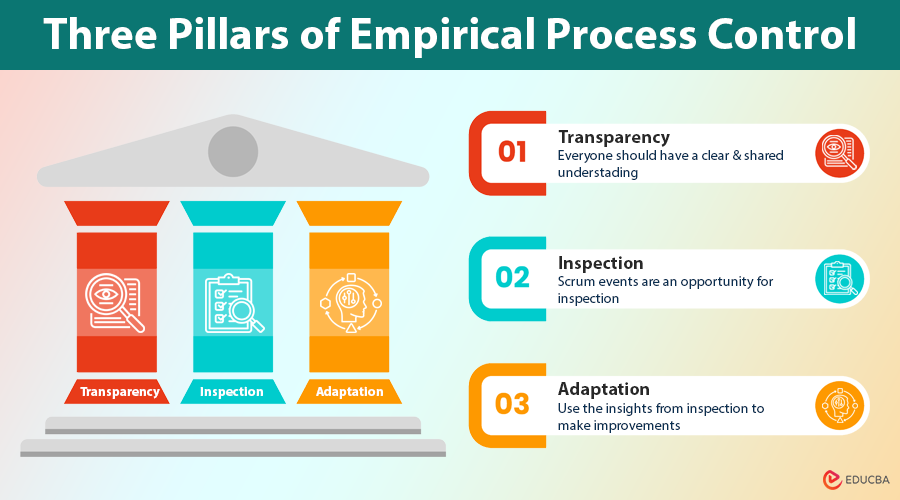
Scrum defines three core pillars that support Empirical Process Control in Scrum:
- Transparency: Everyone must share a common and clear understanding of the work. The product backlog, sprint backlog, and increment should be clear and available to anyone who wants to see them. Transparency is necessary for inspection and adaptation to be reliable.
- Inspection: Scrum meetings (Daily Scrum, Sprint Review, Retrospective) provide opportunities for progress monitoring and early issue identification. The focus is not on blaming but on finding improvements.
- Adaptation: The team must be capable of adapting quickly when things do not go as expected. Adaptation ensures that the product and process move closer to delivering value. Adaptations involve reprioritizing items in the backlog, clarifying scope, or enhancing how the team works together.
These three pillars work together to help Scrum teams deal with uncertainty and make products that meet real customer needs.
Why Empirical Process Control Is Important in Scrum?
Most modern projects, particularly in the tech sector, are fraught with uncertainty due to frequent customer requirement changes, market competition challenging the product, the need for regular new feature releases, and the rapid evolution of technology. These reasons necessitate a strict plan to ensure long-term survival, which can lead to wasted effort before project delivery.
Empirical process control opens the way for Scrum teams to:
- Respond to change quickly
- Deliver smaller increments of value regularly
- Reduce risk by getting feedback early
- Improve their way of working over time.
Practical Examples of Empirical Process Control in Scrum
- Product Feedback: A team releases a minimum version of a feature. Users test it and share feedback. Based on this, the next Sprint focuses on improvements.
- Process Improvement: During a Retrospective, the team notices delays in code reviews. They decide to set a new working agreement to reduce waiting time.
- Market Adaptation: A competitor launches a similar feature. The Product Owner adjusts priorities in the backlog to ensure a quick response.
These examples show how observation leads to decisions, and decisions lead to adaptation.
How Empiricism Supports Agile Methodology?
This empirical process control is not just for Scrum applications. It is a central concept that applies to the whole Agile methodology. Agile teams all over the world use empirical methods to handle uncertainty, cut down on waste, and keep customers at the center of development.
According to the 15th Annual State of Agile Report, more than 90% of businesses say that Agile practices help them deal with changing priorities better. These numbers demonstrate the impact of empiricism on businesses today.
Final Thoughts
Empirical Process Control in Scrum is the backbone of the framework. Teams make better choices in unpredictable situations when they rely on transparency, inspection, and adaptation. They do not guess; instead, they look at real progress to decide what to do next.
This information helps you build flexible teams, add value, and do well in difficult situations. In the end, empirical process control shows that the best way to deal with uncertainty is not to run away from it but to learn from it, one Sprint at a time.
Recommended Articles
We hope this guide on empirical process control in scrum was helpful. Explore related articles on Agile frameworks, Scrum best practices, and iterative project management to enhance team performance.

