


Fourteen thousand GitHub stars. Forty pages of EB-1A evidence. Months of preparation. Still, the petition was denied.
For many AI engineers, this scenario highlights an important reality: technical excellence alone is not enough to qualify for an EB-1A petition.
Here is what makes the EB-1A case uniquely challenging for AI engineers in 2026: it is not about talent, or scale, or how sophisticated the models they deliver are. It is about having a very specific kind of credibility that most engineers have not even been asked to develop. The difference between being “extraordinary” and “documentably extraordinary” to USCIS is the place where engineers fail in their H-1B cases.
By 2026, the issue will no longer be talent, scale, or model complexity. It will be USCIS-readable credibility that H-1B engineers never had to create. AI generates a quantifiable portion of the public codebase. GitHub is at its weakest point. USCIS cannot differentiate between an engineer’s code repository and one produced by AI.
This guide explains how to build the evidence required for an EB-1A petition for AI Engineers and how to avoid common mistakes that lead to petition denials.
Why EB-1A for AI Engineers Has a Specialized Credibility Problem?
The vast majority of achievements in this industry occur behind closed doors within corporations, under NDAs, and on an infrastructure that cannot be publicly cited in any way.
According to 8 C.F.R. § 204.5(h)(3), USCIS determines whether recognition of your achievements comes from your professional peers rather than your employer. That distinction is where most EB-1A petitions for AI engineers fail.
Why GitHub Metrics No Longer Work?
By 2026, artificial intelligence will contribute a discernible portion to the public codebase. Researchers at Singapore Management University studied 300,000+ confirmed AI contributions to code across 6,000+ repositories (each with 100+ stars) using five popular coding helpers. All tools exceed a 15% problem-generating rate – GitHub Copilot at around 17%, Gemini at approximately 29%.
The analysis revealed almost 500,000 unique problems: code smell (89.3%), correctness (6.0%), and security (4.7%). About 22.7% of those problems persisted in the code until the most recent update, and unresolved technical debt increased dramatically through early 2026. USCIS officers evaluating EB-1A applications for AI Engineers cannot reliably determine whether a particular commitment reflects an engineer’s expertise or an AI assistant’s work.
What Builds Real Technical Credibility for EB-1A?
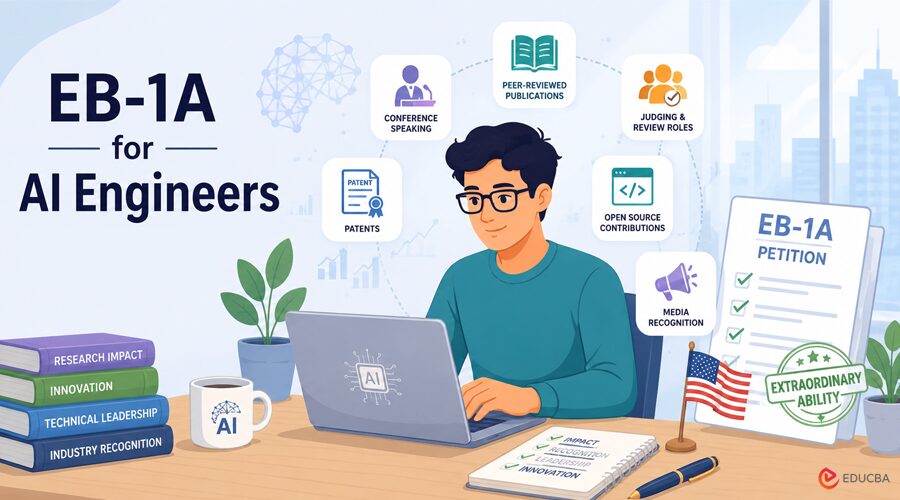
1. Conference Speaking
Conference speaking can be verified through an independent program committee’s selection process. Engineers pursuing EB-1A for AI Engineers should aim to present at conferences such as ICLR (April), CVPR (June), ICML (July), ECCV (September), and NeurIPS (December). Strengthen your evidence by including invitation letters, presentation details, keynote invitations, acceptance rates, and post-conference citations. Internal company presentations and booth sessions generally do not qualify as independent recognition.
2. Peer-Reviewed Publications
There are six tiers of publication strength for EB-1A for AI Engineers:
- Tier 1: Top conference publications (NeurIPS, ICML, ICLR, CVPR, ACL)
- Tier 2: Peer-reviewed journals (JMLR, IEEE TPAMI, Nature Machine Intelligence)
- Tier 3: Highly cited arXiv preprints with documented adoption
- Tier 4: Industry white papers cited outside the company
- Tier 5: Technical articles in MIT Technology Review, VentureBeat, and The Gradient
- Tier 6: Editorials and standards documentation.
3. Judging Roles
Serving as a reviewer or judge is strong evidence for EB-1A for AI Engineers. Committee membership at NeurIPS, ICML, and ICLR is highly indicative. In contrast, committee memberships at CVPR, ECCV, and ACL, grant review panel service (NSF, NIH, DARPA), and advisory roles at independent research organizations also strengthen a petition. A formal invitation letter serves as essential evidence. Becoming a reviewer for a leading AI conference is often one of the most valuable first steps.
4. Patents
For EB-1A for AI Engineers, patents should be supported by evidence of real-world impact, including commercial adoption, citations by later patents or research papers, and influence on industry-wide architectural decisions. A patent application by itself carries limited value.
5. Open-Source Contributions
For EB-1A for AI Engineers, documentation matters more than commit history. Strong evidence includes academic citations, enterprise adoption case studies, framework dependencies, community discussions, and news coverage demonstrating the importance of your work. Fifty GitHub stars supported by academic citations often carry more weight than 10,000 stars without independent validation.
6. Media Recognition
Recognition as an expert in publications such as MIT Technology Review, Wired, VentureBeat, or The Information, or appearances on podcasts like TWIML AI or Import AI, can significantly strengthen EB-1A for AI Engineers. The strongest evidence comes from journalists seeking your expertise independently rather than from company-issued press releases.
Common Pitfalls When Preparing EB-1A for AI Engineers
- Overrelying on GitHub metrics: Stars, forks, and commits support your profile but are not strong evidence of extraordinary ability.
- Equating code quantity with expertise: The impact of your work matters far more than the volume of code you write.
- Relying on employer prestige: USCIS evaluates your individual achievements, not the reputation of your employer.
- Using self-published content as proof: Blogs and repositories gain value only when supported by third-party citations, media coverage, or industry recognition.
- Starting too late: Building a competitive EB-1A for AI Engineers profile typically takes 18–24 months, so planning early is essential.
Final Thoughts
Building a strong EB-1A for AI Engineers petition is not simply about showcasing technical skills or an impressive portfolio; it is about demonstrating extraordinary ability through credible, independent recognition. Whether it is a peer-reviewed publication, an invitation to judge a respected competition, conference speaking opportunities, or a salary that reflects exceptional market value, the strongest evidence comes from impartial third parties who recognize the impact of your work. USCIS places significant weight on achievements validated by objective selection and professional recognition rather than self-promotion. If you are considering an EB-1A petition, the best time to start building this evidence is well before you apply. A strategic, long-term approach can transform your accomplishments into a compelling case for extraordinary ability and significantly improve your chances of approval.
Recommended Articles
We hope this guide on EB-1A for AI Engineers helps you understand the importance of building credible, independently recognized achievements that strengthen your extraordinary ability petition. Explore these recommended articles for more insights on EB-1A visas, immigration strategies, career growth for tech professionals, and building a strong professional portfolio.

