


Security teams rarely have the luxury of seeing threats develop. Most of the time, the damage begins elsewhere, quietly, outside the organization’s visibility. Credentials appear in underground forums. Session cookies are traded in private channels. Internal documents move between anonymous buyers.
Moreover, by the time an incident becomes visible inside the network, the original exposure may have happened weeks earlier.
Dark web monitoring alerts sit in that early window. They surface risk fragments before attackers attempt to exploit them. Not every alert signals an immediate breach, yet many point to something more subtle. A forgotten account, an exposed employee credential, or a supplier compromise that quietly spreads outward.
Understanding what these alerts actually mean requires some context. They are signals from an environment that operates according to its own rules, language, and economy.
The Underground Markets Where Company Data Circulates
The phrase “dark web” conjures images of hidden marketplaces selling stolen databases. Some of that is true, but the reality is broader and messier.
Credential leaks often appear in Telegram channels before they reach structured markets. Small criminal forums trade access to corporate VPN accounts. Initial access brokers advertise footholds into networks long before ransomware operators get involved.
Data rarely arrives all at once. Pieces move slowly.
For instance, an employee password from a retail breach might sit unused for months before someone tests it against a corporate email account. A developer token posted in a code repository can quietly end up in an access bundle sold to other attackers.
Dark web monitoring alerts track these fragments as they surface across forums, marketplaces, paste sites, and criminal chat channels. The value lies less in the alert itself and more in the context surrounding it.
A single credential appearing in the wrong place can reveal more about an organization’s exposure than a vulnerability scan.
Why These Alerts Matter More Than Many Teams Expect?
Security programs often focus on what can be controlled internally. Endpoint protection, patching cycles, firewall rules. Those layers matter, but they do not address the moment when company data leaves the environment.
Dark web monitoring alerts shift attention outward. They show when information related to the organization begins circulating beyond the perimeter.
Sometimes the signal is obvious. A dump containing thousands of employee email addresses has been found in a breach archive. More often, the clues are quieter.
A password associated with a finance employee is listed on a credential marketplace. An internal project name appears inside a forum conversation. An initial access broker advertises access to a company server in search of ransomware partners.
None of those signals guarantees an ongoing attack. However, ignoring them creates blind spots. Attackers build campaigns around small exposures. Security teams that notice those pieces early gain room to respond.
What Typically Triggers Dark Web Monitoring Alerts?
Alerts originate from several different types of exposure. Some stem from breaches outside the organization. Others come directly from compromised internal accounts.
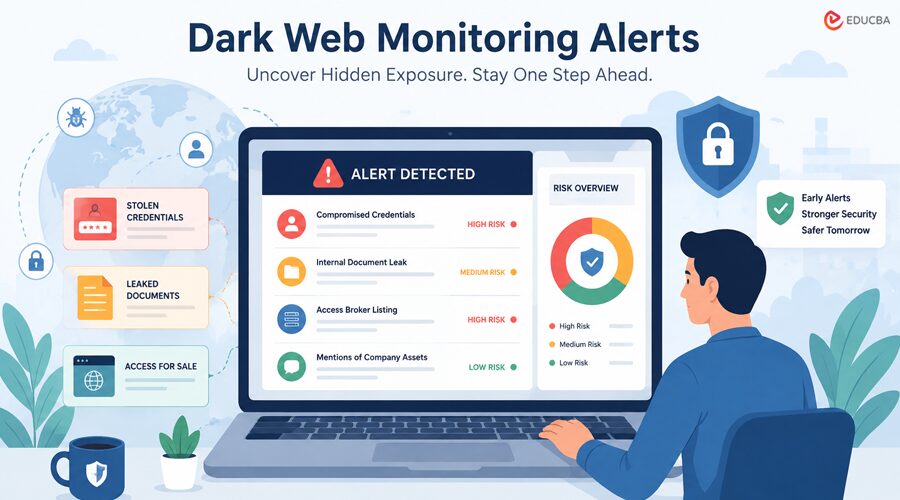
The following signals often form the backbone of dark web monitoring systems. Before examining them individually, it helps to view them as stages through which corporate information drifts into criminal ecosystems.
Credential Leaks from Third-Party Breaches
Employees reuse passwords. Despite years of awareness campaigns, the behavior persists. When a consumer platform suffers a breach, employee credentials are often included in the leaked dataset.
Attackers collect these credentials and test them against corporate systems. Email portals, VPN gateways, and collaboration platforms are common targets.
In this scenario, a monitoring alert may indicate that a password associated with a corporate email domain appears in a breach archive. That single signal often leads to a broader review of password hygiene across the workforce.
Malware Stolen Credentials
Infostealer malware has become one of the most active data collection tools in the criminal ecosystem. After infecting a device, the malware collects browser passwords, authentication cookies, and stored session tokens.
Those logs are then sold or distributed through underground channels.
Dark web monitoring alerts often originate from these infostealer logs. A session cookie tied to a cloud platform, for example, can allow attackers to bypass authentication controls entirely.
In some incidents, the compromised device is not a corporate-owned device. An employee’s laptop used for remote work may be enough.
Database Dumps and Breach Archives
Large-scale breaches still occur with unsettling regularity. When attackers steal customer or user databases, the data eventually spreads through dark web marketplaces and leak sites.
If the breached platform shares users with the organization’s employees or customers, monitoring systems flag the appearance of related credentials.
This category often generates the highest volume of alerts. Most are indirect exposures, yet they remain useful indicators of the risk of credential reuse.
Initial Access Listings
A more serious signal appears when access to a corporate network is advertised for sale. Initial access brokers specialize in selling footholds. They compromise systems through phishing, vulnerabilities, or stolen credentials, then offer that access to ransomware groups or other attackers.
Listings might describe the network size, industry, and revenue bracket. Occasionally, they include screenshots proving access.
Dark web monitoring alerts tied to these listings require immediate investigation. They suggest the network may already be compromised.
Mentions of Company Assets or Internal Data
Sometimes alerts originate from conversations rather than structured listings. A forum discussion might reference internal documents, proprietary code, or system screenshots.
These fragments can indicate reconnaissance activity or previous compromise attempts. While they appear less concrete than credential leaks, they often reveal an attacker’s interest in the organization.
Interpreting Alerts Without Overreacting
Not every alert signals active danger. Some exposures represent recycled data from years-old breaches. Others come from credential combinations that attackers have already exhausted. Security teams need to carefully interpret alerts.
Context matters more than volume. A single valid credential tied to a privileged account deserves more attention than thousands of obsolete passwords from historic leaks. Analysts often examine three basic factors when evaluating alerts.
- Recency of the Data: Newly posted credentials or access listings carry more weight than recycled breach datasets.
- Account Privilege: Administrative accounts or developer credentials pose a greater risk than standard user logins.
- Evidence of Activity: Screenshots, access proofs, or references to specific infrastructure can indicate a deeper compromise.
The goal is not to panic. It is awareness. Dark web monitoring alerts provide early signals, but they need to be correlated with internal security data to reveal the full picture.
The Operational Challenge Behind Effective Monitoring
Collecting alerts sounds simple in theory. In practice, it requires sustained observation of a constantly shifting ecosystem.
Criminal forums disappear and reappear under new names. Marketplaces shut down after law enforcement actions. Private invitation channels are becoming the preferred locations for sensitive data trading.
Monitoring tools rely on a mixture of automated scraping, human intelligence gathering, and community infiltration. Even with those techniques, visibility remains partial. The dark web is not a single location, but a loose network of communities scattered across multiple platforms.
That uncertainty is part of the reason early alerts carry value. When fragments of exposure appear publicly, it often means the data has already circulated privately.
Final Thoughts
Dark web monitoring alerts do not stop attacks on their own. They reveal something earlier in the chain. Evidence that company-related data has started moving through criminal channels.
Sometimes the alert points to a reused password that needs to be reset. At other times, it uncovers access already available on an underground marketplace, waiting for a buyer. Ignoring those signals leaves organizations reacting after the damage has spread throughout the network.
Effective monitoring requires more than automated alerts. It involves interpreting the signals, validating whether credentials remain active, and understanding how the exposure might connect to broader threat activity. This is where external expertise often becomes valuable.
CyberNX offers robust dark web monitoring services, backed by experienced experts and cost-effective plans. They can give you a full picture of your security, including any vulnerabilities, dark web behaviors, and the risks that come with them.
Recommended Articles
We hope this guide on Dark Web Monitoring Alerts helps you better understand hidden cyber risks and strengthen your organization’s security. Explore these recommended articles for more insights on cybersecurity, threat intelligence, data protection, and dark web monitoring.


