
Introduction to Cloud Management Tools
Cloud management tools are software solutions designed to monitor, optimize, and control cloud infrastructure, applications, and services across public, private, or hybrid environments. They enable businesses to manage resources efficiently, ensure security and compliance, automate workflows, and optimize costs. By offering centralized dashboards, real-time monitoring, and integration capabilities, these tools streamline operations, enhance performance, and reduce complexities in multi-cloud or hybrid setups, empowering organizations to scale seamlessly while maintaining governance and operational efficiency.
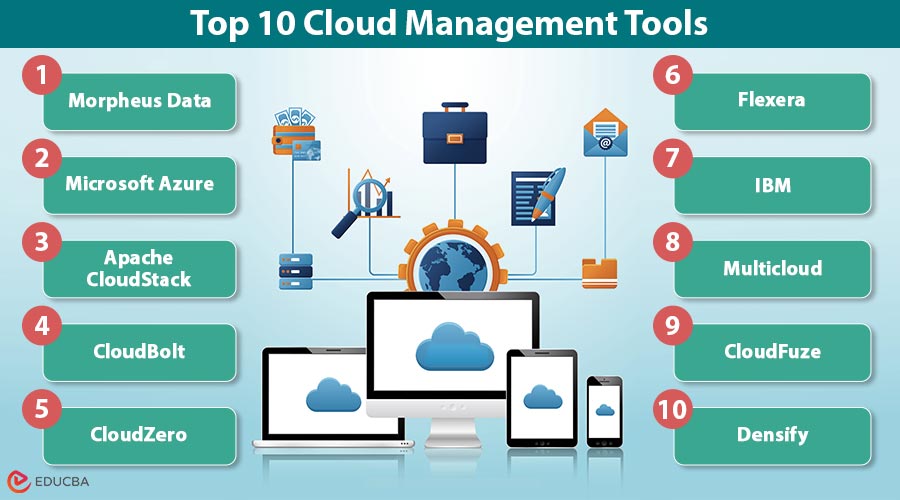
Top 10 Cloud Management Tools
Here are the top cloud management tools that help organizations efficiently monitor, optimize, and control their cloud environments across various platforms and use cases.
#1. Morpheus Data
Morpheus Data is a comprehensive hybrid cloud management tool that offers self-service provisioning, automation, cost analytics, and governance. It integrates with over 90 cloud and infrastructure technologies, making it ideal for enterprises running multiple environments.
Category: Hybrid Cloud Management & Orchestration
Key Features:
- Unified management across AWS, Azure, GCP, VMware, and more.
- Role-based access control.
- Built-in automation and CI/CD integrations.
#2. Microsoft Azure
Microsoft Azure is a cloud platform that provides a variety of services, including software (SaaS), platforms (PaaS), and infrastructure (IaaS). It comes with built-in tools for management, analytics, and security, allowing businesses to create, run, and manage applications worldwide using Microsoft’s ecosystem.
Category: Public Cloud Platform & Management
Key Features:
- Global data center coverage.
- AI-driven performance monitoring.
- Advanced analytics and security compliance.
#3. Apache CloudStack
Category: Open-Source Cloud Infrastructure Management
Key Features:
- Multi-hypervisor support (KVM, VMware, XenServer).
- REST API for automation.
- High availability architecture.
#4. CloudBolt
CloudBolt is a tool that helps businesses manage both private and multiple public clouds from one place. It makes setting up resources easier, helps save costs, and ensures rules are followed, so companies can handle complex cloud setups smoothly and stay in control.
Category: Hybrid/Multicloud Management
Key Features:
- Integration with over 20 cloud providers.
- Policy enforcement and compliance.
- Resource usage and cost tracking.
#5. CloudZero
CloudZero is a tool that shows you exactly how much your cloud services are costing in real time. It helps you see which products, features, or customers those costs belong to, so you can make smarter financial decisions and save money, especially if you run a SaaS or cloud-based business.
Category: Cloud Cost Intelligence
Key Features:
- Automatic cost allocation.
- Detailed cost anomaly detection.
- Developer-friendly integrations.
#6. Flexera
Flexera’s cloud management tool helps big companies see their cloud costs clearly, automate tasks based on rules, and make the best use of software licenses. This makes it easier to manage multiple cloud services, save money, and control resources better.
Category: IT Asset & Cloud Cost Management
Key Features:
- Multi-cloud cost visibility.
- Policy-based automation.
- License optimization.
#7. IBM
IBM Cloud offers secure, enterprise-grade IaaS, PaaS, and SaaS services, integrating AI and hybrid cloud capabilities, making it ideal for regulated industries requiring robust compliance and multi-cloud management solutions.
Category: Public Cloud & Hybrid Solutions
Key Features:
- Enterprise-grade security and compliance.
- AI-powered analytics.
- OpenShift-based hybrid cloud capabilities.
#8. Multicloud
Multicloud management tools let you control and manage workloads on AWS, Azure, Google Cloud, and private clouds all from one place. They help keep rules consistent, prevent dependence on a single provider, and make your systems stronger by spreading them across different clouds.
Category: Cross-Platform Cloud Management
Key Features:
- Avoid vendor lock-in.
- Consistent security and compliance policies.
- Centralized performance monitoring and analytics for all connected cloud environments.
#9. CloudFuze
CloudFuze is a cloud file migration and management platform that simplifies transferring, syncing, and managing data across multiple cloud storage services. It supports enterprise collaboration by enabling seamless access and migration of files across providers without downtime or data loss.
Category: Cloud Data Migration & Collaboration
Key Features:
- Supports 40+ cloud storage platforms (Google Drive, OneDrive, Dropbox, Box, etc.)
- Automated, secure migration with minimal disruption
- Centralized management dashboard for multi-cloud file access
#10. Densify
Densify uses machine learning to optimize cloud resource allocation, reducing waste, improving performance, and lowering costs by continuously analyzing usage patterns and automating efficient resource management in dynamic cloud environments.
Category: Cloud Resource Optimization & Management
Key Features:
- AI-driven resource optimization recommendations
- Continuous monitoring of cloud workloads and utilization
- Automated rightsizing and scheduling of cloud resources
Frequently Asked Questions (FAQs)
Q1. What is the main purpose of cloud management tools?
Answer: The main purpose of cloud management tools is to centralize control, monitor, automate, and optimize cloud resources.
Q2. Can cloud management tools work across multiple providers?
Answer: Yes, many support hybrid and multi-cloud setups for centralized control.
Q3. Are open-source cloud management tools available?
Answer: Yes, Apache CloudStack and Terraform are popular open-source options.
Q4. How do these tools help with cost optimization?
Answer: They track resource usage, detect anomalies, and allocate costs to projects or teams.
Final Thoughts
Cloud management tools are essential for efficiently operating in today’s hybrid and multi-cloud landscapes. From provisioning to cost intelligence, they streamline workflows, enhance governance, and boost performance. Whether leveraging open-source flexibility or enterprise-grade platforms, choosing the right tool depends on your operational scale, compliance needs, and integration goals, ensuring scalable, secure, and cost-effective cloud operations.
Recommended Articles
We hope that this EDUCBA information on “Cloud Management Tools” was beneficial to you. You can view EDUCBA’s recommended articles for more information.


