


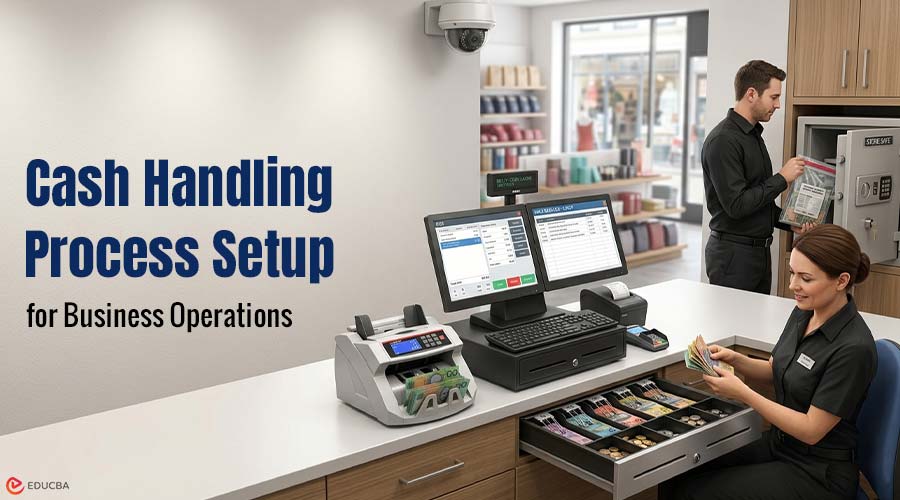
Cash remains a stubborn fixture of modern commerce. Even as digital payments surge, roughly 14% of U.S. consumer transactions in 2024 were still made with physical currency, according to the Federal Reserve’s Diary of Consumer Payment Choice. For retailers, restaurants, service providers, and any business that takes in notes and coins, that means cash handling is not an afterthought. It is a core operational discipline that, when done poorly, quietly erodes margins and exposes the business to theft, fraud, and regulatory risk.
Why Does a Formal Cash Handling Process Matters?
Businesses that rely on informal routines for counting, storing, and depositing cash tend to lose money in ways they never fully measure. Shortages accumulate quietly, counterfeit bills slip through undetected, and discrepancies between register totals and deposit slips become routine rather than alarming.
The financial damage is rarely small. The Association of Certified Fraud Examiners reports that businesses typically lose around 5% of their yearly revenue to occupational fraud, with asset misappropriation—including cash theft—making up 89% of all recorded incidents. Smaller businesses typically operate with fewer internal controls and layers of oversight, making them the hardest hit.
A documented cash handling process addresses these problems directly. It creates accountability, establishes audit trails, and gives every employee a clear standard to follow. Just as importantly, it is the foundation of effective cash management, ensuring that the physical movement of money is as disciplined as the financial planning built on top of it.
Core Objectives of a Cash Handling Process
Before designing the workflow, define what the process is supposed to accomplish:
- Accuracy in counting, recording, and reconciling cash at every stage
- Security of funds from the point of customer payment to the bank deposit
- Clear accountability is assigned to specific employees for specific steps
- Compliance with tax and anti-money-laundering reporting requirements
- Efficiency that does not bog down frontline staff with excessive friction
These objectives often diverge. A highly secure process can be slow. An efficient process can create accountability gaps. A well-designed system balances the two.
Step 1: Assign Roles and Access Control
The first structural decision is who touches cash and when. In most businesses, cash moves through three distinct stages: collection at the point of sale, intermediate handling and storage, and final deposit. Each stage should be assigned to a specific role, with clear boundaries.
A useful rule borrowed from accounting is a separation of responsibilities. No single employee should control the entire lifecycle of a cash transaction. The person who collects payments shouldn’t be the one who reconciles the drawer. The safe should be accessible to more people than just the manager who counts the deposit.
Access control should follow the same logic:
| Role | Access to Cash Drawer | Access to Safe | Authority to Make Deposits |
| Cashier | Yes (own drawer only) | No | No |
| Shift Lead | Yes (all drawers) | Limited (drops only) | No |
| Manager | Yes | Yes | Yes |
| Owner/Finance | Yes | Yes | Yes |
Document who holds each role, who can substitute during absences, and how access credentials are revoked when employees leave.
Step 2: Standardize the Point-of-Sale Workflow
Most cash-handling errors happen at the register, not in the back office. A standardized POS workflow eliminates the small habits that cause shortages and overages to drift into larger problems.
At the start of each shift, cashiers should count their opening float in front of a witness and sign a log confirming the amount. This creates a verifiable starting point. Without it, any discrepancy at the end of shift is guesswork.
During the shift, a few practices reduce errors sharply:
- Close the drawer between every transaction, even during a rush
- Keep large bills under the drawer tray rather than in it
- Never let two cashiers share a drawer during the same shift
- Perform a mid-shift drop to the safe once the drawer exceeds a set threshold
That threshold should be written into policy. A common benchmark is $300 to $500 in the drawer at any time, with anything above that amount dropped into the safe via a tamper-evident deposit bag. This limits exposure if the drawer is robbed or if a count is off.
Step 3: Invest in the Right Equipment
Manual cash counting is slow and error-prone. Once a business is processing more than a few hundred dollars per day, the math on counting equipment starts to make sense: labor savings plus reduced counterfeit losses typically pay back the hardware cost within months.
The essential kit for a small to mid-sized operation includes:
- A bill counter or mixed denomination counter for end-of-shift reconciliation
- A coin counter or sorter for businesses with meaningful change volume
- Counterfeit detectors, either standalone or built into the bill counter
- A commercial-grade safe with a drop slot for mid-shift deposits
- Tamper-evident deposit bags and a sealed transport container
Businesses that handle higher volumes often switch to dedicated commercial counting equipment from providers such as Kolibri, which builds mixed-denomination counters with integrated ultraviolet, magnetic, and infrared counterfeit-detection systems. The practical benefit is twofold: reconciliation speeds up sharply, and the risk of accepting counterfeit currency drops to near zero. For a business processing daily cash deposits, that combination of speed and verification is where most of the operational gains come from.
Whatever equipment you choose, standardize it across locations. Mixed hardware across stores creates inconsistent workflows and complicates training.
Step 4: Define the Reconciliation Procedure
Reconciliation is the process by which the cash handling process either catches errors or hides them. A sloppy reconciliation step is worse than none at all, because it creates the illusion of control.
The end-of-shift reconciliation should follow a fixed sequence:
- Remove the drawer and move it to a secure counting area, away from customers
- Run the POS close-out report to get the expected cash total
- Count the drawer contents using the bill counter, recording each denomination
- Subtract the opening float to isolate the day’s receipts
- Compare the counted total to the POS expected total
- Document any variance, however small, and note the cashier and shift
Variance tolerance should be explicit. Most businesses accept drawer differences of $1 to $5 without investigation, but anything beyond that triggers a review. Persistent variances by the same cashier, even within tolerance, are also worth flagging – a pattern is more significant than any single discrepancy.
All reconciliation records should be retained for at least three years. This supports internal audits, tax inquiries, and any investigation into suspected theft.
Step 5: Set Clear Deposit and Transport Rules
The physical movement of cash from the business to the bank is one of the highest-risk stages in the process. Predictability is the enemy here. If employees always make deposits at the same time, through the same door, along the same route, the business becomes an easy target.
A few operational rules reduce that risk:
- Vary deposit times and routes on a rotating schedule
- Never allow a single employee to transport large cash deposits alone
- Use sealed, tamper-evident bags that are signed over at each handoff
- Keep deposit slips and cash records separate during transport
- Record the deposit confirmation number in the reconciliation log on the same day
For businesses handling large daily volumes, contracting with an armored cash-in-transit provider usually costs less than a single serious incident would. Even for smaller businesses, a two-person deposit rule costs nothing to implement and significantly reduces exposure.
Step 6: Build Fraud Prevention into the System
Internal theft is more common than external robbery and harder to detect. The ACFE data shows that most fraud schemes last around 12 months before detection, and nearly half are uncovered through tips rather than formal controls.
Practical fraud prevention layers onto the cash handling process in several ways:
- Rotate duties periodically so no one employee controls the same cash role indefinitely
- Require vacations for anyone handling cash, and have someone else cover their role during that time
- Install cameras over registers, safes, and counting areas, with retention of at least 30 days
- Create an anonymous reporting channel for employees to flag concerns
- Review variance patterns monthly, looking for trends rather than single incidents
Mandatory vacation coverage is particularly effective. Many long-running fraud schemes depend on the perpetrator being the only person who knows how their part of the process works. When someone else steps in for a week, irregularities tend to surface.
Step 7: Stay Compliant with Cash Reporting Laws
Any business that accepts significant cash payments has compliance obligations that cannot be delegated to the accountant at year-end. In the United States, businesses must file IRS Form 8300 within 15 days of receiving more than $10,000 in cash from a single customer, whether through a single payment or multiple connected transactions completed within a 24-hour timeframe.
The reporting requirement covers more than just large single payments. It also includes:
- Multiple smaller payments from the same customer that total over $10,000
- Cash received as an advance payment, loan repayment, or rental income
- Cash received in installments on a single underlying transaction
Failure to file carries significant penalties, and the IRS treats deliberate structuring to avoid the threshold as a separate offense. Employees who accept cash should know the threshold and escalate any qualifying transaction to a manager for documentation.
Beyond federal reporting, many states impose their own record-keeping and sales tax requirements that vary by industry. Integrating these rules into the daily cash-handling process, rather than treating them as a separate compliance workflow, keeps the business audit-ready without creating parallel systems.
Step 8: Train and Retrain Staff
A cash handling process only works if the people executing it actually follow it. That means training cannot be a one-time event during onboarding.
Effective training programs cover:
- Hands-on drills for counting, counterfeit detection, and reconciliation
- Role-playing for handling suspected counterfeit bills and aggressive customers
- Regular refresher sessions when procedures change, or error rates increase.
- Written documentation that employees can reference during a shift
- A clear escalation path for unusual situations
Strong controls start at the point of sale. Cash handling falls within the broader discipline of financial management, and staff benefit from understanding why the process exists, not just the steps. An employee who sees the reconciliation step as a defense against accusations of theft rather than as busywork is far more likely to do it properly.
Final Thoughts
Setting up a cash handling process is less about heroic security measures and more about quiet, repeatable discipline. The businesses that lose the least to errors, theft, and compliance problems are rarely the ones with the most sophisticated vaults. Every cashier counts the same, every manager reconciles on the same schedule, and every deposit follows the same documented path. Build the system once, train the team well, and review it annually. The returns, measured in recovered shrinkage and avoided penalties, tend to exceed the cost of implementation many times over quietly.
Recommended Articles
We hope this guide on the cash handling process helps you strengthen financial control and reduce risk across your business operations. Explore these recommended articles for additional insights and practical strategies to improve your cash management and overall financial efficiency.


