


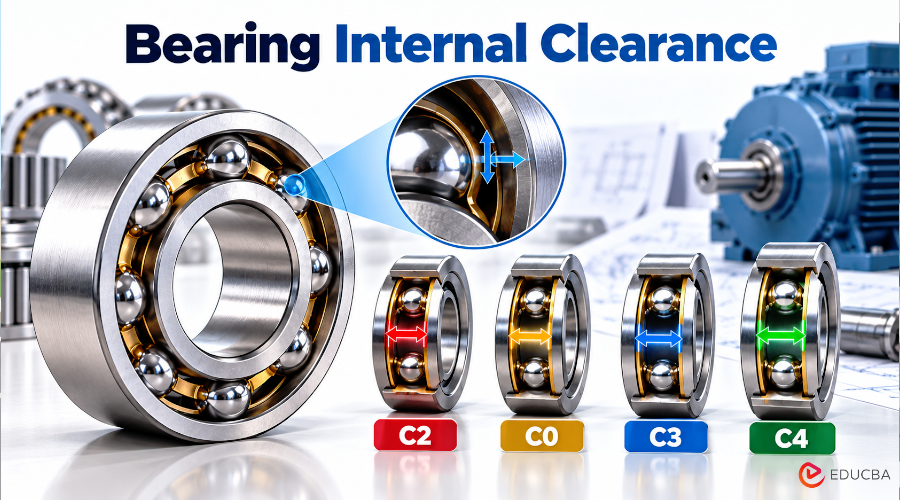
Pick up a ball bearing, hold the outer ring, and push the inner ring sideways. It moves slightly. That small movement is known as bearing internal clearance, and the code that specifies it is one of the most misunderstood parts of a bearing number.
This guide explains what clearance is, what the C codes mean, why a tight bearing is not a better bearing, and two real orders that show how a wrong code turns into a returned shipment.
Key Takeaways
- Internal clearance is the small gap between the rings and the rolling elements.
- C2 is smaller than Normal, C0 is Normal, C3 and C4 are larger.
- Shaft fit and heat reduce the gap after mounting.
- A tighter bearing is not a higher quality bearing.
- Most clearance problems start on the purchase order, not in the factory.
What is Internal Clearance?
Internal clearance is the total distance one ring can move against the other. When measured across the bearing, it is radial clearance. Measured along the shaft, it is axial clearance. For deep groove ball bearings, the figure written on an order is the radial one.
The gap is tiny. On a bearing with a 30 to 40 mm bore, Normal clearance is at most a few hundredths of a millimeter. Even so, it determines how the bearing runs once it is fitted and warmed up.
Understanding Bearing Internal Clearance Classes
International standards group clearance into classes. Bearing makers mark them like this:
| Code | Meaning | Typical use |
| C2 | Smaller than Normal | Low-play positions with controlled fits |
| C0 or CN | Normal, usually not marked | Most ordinary machines |
| C3 | Larger than Normal | Electric motors, warm shafts, tight fits |
| C4 | Larger than C3 | Both rings pressed in, hot shafts |
So a bearing marked 6205-2RS C3 is a 6205 with two rubber seals and C3 clearance. A plain 6205-2RS with no C code is Normal.
Why the Bearing Needs a Gap At All?
Two things eat the clearance after the bearing leaves the box.
The first is the fit. When you press the inner ring onto a shaft with interference, the ring expands slightly. The gap between balls and raceways shrinks.
The second is heat. In a running motor, the shaft and inner ring are usually warmer than the housing and outer ring. The inner ring grows more, and the gap shrinks again.
If the bearing starts too tight, it can reach zero or negative clearance in service. Then it runs hot and wears quickly. If it starts too loose, it rattles, vibrates, and makes noise. The right clearance leaves a small positive gap when the machine is running.
A Tight Bearing is Not a Better Bearing
Many buyers judge a bearing by hand. If the inner ring rocks, it feels cheap. If it is stiff, it feels precise. That instinct is wrong.
C2, C0, C3, and C4 bearings are made to the same dimensional tolerances. The only difference is the gap. A C2 bearing is not better made than a C3. It is meant for a different job.
Two Orders that Went Wrong on Clearance
At FULI Bearings, our bearing factory in Linqing, Shandong, two past orders show both sides of the mistake.
- Too much clearance: An OEM customer in Southeast Asia, who had purchased bearings from the factory several times, ordered cylindrical roller bearings with C4 clearance. Based on the drawing, the engineering team anticipated that C4 would result in excessive play. The engineering team raised the concern in writing before production. However, the buyer instructed the factory to manufacture the bearings according to the purchase order. After delivery, the end user found that the clearance was unsuitable for the machine because it was too large.
- Too little clearance: A domestic customer in China supplied a batch of 6205 bearings to a drum manufacturer. The drums needed to operate with very little wobble. Because no clearance group was agreed upon, the factory manufactured the batch with standard C0 clearance. The drum manufacturer required C2 clearance, so the bearings were returned. The factory checked the clearance of every bearing in the replacement batch before shipping.
In both cases, the bearings were made correctly. The problem was the order code.
How Clearance is Controlled in Production?
At the factory, automatic equipment assembles deep groove ball bearings. The machine sets the assembly clearance, and samples are checked at regular intervals during production to confirm they meet the required specifications. When an order requires every bearing to be checked, as in the drum case, a separate full inspection is conducted before shipping.
How to Choose the Right Code?
A few simple rules cover most cases:
- Copy the full number from the old bearing: If it says C3, order C3. If it shows no C code, it is Normal.
- Ask who owns the machine design: The engineer who set the shaft and housing fits knows what clearance the bearing needs.
- Motors and warm shafts usually need C3: The heat difference between the inner and outer rings reduces the gap.
- Use C2 only when someone has calculated it: A low-play position without that check risks a bearing that runs hot.
- Write the code in order: If clearance is not stated, the factory will make Normal.
When in doubt, send the supplier the old bearing’s full number and a note on the machine, its speed, and how hot it runs. That is usually enough to settle the right clearance before production starts.
Recommended Articles
We hope this comprehensive guide to bearing internal clearance helps you understand clearance classifications and choose the right bearings for your applications. Explore these recommended articles for more insights into performance and maintenance.

