


Updated April 18, 2026
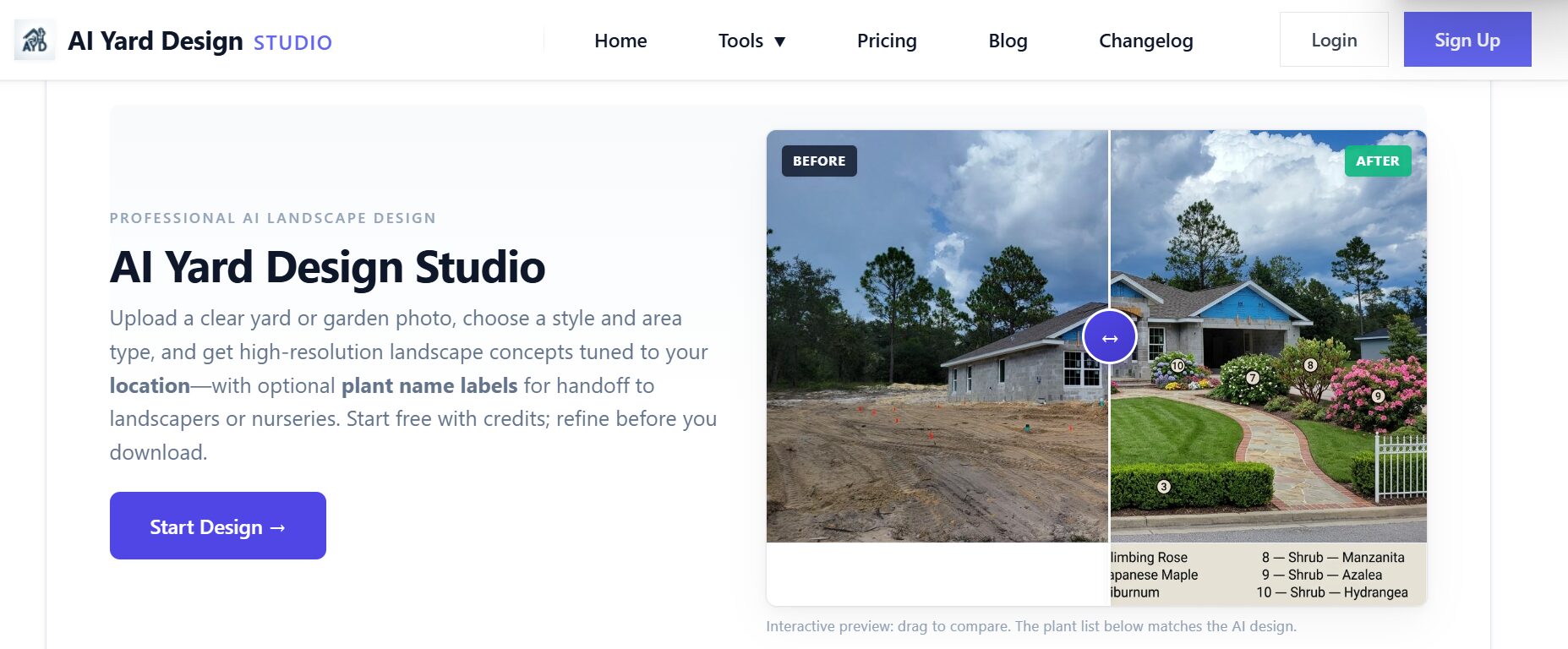
Image Source: AI Yard Design Studio
If you are comparing AI landscaping tools, the category can sound like a single promise: type a dream, get a garden. In practice, slopes, property lines, mature trees, climate, and maintenance tolerance constrain outdoor work, along with the unglamorous truth that late alignment drives up costs. AI Yard Design Studio focuses on a narrower, more useful job: it helps you turn a real yard or garden photo into iterable landscape concepts you can share—so decisions start with a picture everyone recognizes as your lot, not a stranger’s inspiration post. This guide explains what to expect from the platform: what it does well, what it will not pretend to do, and how to get better results on the first day.
What is an AI Yard Design Studio?
AI Yard Design Studio is a residential-first AI landscaping workflow centered on photo-grounded generation. It is designed for homeowners and small-project leaders who need early clarity and a strong visual direction that can be critiqued, refined, and discussed with a partner, landscaper, or nursery before committing to hardscape and material decisions. Rather than replacing essential processes like drainage analysis, permitting, or construction documentation, this tool serves a different purpose. Instead, it serves as a front-end visualization aid that helps minimize misalignment and reduce rework caused by unclear or vague project briefs.
The Baseline Input: Your Real Yard Photo
Expectations start with inputs. The studio uses an uploaded yard or garden image with enough context—house relationship, boundaries, existing paving, and major vertical elements like trees you may want to keep. If constraints are removed, the output may appear “beautiful” but fail to align with your intended property. By incorporating honest, accurate context, it becomes much easier to evaluate and discuss the results meaningfully. Even without a personal photo, the interface can be explored using sample images, but the real value comes from working with a contextual image of your own space.
Zone-Based Yard Planning
Front yards, backyards, side yards, garden retreats, and pool surrounds are not interchangeable problems. AI Yard Design Studio organizes generation around home-scale outdoor zones so the system is not guessing whether you are solving curb appeal, private living, tight circulation, intimate planting, or pool-adjacent safety and materials. If you skip this step mentally, you will blame the tool for your brief. If you use it deliberately, comparisons become meaningful.
Turning Style Into a Real Design Brief
You should expect to choose a required style direction and add optional elements where appropriate. Expect to write additional requirements, such as a professional brief: screening needs, pet paths, maintenance tolerance, features you refuse, and what you must preserve. AI landscaping outputs improve sharply when constraints are explicit. Style without constraints produces a lot of ambiguity; constraints produce decisions.
Location Context: A Realism Lever, Not a Guarantee
Expect an optional location context meant to steer planting palettes and materials toward outcomes that feel more appropriate where you live. Do not expect certainty. Location context does not replace nursery inventory checks, diligence on invasive species, or local designer judgment. It reduces climate fantasy—the common failure mode where renders look premium but belong to another region.
Two Quality Modes: Exploration vs Shareable Detail
Expect a faster draft tier for layout exploration: circulation, openness versus enclosure, hardscape versus planting emphasis—without paying for a meeting-ready render too early. Expect a higher-detail tier when you need sharper output and a more presentation-grade concept. In that tier, you may see on-image plant callouts useful for discussion. Treat callouts as reference prompts, not botanical certification. Mature size, winter hardiness, water needs, and availability still require human verification.
Expect transparent credit use tied to quality and resolution—so you can iterate inexpensively while ideas are fluid, then invest when you have a version worth emailing to a contractor or bringing to a nursery consult. Most runs complete in a couple of minutes, while larger high-detail outputs sometimes take longer, depending on settings and load.
Fine-Tuning: Expect Iteration, Not Endless Resets
Expect fine-tuning controls—pathway materials, planting emphasis, common outdoor amenities—plus custom instructions for targeted edits that should not discard a mostly-right concept. Outdoor design naturally moves in layers—hardscape logic, planting structure, and detailing—and the platform aligns with that reality.
Large-Scale Work: Expect a Separate Lane
Expect AI Yard Design Studio to define its scope clearly: it focuses on residential outdoor rooms. If you are working on parks, campuses, commercial grounds, or street-scale environments, expect to use the platform’s large-scale landscape workflow so your brief matches the scale of the decision. Using the wrong lane produces the wrong questions—and weak outputs that feel disconnected from the job.
Quick Start Guide for Using an AI Yard Design Studio
If you want a strong first session with AI landscaping on this platform:
- Photograph your outdoor space with honest context.
- Choose the correct zone and a coherent style direction.
- Write requirements like a brief, not like vibes.
- Add location context if plant believability matters to you.
- Run a draft pass, compare directions, then move to greater detail when you are ready to share.
- Fine-tune in layers and verify assumptions locally.
Final Thoughts
The AI yard design studio represents a practical shift in AI landscaping tools—from abstract inspiration to real, photo-based design thinking.
It is not about generating perfect gardens instantly. Instead, it helps you move from confusion to clarity by turning your actual yard into a space you can visually redesign, refine, and confidently discuss with others. When used correctly, an AI yard design studio becomes less about “magic design” and more about structured decision-making for real outdoor spaces.
Recommended Articles
We hope this comprehensive guide to the AI yard design studio helps you visualize and plan your outdoor space with greater clarity. Check out these recommended articles for more insights and strategies to enhance your landscaping projects.


