



How AI Text-to-Image Tools Are Revolutionizing Visual Content Creation?
In the fast-paced digital world, creating eye-catching visuals is essential for businesses and individuals. AI text-to-image technology is changing the way we produce images by turning simple text descriptions into detailed visuals quickly and creatively. This article explores how AI text-to-image tools help speed up content creation, reduce costs, and inspire new ideas across many fields.
Automating Repetitive Design Tasks
Traditionally, creating visuals for digital campaigns, blogs, ads, and other marketing materials required manual input from designers. This process often involves setting up design software, selecting layouts, sourcing assets, and finalizing designs — a workflow that can take hours per visual.
AI text-to-image tools complete these tasks in minutes. For example, a marketing professional can simply input a phrase like “a woman using a smartphone while walking in a city street, in a flat design style” and instantly get a polished image. This level of automation minimizes creative bottlenecks and enables businesses to scale content production without needing to expand their design teams.
Accelerating Social Media Content Production
Social media is fast-paced, and audiences expect fresh, visually engaging content regularly. AI image generators empower content teams to stay ahead by generating multiple graphics quickly from different prompts.
By tailoring visual styles and themes for specific platforms (e.g., a vibrant, square image for Instagram, or a minimalist banner for LinkedIn), AI helps creators maintain relevance without overwhelming their resources. This also encourages experimentation; users can A/B test visual ideas without committing to lengthy design processes.
Reducing Dependency on Stock Images and Manual Design
While platforms like DepositPhotos offer vast image libraries, they may still lack the originality or brand-specific focus that AI-generated visuals provide. AI-generated visuals, on the other hand, offer complete control. Want a custom image showing ‘a futuristic classroom with interactive holograms’? AI can create it instantly.
This eliminates the need to purchase expensive stock licenses or spend hours editing generic visuals. Additionally, AI visuals avoid the risk of image duplication that often comes with free stock photos, ensuring your content feels unique and on-brand.
How can AI-Generated Visuals Support Creative and Strategic Thinking?
Below are practical ways AI text-to-image visuals boost creative ideation and strategic decision-making:
1. Turns Abstract Ideas into Visual Mockups
Text-to-image tools are especially helpful in creative brainstorming and product development. For instance, a team envisioning a new mobile app interface can input a prompt like ‘a dark-mode financial dashboard with pie charts and transaction history’ and generate a conceptual image in seconds. These visuals serve as an early-stage mockup to facilitate discussion, gather feedback, and accelerate development. This process reduces the need for full-scale mockups early on and helps stakeholders align on vision before investing in actual design and development.
2. Helps Non-Designers Communicate Visually
In many teams, great ideas come from individuals who lack design skills. AI tools democratize creativity by empowering everyone to turn their ideas into reality. For example, a sales manager might want a presentation slide showing ‘a happy customer shaking hands with a service representative in a clean office setting.’ With AI, they can create it without waiting for design support. This empowers team members across departments, sales, HR, and support to take ownership of their presentations and projects.
3. Enhances Content Testing and Design Optimization
Modern marketing thrives on data and optimization. AI image generation complements this by making it easier to test different image variants.
Want to see whether your audience responds better to warm or cool color tones? You can generate both styles with simple prompt adjustments. Need to explore multiple image placements or styles for an ad campaign? Create dozens of variations instantly. This rapid content generation allows for more agile campaigns, reduces dependency on large creative teams, and supports fast-paced decision-making.
Top Ways Businesses Use AI Text-to-Image for Real-World Results
Here are the top ways businesses use AI text-to-image tools to achieve real-world success and drive innovation:
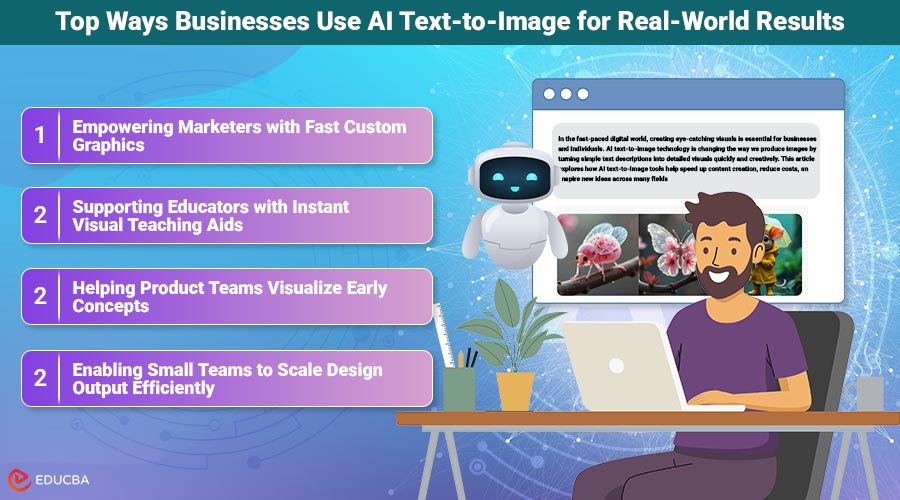
1. Empowering Marketers with Fast Custom Graphics
Marketers are constantly producing visuals for email headers, landing pages, social posts, and paid ads. AI tools reduce their reliance on static templates by enabling the dynamic creation of custom graphics with a few keystrokes. Marketers can generate seasonal themes like ‘autumn sale with falling leaves and cozy vibes’ or location-specific scenes such as ‘a rooftop café in Paris at dusk’, all on demand. This helps deliver targeted content quickly and ensures a consistent visual tone across campaigns.
2. Supporting Educators with Instant Visual Teaching Aids
Educational content becomes significantly more engaging with visuals. Teachers, trainers, and instructional designers can use AI to create context-specific illustrations, like ‘the water cycle with labeled arrows’ or ‘a medieval knight in armor’ for history lessons. This is particularly useful for remote education, where visual learning aids keep students interested. AI also helps in creating inclusive, localized visuals that represent diverse learners more accurately.
3. Helping Product Teams Visualize Early Concepts
Before prototyping or UI design begins, product teams often need to convey ideas quickly. AI-generated imagery helps teams present visual representations of new features, app screens, or even physical products. Visualizing ‘a compact wearable health device with a digital screen’ lets the team evaluate designs, gather feedback, and iterate before opening any design tools.
4. Enabling Small Teams to Scale Design Output Efficiently
For startups and small businesses, hiring full-time designers may not be feasible. AI-generated visuals bridge the gap by enabling team members to create polished, brand-aligned graphics independently. This not only reduces costs but also allows teams to act quickly, an essential trait in fast-moving markets. Whether it is for pitch decks, newsletters, or ads, AI tools provide the flexibility and speed needed to stay competitive.
Final Thoughts
AI text-to-image generators are no longer just experimental tools; they are redefining the boundaries of creative and commercial visual production. These tools empower anyone—no matter their skill level—to transform text into high-quality, personalized visuals, making design more accessible than ever before. From boosting productivity to inspiring innovation, their real-world impact spans across marketing, education, product development, and beyond. As technology advances, early adopters who integrate these tools will gain a strong competitive advantage, saving time and money while unlocking new levels of creative potential.
Recommended Articles
We hope this guide on AI text-to-image helps you enhance your visual content creation. Check out these recommended articles for more tips and insights.


