
Updated August 25, 2026
What is AI Security?
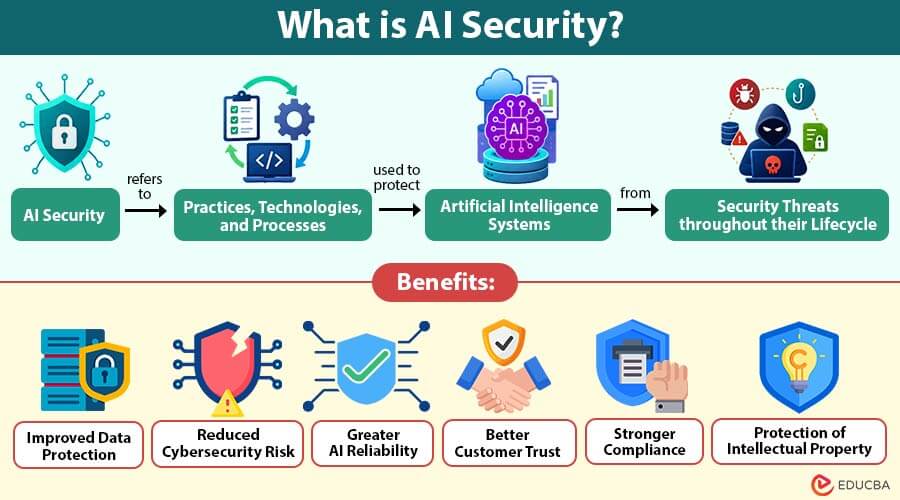
AI security refers to practices, technologies, and processes used to protect artificial intelligence systems from security threats throughout their lifecycle.
AI systems can be targeted at different stages, including data collection, model development, training, deployment, and ongoing use. Attackers may attempt to manipulate training data, steal models, extract sensitive information, bypass safeguards, or influence model outputs.
For example, an organization may use an AI chatbot to answer customer questions. If the system is not properly secured, an attacker could use specially designed prompts to make the chatbot reveal confidential information or ignore its intended restrictions.
AI security, therefore, aims to protect both the AI system and the information it processes.
Table of Contents:
Key Takeaways:
- AI Security protects sensitive data, models, applications, and users from evolving cybersecurity threats and misuse.
- Strong AI security reduces risks from prompt injection, data poisoning, model theft, and information leakage.
- Continuous monitoring, testing, access controls, and governance help organizations keep AI systems secure and trustworthy.
- Effective AI security supports compliance, protects intellectual property, strengthens reliability, and builds customer trust.
Why is AI Security Important?
The growing adoption of generative AI, machine learning, and AI-powered applications has increased the need for stronger security measures. AI systems often process large amounts of business, customer, financial, and operational data.
A security weakness in an AI application can therefore expose sensitive information or affect important business decisions.
AI security is important because it helps organizations:
1. Protect Sensitive Data
Protects sensitive business, customer, financial, and operational data from unauthorized access, exposure, misuse, and potential security breaches.
2. Prevent Unauthorized Access
It prevents unauthorized users from accessing AI models, applications, systems, and underlying data, reducing potential security threats.
3. Reduce Output Manipulation
Reduces risks from manipulated inputs and outputs, helping organizations maintain accurate, reliable, and trustworthy AI-driven decisions.
4. Protect AI Models
It protects AI models from theft, unauthorized modifications, reverse engineering, and other attacks that could compromise their functionality.
5. Detect AI Attacks
AI Security helps organizations identify, monitor, and respond to attacks targeting AI applications, models, data, and supporting infrastructure.
6. Maintain Customer Trust
Strong AI security protects customer information and demonstrates responsible AI practices, helping organizations maintain customer and stakeholder confidence.
7. Support Compliance Requirements
AI security helps organizations meet regulatory, privacy, governance, and compliance requirements associated with responsible use of artificial intelligence technologies.
Common AI Security Risks
AI systems face several threats that are different from traditional software vulnerabilities.
1. Prompt Injection
Attackers use malicious instructions to manipulate AI systems into ignoring intended rules, revealing restricted information, or performing unauthorized actions.
2. Data Poisoning
Attackers insert incorrect, biased, or malicious information into datasets, causing AI models to learn harmful patterns and produce unreliable outputs.
3. Adversarial Attacks
Attackers make carefully designed changes to inputs that cause AI models to produce incorrect classifications, predictions, or decisions, even when the inputs appear normal.
4. Model Theft
Attackers may obtain AI models through unauthorized access or repeated interactions, exposing valuable intellectual property and enabling unauthorized replication or analysis.
5. Sensitive Data Leakage
AI applications can accidentally expose confidential customer, financial, business, or proprietary information through prompts, datasets, logs, responses, or inadequate security controls.
6. Model Manipulation
Attackers may modify AI models, configurations, APIs, or deployment resources, potentially changing system behavior and creating inaccurate, unsafe, or harmful outcomes.
Key Components of AI Security
An effective AI security strategy should cover the complete AI lifecycle.
1. Data Security
Organizations should protect the data used to train, test, and operate AI systems. Organizations should validate, classify, encrypt, and restrict access to data to authorized users.
2. Model Security
AI models should be protected from unauthorized access, modification, extraction, and tampering. Organizations should also maintain secure model repositories and controlled deployment processes.
3. Application Security
AI applications and APIs should follow secure development practices. Authentication, authorization, input validation, rate limiting, and monitoring can help protect AI applications.
4. Access Control
Users and applications should receive only the permissions required to perform their tasks. Role-based or attribute-based access controls can help limit unauthorized access to AI resources.
5. Monitoring and Detection
Continuous monitoring can help identify unusual prompts, suspicious requests, abnormal API usage, unexpected model behavior, and potential attacks.
6. Governance
AI governance establishes policies and responsibilities for developing, deploying, monitoring, and securing AI systems. It can help organizations maintain accountability and manage security risks throughout the AI lifecycle.
Best Practices for AI Security
Organizations can adopt several practices to strengthen AI security.
1. Secure the AI Lifecycle
Consider security during data preparation, model development, testing, deployment, and maintenance rather than adding it after deployment.
2. Protect Sensitive Data
Avoid exposing confidential information in prompts, training datasets, logs, and model outputs.
3. Apply Strong Access Controls
Restrict access to models, datasets, APIs, development environments, and administrative functions.
4. Test AI Models Regularly
To find vulnerabilities like adversarial manipulation, prompt injection, and data leaking, conduct security testing.
5. Monitor AI Activity
Track unusual user behavior, unexpected outputs, excessive API requests, and other indicators of potential attacks.
6. Validate Training Data
Use trusted sources and implement quality checks to reduce the risk of data poisoning and unreliable model behavior.
7. Secure Third-Party AI Services
Evaluate the security practices, data handling policies, and access controls of external AI providers and tools.
Benefits of AI Security
A strong AI security strategy provides several benefits.
1. Improved Data Protection
AI Security protects confidential business and customer information from unauthorized access, misuse, and accidental exposure.
2. Reduced Cybersecurity Risk
AI-specific security measures identify and address threats that traditional cybersecurity tools may not effectively detect.
3. Greater AI Reliability
Regular testing and monitoring help detect unexpected model behavior, improving AI system accuracy, stability, and reliability.
4. Better Customer Trust
Secure AI applications demonstrate responsible information handling, helping organizations build stronger customer confidence and long-term relationships.
5. Stronger Compliance
Security and governance controls help organizations meet applicable privacy, cybersecurity, regulatory, and AI-related compliance requirements.
6. Protection of Intellectual Property
Securing proprietary models, datasets, algorithms, and applications protects valuable organizational assets from theft, misuse, and unauthorized access.
Challenges of AI Security
Despite its importance, implementing AI security can be challenging.
1. Rapidly Evolving Threats
The rapid evolution of AI technologies and attack techniques makes it challenging for security teams to recognize and counter new threats.
2. Complex AI Infrastructure
AI systems depend on models, datasets, APIs, cloud platforms, and third-party components, creating multiple security risks.
3. Unpredictable Model Behavior
AI models may produce unexpected outputs when exposed to unusual, manipulated, or previously unseen inputs.
4. Limited AI Security Expertise
Organizations may struggle to find professionals with strong knowledge of both artificial intelligence and cybersecurity.
5. Data Privacy Concerns
AI systems often process sensitive information, increasing the risk of unauthorized access, exposure, misuse, or accidental data leakage.
6. Continuous Monitoring Requirement
AI systems require ongoing testing, monitoring, and security updates to identify vulnerabilities and respond effectively to emerging risks.
Final Thoughts
AI Security protects AI systems, models, data, applications, and users from evolving threats and misuse. Organizations should combine secure development, data protection, access controls, model testing, monitoring, governance, and incident response. Integrating security throughout the AI lifecycle reduces risk, protects sensitive information, supports compliance, and builds trustworthy, resilient, and responsible AI systems.
Frequently Asked Questions (FAQs)
Q1. Which AI systems require security measures?
Answer: Machine learning models, generative AI applications, chatbots, recommendation systems, computer vision solutions, AI agents, and other systems that process or generate data require appropriate security measures.
Q2. Can AI security prevent all AI-related attacks?
Answer: No. AI Security cannot eliminate every threat, but layered controls, continuous testing, monitoring, and incident response can significantly reduce the likelihood and impact of attacks.
Q3. What role does encryption play in AI security?
Answer: Encryption helps protect sensitive data while it is stored or transmitted, reducing the risk of unauthorized parties accessing information used by AI systems.
Q4. How can organizations secure AI APIs?
Answer: Organizations can secure AI APIs through authentication, authorization, rate limiting, input validation, encryption, activity monitoring, and careful management of API credentials.
Recommended Articles
We hope that this EDUCBA information on “AI Security” was beneficial to you. You can view EDUCBA’s recommended articles for more information.


