


Updated September 11, 2026
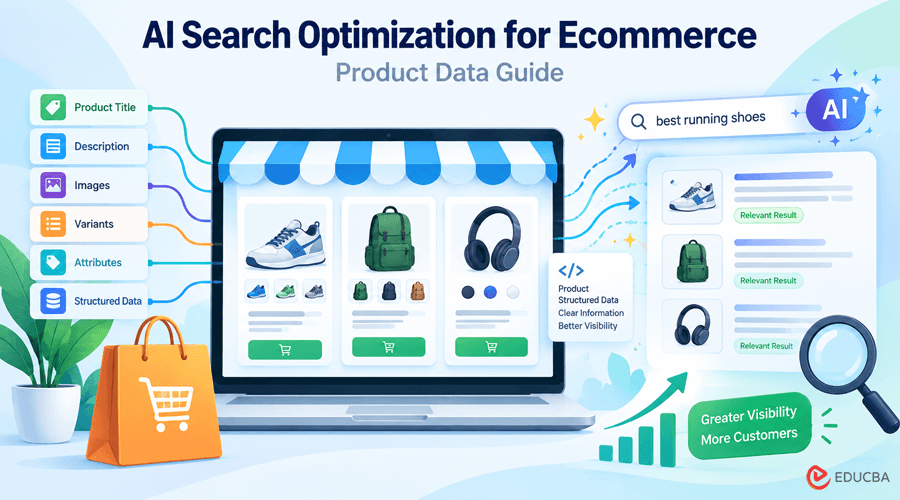
AI-driven search is revolutionizing product discovery. People can now ask detailed questions and get direct recommendations instead of typing short keywords and viewing dozens of links. This shift makes AI search optimization for ecommerce increasingly important for online retailers.
High-quality product data is at the center of this transition. Search systems may struggle to interpret product information when it is incomplete, unclear, or conflicting. By optimizing product titles, descriptions, specifications, variants, structured data, and availability, ecommerce businesses can make their products easier for AI-powered search systems to understand.
Why Product Data Matters for AI Search?
Traditional SEO strategies tend to be keyword-based, ranking-oriented, and focused on page optimization. AI search optimization for ecommerce takes this a step further because AI systems need to understand the semantics, context, and relationships behind product information.
Google’s ecommerce guidelines recommend sharing product data and using structured data to help search systems understand ecommerce pages.
This means product titles, descriptions, prices, availability, variants, specifications, and reviews should communicate consistent information about a product. Clear and accurate data gives search engines stronger signals to match products with relevant shoppers and product-related questions.
Write Product Titles That Say Something Useful
The product name should immediately tell you what the product is. Do not keyword it or fill it with general jargon.
The title should be stronger and often include the following: Product type, brand or model if applicable, and a significant distinguishing characteristic. A store might, for instance, have a category of “Best Amazing Shoes for Everyone,” but could use “Men’s Waterproof Hiking Shoes or Lightweight Trail Shoes.”
This way, customers and search engines can better understand the product without interpreting hyperbole.
Make Descriptions Easy to Understand
Product descriptions should answer the questions potential buyers are likely to ask. What is the product used for? Who is it designed for? What does it contain? How is it different from similar products? Are there any limitations or compatibility requirements?
Avoid relying on vague phrases such as “premium quality” or “perfect for everyone.” Instead, provide specific and verifiable information.
For example, if a product is waterproof, state its relevant waterproof rating or describe the conditions it is designed to withstand. Include details such as:
- Material
- Size
- Capacity
- Weight
- Compatibility
- Intended use
- Important limitations
The goal of AI search optimization for ecommerce is to provide search systems with factual information they can understand and use when responding to product-related queries.
Ensure Structured Data is Accurate
Structured data provides information in a format that search engines can read. Google provides structured data for products, offers, and reviews.
Shopify also offers structured data for product objects, such as support for product variants.
Verify that structured data matches how the page appears to customers. If a product is out of stock but the data indicates it is in stock, it can confuse customers and reduce data quality.
Treat Variants as Real Product Information
Product variations can significantly affect whether an item matches a shopper’s search. Customers may search specifically for a particular color, size, material, capacity, or model.
Do not describe these differences only in general terms or hide them entirely in dropdown menus and product images.
For example, if a product is available in 500 ml and 1-liter versions, the product data should clearly represent the capacity. Similarly, each size should have accurate availability and pricing information.
Modern ecommerce platforms such as Shopify support product-level information including variants, pricing, inventory, media, SEO metadata, product categories, and availability. Managing these details accurately can strengthen the overall product data foundation.
For effective AI search optimization for ecommerce, each important variant should have a clear, meaningful identity so search systems can distinguish between different versions of the same product.
Use Questions and Answers
Shoppers often search for answers to specific questions, such as:
- Is this compatible with a particular device?
- Can it be used outdoors?
- What size should I choose?
- Is this material suitable for sensitive skin?
- How much weight can it support?
Frequently asked questions and product-specific Q&A content can help address these needs directly. Google’s Merchant API also supports product question-and-answer data, including fields for product-related questions and answers.
Keep answers factual, concise, and relevant. Avoid subjective claims and overly promotional responses.
Providing clear answers can also support AI search optimization for ecommerce by giving search systems additional context about how, where, and for whom a product is suitable.
Keep Your Product Data Consistent
Suppose a product page indicates a jacket can be purchased in 3 colors and another indicates a jacket can be purchased in 5 colors. One page mentions that the item weighs 800 grams, and another page mentions 1 kilogram. Product information can be more ambiguous at a smaller scale.
Create a trusted data source for your catalog and review key fields regularly. Google now offers product data through Merchant Center and its Merchant API, which also includes updates to product information and catalog management.
Maintain consistency across your website, product feeds, structured data, marketplaces, and other sales channels. This is a foundation of effective AI search optimization for ecommerce.
Build for Search Beyond Keywords
AI search does not eliminate the need for good old-fashioned SEO. It changes what strong optimization means. Instead of simply asking where to put their keyword, ecommerce teams should also ask, “Can a search system clearly understand this product?”
This is where AEO for Shopify can come into play. It is about making product information clear, structured, complete, and easy to interpret for answer-focused search experiences.
Final Thoughts
Optimizing ecommerce product data for AI search is not simply about keyword stuffing. It is about improving the quality and clarity of the information behind each product.
Clear titles, helpful descriptions, accurate structured data, complete variants, authentic reviews, and consistent availability give search systems stronger signals. As AI-powered product discovery evolves, merchants with accurate, well-structured catalogs will be better positioned to appear when shoppers search with conversational, detailed queries.
A strong AI search optimization strategy for ecommerce starts with a simple principle: make every important piece of product information clear, accurate, consistent, and useful.
Frequently Asked Questions (FAQs)
Q1. What is AI search optimization for ecommerce?
Answer: It involves structuring product information and data, so AI-powered search systems can understand products and match them to relevant customer queries.
Q2. Will structured data bring more traffic to your ecommerce site?
Answer: Yes. Structured data can provide product information for search engines and help meet eligibility requirements for certain search features, but Google cannot guarantee enhanced results.
Q3. What information would merchants want to know?
Answer: Pay attention to the correct title, description, price, availability, variants, specifications, photos, reviews, and other key information to help consumers learn about products.
Q4. Do traditional marketing strategies for SEO still make sense?
Answer: Yes. While most existing search basics still apply, AI search also relies heavily on existing search concepts, so it is still important to do strong technical SEO, create helpful content, and make product pages easy to find.
Q5. How often should the product data on ecommerce be updated?
Answer: Keep it updated whenever important information changes, such as price, stock, variants, specifications, or product availability. Standard catalog checks can also catch inconsistencies early, before they grow and become issues.
Recommended Articles
We hope this guide helps you understand AI search optimization for ecommerce and improve your product data for AI-powered discovery. Explore our recommended articles for more insights on ecommerce SEO, structured data, AI search, product optimization, and online visibility.


