


Introduction to AI in Product Management
If you are considering a product management course, it is crucial to understand how artificial intelligence (AI) is transforming the sector. The new-age product managers are far different from those of the past; they may no longer be seen only as strategists or coordinators but have become tech-savvy maestros equipped with AI-enabled tools to arrive at smarter decisions, faster. Institutions like SPJain have incorporated AI in product management curriculum, preparing the next generation of product managers to harness the power of these new-age technologies.
Artificial intelligence has influenced almost every industry, including product management. AI tools like ChatGPT help product managers discover market trends, capture customer feedback, and decide on features. In this post, we will explore how AI in product management is reshaping the field. By taking a popular Product Management course, you can significantly improve your position.
AI in Product Management: A Deeper Dive
Being a product manager has always required a combination of creativity, analytics, and leadership. However, AI in product management is quickly expanding these capabilities by automating redundant tasks, offering data-driven insights, and enabling personalized customer interactions.
AI tools such as ChatGPT by OpenAI provide natural language processing features, which make it easier for product managers to interact with data and team members in a more human-like manner. One example is creating product requirement documents, user stories, or writing customer conversations. Many of these tasks can be handled by a chatbot like ChatGPT, making them time savers.
Revolutionizing Product Management with ChatGPT
In the realm of AI in product management, ChatGPT stands out as a conversational AI that acts as a versatile assistant to product managers. Here is how it is changing the game:
Enhanced Market Research
It is a slow process to research the market. You can use ChatGPT to analyze massive datasets, summarize reports, or craft competitor analysis faster. This allows product managers to directly ask questions about a discussion and get deeper insights that will help them better understand the needs of the market faster.
Streamlining Communication
Product managers have a lot to balance, including their development team, marketing department, sales teams, and customers. It could help in drafting emails, meeting agendas, status updates, etc., contextualizing the messages, thereby leading to clear and concise communication. You can also translate tech into architecture to speak to different audience types, such as business jargon.
Generating Product Documentation
Writing specs, user stories, and test cases is such a drag. ChatGPT helps draft these documents with high-level inputs, reducing the development time from concept to ship. It means that product managers can spend more time on strategic decisions.
Customer Support and Feedback Analysis
Product feedback analysis is crucial for improving any product. AI-powered tools like ChatGPT can quickly go through large volumes of feedback from surveys, reviews, and social media to spot common issues and discover what features customers are asking for.
Why Learning AI in Product Management Courses Matters?
The tools and techniques of AI are now integral to modern product workflows. Therefore, pursuing a product management course that covers AI in product management is essential. Institutions like SPJain include AI and data analytics as core components of their curriculum. These courses blend theory with hands-on experience, enabling students to apply AI-powered tools to real-world product challenges practically.
Students in SPJain learn to apply AI-powered software in hands-on class experiences and get their hands dirty with case studies and real-life projects. This sets the stage for students to step into the modern era of digital transformation and create new things in their roles.
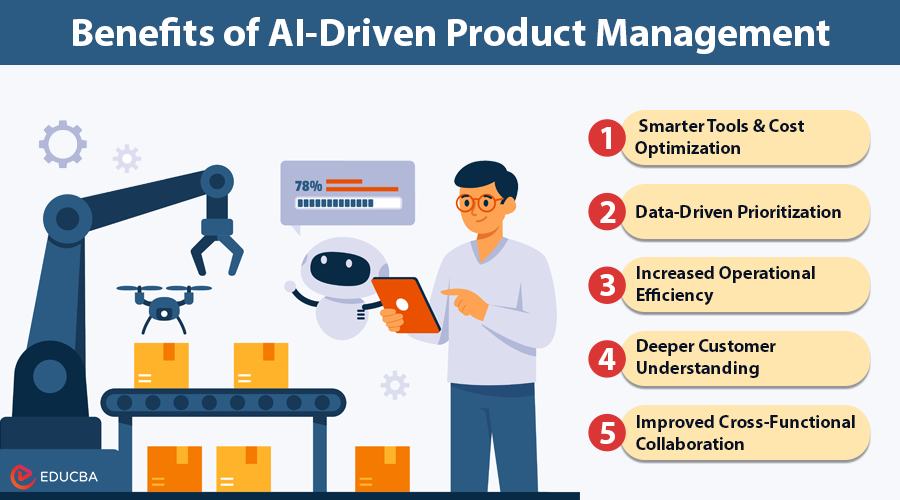
Benefits of AI-Driven Product Management
When you integrate AI in product management, a wide range of tangible benefits emerge across tools, processes, efficiency, and collaboration:
1. Smarter Tools and Cost Optimization
AI-powered tools enable the creation of intelligent wireframes that align closely with product features, helping drive more effective stakeholder conversations. For teams with a budget, AI also simplifies rapid prototyping, speeding up validation without excessive costs.
2. Data-Driven Prioritization
With AI in product management, decision-making becomes far more objective. Product managers can use data-driven insights to prioritize features, roadmap items, and user stories, eliminating guesswork and focusing on what truly matters to customers.
3. Increased Operational Efficiency
AI automates time-consuming and repetitive tasks like writing documentation, summarizing user feedback, or generating test cases. This allows product managers to focus on high-impact activities such as strategy, ideation, and creative problem-solving.
4. Deeper Customer Understanding
AI tools enable advanced behavioral analytics and sentiment analysis, helping product managers better understand customer needs, motivations, and pain points. This leads to the development of more user-centric, targeted, and relevant products.
5. Improved Cross-Functional Collaboration
AI facilitates clearer, more contextual communication across departments—whether it is translating technical jargon for business teams or creating unified project updates. This reduces misunderstandings, enhances alignment, and accelerates the development cycle.
Challenges and Ethical Considerations
Even though AI is extremely powerful, it has its major challenges, including data privacy concerns, algorithmic bias, and overuse of automation that product managers need to be watchful about. Companies can establish guidelines that require transparency with customers about AI usage and regularly verify the fairness and accuracy of AI-generated outputs.
Future Trends for AI in Product Management
AI innovation is actively shaping the future of product management. Here is what to expect:
- Smarter predictive tools: AI systems that forecast customer demand and market shifts with increasing accuracy.
- Agile integration: Tighter AI integration into Agile workflows and project management platforms.
- Personalized experiences: Hyper-customized products through advanced segmentation and predictive modeling.
Aspiring and current product managers who stay updated on these trends and who invest in specialized courses covering AI in product management will remain well ahead of the curve.
Final Thoughts
If you want your career to thrive in the digital landscape, investing in a product management course that focuses on AI in product management can be a game-changer. ChatGPT-level tools are already transforming how products are created, iterated, and improved. Thanks to educational powerhouses like SPJain stepping in, you can even learn them, and never fall behind in product management.
Recommended Articles
We hope this guide on AI in product management was insightful. Explore related articles on emerging AI tools for product managers, the role of machine learning in product lifecycle management, and top courses to master AI-driven product strategies.


