


Updated June 3, 2026
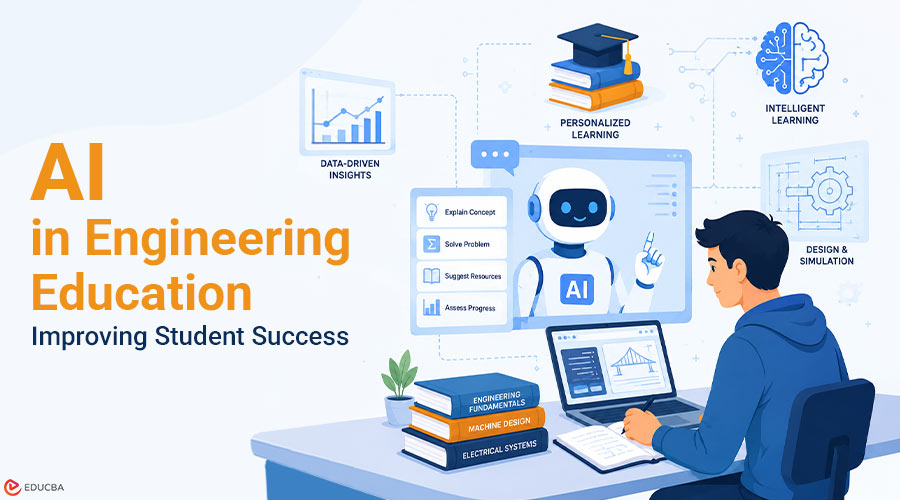
Artificial Intelligence (AI) is rapidly transforming the education industry, especially in technical and engineering fields. Traditional learning methods are now being enhanced with intelligent technologies that help students learn more efficiently, access personalized support, and improve problem-solving skills. As a result, AI in engineering education is reshaping how students study, interact with learning materials, and receive academic guidance. From virtual tutors and adaptive learning platforms to AI-powered simulations and automated assessments, technology is making education more flexible and accessible for students worldwide.
The Rise of AI in Engineering Education
AI is no longer limited to industries like robotics, automation, and software development. Many educational institutions and e-learning platforms are adopting AI-driven tools and technologies to enhance student learning and academic performance.
Platforms such as Coursera and edX use AI-driven recommendation systems to personalize courses and suggest learning paths based on student interests and performance. This shift is particularly important in engineering education because engineering subjects often involve complex mathematical models, analytical thinking, and technical problem-solving.
Personalized Learning Experiences
One of the biggest advantages of AI in online learning is its ability to personalize learning. Each student learns at their own pace and has a distinct learning style. AI systems can analyze student behavior, identify weaknesses, and provide customized recommendations to improve understanding.
For example, engineering students struggling with subjects like calculus, thermodynamics, structural analysis, or circuit theory can receive targeted learning materials and practice exercises tailored to their needs. Adaptive learning platforms also allow students to revisit difficult topics multiple times without feeling pressured by classroom pace limitations.
AI-Powered Tutoring and Academic Support
Online tutoring platforms are becoming increasingly important for engineering students who require additional academic guidance outside traditional classrooms. My Engineering Buddy provides online engineering tutoring and homework help services for students studying various engineering disciplines. Personalized tutoring provides students with one-on-one assistance with assignments, projects, and technical subjects.
Similarly, My Physics Buddy supports students who need help understanding difficult physics concepts that form the foundation of many engineering courses. Topics such as mechanics, electromagnetism, thermodynamics, and modern physics become easier to understand with expert guidance and structured learning support. AI tools enable tutors to track student progress and pinpoint areas that may require extra support.
Virtual Labs and Simulations
Engineering education heavily relies on practical learning and experimentation. However, physical laboratories can sometimes be expensive or inaccessible for remote learners. AI-powered virtual labs and simulation tools are helping solve this challenge. Students can now perform engineering experiments, visualize scientific concepts, and simulate real-world systems from anywhere.
Platforms such as MATLAB enable students to perform simulations, analyze engineering data, and solve computational problems efficiently. Interactive tools such as PhET Interactive Simulations help students understand difficult physics and engineering concepts through visual experimentation and interactive learning. By offering interactive, hands-on experiences, these technologies enhance student engagement and support a deeper understanding of complex concepts.
AI Tools Are Improving Productivity
Modern AI tools are helping engineering students save time and improve academic productivity. Students now use AI for:
- Solving equations
- Generating coding examples
- Summarizing technical content
- Creating study notes
- Understanding complex derivations
- Performing data analysis
Students widely use tools like OpenAI and Wolfram Alpha for technical learning and problem-solving. By automating repetitive tasks, AI allows students to focus more on creativity, innovation, and deeper conceptual learning.
Challenges and Ethical Concerns
Despite its benefits, AI in education also raises several concerns. Overdependence on AI-generated answers may reduce independent critical thinking if students use these tools irresponsibly. Educational institutions are also facing challenges related to plagiarism, academic integrity, and fair evaluation methods.
Students should use AI as a learning assistant rather than a shortcut to bypass genuine understanding. Another concern is accessibility. Access to high-speed internet, modern devices, and advanced educational technologies is not equally available to all students.
The Future of AI in Engineering Education
The future of engineering education will likely combine traditional teaching methods with AI-powered learning systems. Teachers, tutors, and AI tools will work together to create more efficient and personalized educational experiences.
AI will not replace educators, but it will continue to enhance learning by improving accessibility, flexibility, and engagement. Students who effectively use AI-powered educational resources will likely gain significant advantages in technical understanding and career preparation. As technology continues to evolve, engineering students will increasingly rely on digital learning platforms, virtual collaboration, and intelligent tutoring systems to succeed in an increasingly competitive world.
Final Thoughts
AI in engineering education is changing the way students learn, practice, and develop technical skills. From adaptive learning systems and AI-powered tutoring to virtual simulations and advanced productivity tools, technology is making education more interactive and accessible. Platforms like My Engineering Buddy and My Physics Buddy demonstrate how online academic support services are evolving alongside AI-driven education to help students better understand concepts in engineering and physics. As AI technology advances, engineering education is expected to become increasingly personalized, flexible, and student-centered.
Recommended Articles
We hope this guide on AI in engineering education has helped you understand how intelligent technologies are transforming learning experiences. Explore the recommended articles below for more expert insights and educational resources.


