


Introduction of AI-Enhanced Virtual Reality
Training employees can often feel like an endless challenge. Traditional methods frequently struggle to keep workers engaged or help them retain the knowledge they have gained. Many business owners worry that their current training programs are not equipping staff for real-world tasks, which is where AI-Enhanced Virtual Reality Training can make a significant difference.
Here is the good news: technology is transforming employee training. AI-enhanced virtual reality training combines intelligent learning tools with immersive, realistic simulations to provide practical, hands-on experiences. In this blog, we will explore how this innovative approach helps businesses build stronger, more skilled teams while overcoming common training challenges.
How AI-Enhanced Virtual Reality Training Improves Employee Learning?
AI sharpens virtual reality by making training smarter and more precise. It adapts on the fly, keeping employees focused and improving their skills.
1. AI-driven personalization in VR training
AI-Enhanced Virtual Reality Training customizes sessions to each employee’s specific needs. It adjusts scenarios based on skill levels, roles, and learning styles. For instance, a new retail staff member might practice handling customer complaints, while an experienced employee hones upselling techniques.
This focused method saves time by skipping material that an individual already understands. Businesses adopting such innovations often rely on trusted IT experts like forit.ca to ensure smooth integration and reliable system performance. Personalized training drives faster learning and retains knowledge longer. Real-time feedback and performance analysis make these tailored experiences even more efficient.
2. Real-time feedback and performance analysis
Real-time feedback helps employees recognize mistakes as they occur, allowing them to correct them promptly. Instead of waiting for a review, workers receive guidance during their AI-Enhanced Virtual Reality Training sessions. For example, virtual reality can notify an employee if they use the wrong technique in a medical procedure simulation.
Performance analysis monitors progress using data collected throughout each session. It identifies areas that need improvement and emphasizes strengths for every individual. For instance, customer service trainees can review their response times or tonal consistency in simulated interactions. These findings make it simpler to focus on areas that need improvement without losing valuable training time. Keeping these systems secure and optimized with IT managed by FTI further ensures that VR platforms deliver consistent, effective results.
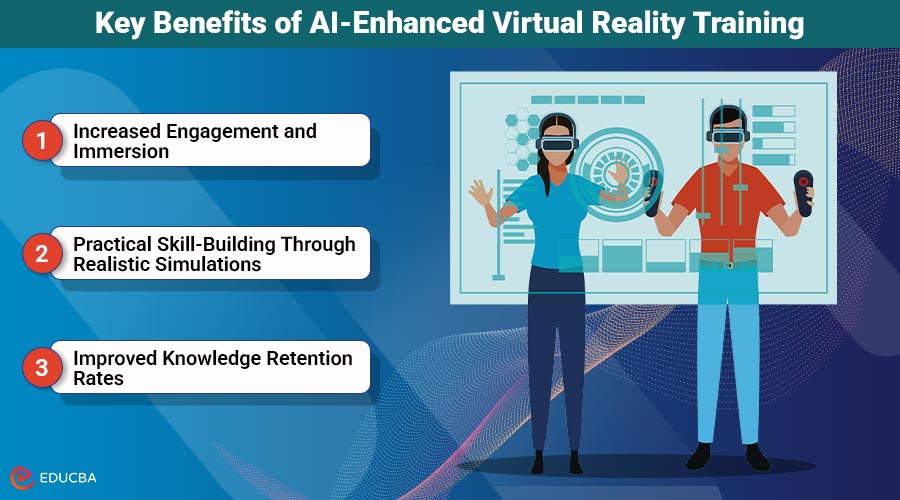
Key Benefits of AI-Enhanced Virtual Reality Training
Employees learn more effectively when training feels authentic and relevant. AI in VR makes practice more engaging and effective.
1. Increased engagement and immersion
AI in virtual reality training creates realistic simulations. These environments keep employees attentive and engaged. Workers interact with scenarios that mirror real-world challenges, making the experience more engaging than traditional methods. Customized content aligns with skill levels or job roles, keeping learners driven. Striking visuals and interactive elements ensure a stronger connection to tasks at hand. This method encourages active learning while maintaining focus longer than passive lessons like slide decks or videos.
2. Practical skill-building through realistic simulations
Realistic simulations turn theory into practice. AI-Enhanced Virtual Reality Training allows employees to perform tasks in lifelike, controlled environments without real-world risks. Workers can practice handling machinery or responding to emergencies as if they were on the job. Mistakes, instead of costing money or causing harm, become growth opportunities.
AI assesses every action during these exercises. It adjusts scenarios to challenge users and enhance specific skills over time. For example, retail staff can rehearse customer interactions while facing different simulated personality types, as generated by AI. Healthcare trainees can refine surgical techniques with steady guidance from virtual systems that monitor their precision.
Practice does not make perfect; it makes permanent. VR training ensures those practices remain effective where they matter most: on the job.
3. Improved knowledge retention rates
AI-Enhanced Virtual Reality Training helps employees learn and retain information more effectively. Interactive simulations replicate real-world scenarios, training the brain through practice instead of passive learning. This practical approach reinforces memory pathways.
Interactive training tools driven by AI adjust to individual learning speeds. Employees repeat tasks as necessary until concepts are fully grasped. Digital environments also minimize distractions commonly found in traditional settings, maintaining focus and enhancing retention.
Real-World Applications of AI-Enhanced VR Training
Companies are using AI-enhanced virtual Reality Training to prepare employees for high-pressure environments without actual risks. This method equips workers for challenges they might encounter on the job, fostering confidence and ability.
1. Healthcare and medical training
Doctors and nurses can practice life-saving procedures using AI-enhanced virtual reality training. These simulations allow hands-on experience without risking patient safety. For instance, trainees might perform a virtual surgery guided by real-time feedback from AI systems.
This method sharpens their skills while building confidence. Emergency scenarios like strokes or cardiac arrests become approachable through VR-based training. Medical staff can repeatedly tackle complex situations until they master them. Such digital training reduces errors and improves preparedness during critical moments in real-world settings.
2. Manufacturing and industrial operations
AI-Enhanced Virtual Reality Training simplifies workforce development in manufacturing. Employees train on tasks like machine operation, assembly line procedures, and equipment maintenance through interactive simulations. Virtual environments replicate real-world factory settings, minimizing risks and operational downtime during skill development.
Simulated scenarios prepare workers for hazards without endangering lives or equipment. AI monitors performance data to pinpoint areas needing improvement, delivering immediate and useful feedback. This method enhances knowledge retention while ensuring accuracy in practical skill-building activities.
3. Retail and customer service training
Retail employees can practice addressing customer complaints with AI-enhanced virtual reality training. Interactive training aids them in enhancing communication and problem-solving skills under pressure. For example, a virtual reality program might mimic a busy store during holiday sales.
Customer service staff grow by navigating various scenarios in a risk-free setting. Artificial intelligence offers immediate feedback, helping workers recognize their strengths and areas needing improvement. This method not only fosters confidence but also ensures better readiness for real-world challenges.
Challenges and Considerations
Adopting AI-Enhanced Virtual Reality Training presents challenges that can give even experienced professionals reason to pause and plan carefully.
1. High initial investment in AI and VR technology
AI-powered virtual reality tools demand a hefty upfront cost. Purchasing advanced headsets, software, and hardware can strain budgets in the early stages. Allocating resources for these digital training technologies can be challenging for small businesses.
Building realistic simulations adds another layer of expense. Custom content creation designed for specific industries takes time and expertise. These costs prompt some business owners to pause before fully committing to experiential learning solutions.
2. Content creation and customization requirements
Crafting content for AI-Enhanced Virtual Reality Training demands precision. Developers must create realistic simulations specific to industries like healthcare, retail, or manufacturing. Organizations implementing these solutions often need to identify the best virtual IT training labs that provide robust authoring tools, support complex multi-vendor environments, and can scale across different learning modalities.
Personalization also plays an important role in addressing workforce diversity. Employees differ in learning speeds and styles, so programs should adapt accordingly. AI-driven systems can adjust VR scenarios based on real-time feedback to meet individual needs. Businesses investing in such solutions often enhance employee productivity while reducing long-term training costs.
Final Thoughts
AI-Enhanced Virtual Reality Training is revolutionizing employee development by combining immersive simulations with intelligent learning tools. This approach enables employees to practice real-world tasks in a safe and controlled environment, thereby improving engagement, confidence, and knowledge retention.
Although implementing AI-enhanced VR training requires investment and careful content creation, the long-term benefits far outweigh the costs. Businesses across healthcare, manufacturing, retail, and customer service are already seeing improved performance, reduced errors, and a more skilled, prepared workforce.
Recommended Articles
We hope this guide on AI-enhanced virtual reality training was helpful. Explore related articles on employee engagement strategies, immersive learning technologies, and practical training tips to gain deeper insights into building a more skilled and confident workforce.


