


Updated May 28, 2026
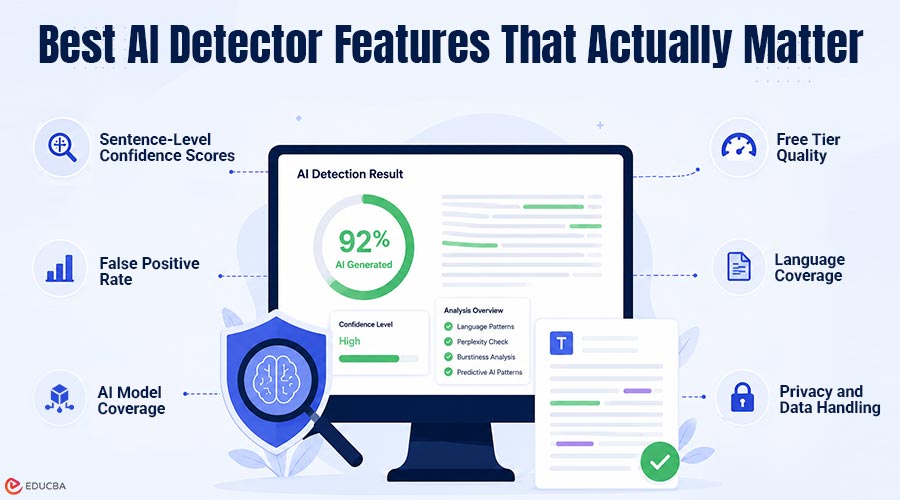
The best AI detector features in 2026 go far beyond a simple percentage score. Current AI models, including GPT-5 and Claude, maintain a low false-positive rate and never store your submitted text. A single overall percentage is less useful than knowing which specific sentences were flagged and why. Look for explainability, not a headline accuracy number.
What Should You Look for in an AI Detector?
Most AI detectors compete on one number: claimed accuracy. The problem is that vendor-sourced accuracy claims are rarely reproducible outside controlled conditions. Fritz.ai’s 2026 analysis found that Originality.ai catches only 31.7% of GPT-5 content in real-world conditions, despite claiming higher rates. GradPilot’s 2026 false positive comparison found that a tool can be 96% accurate at detecting AI-written text while still wrongly flagging 1 in 10 human essays. Those are separate metrics. A headline accuracy number does not tell you which headline the vendor optimized.
The AI detector features that actually predict whether a tool is useful are:
- Sentence-level output (can you see which lines were flagged, not just a score?)
- False positive rate (how often does it flag human writing as AI?)
- Model coverage (does it cover GPT-5, Claude, Gemini, Llama, and Mistral, not just GPT-3.5?)
- Privacy (Is your text stored, sold, or used for training?)
- Free-tier quality (is the free scan genuinely usable, or just a teaser?)
The rest of this article walks through each feature, explains what separates good implementations from weak ones, and shows how Quetext addresses each.
Best AI Detector Features That Actually Matter
The most effective AI detector features focus on:
1. Sentence-Level Confidence Scores
A document-level score tells you a percentage. A sentence-level score tells you where the problem is. Here is the practical difference. A 500-word essay comes back with a 17% AI detection score. With a document-level result, you see “17% AI” and do not know whether that means two suspicious sentences or seventeen evenly distributed phrases. You can not fix it precisely because you do not know what to fix. With sentence-level output, you can see that the system flags three specific sentences with AI confidence scores of 91%, 88%, and 83%. The other 22 sentences are clean. You rewrite those three sentences.
Quetext’s AI Detector uses ColorGrade scoring to flag individual sentences rather than returning a single score for the entire document. Red-highlighted sentences are the high-confidence flags: the priority rewrite targets. Orange-highlighted sentences are lower-confidence matches: worth reviewing but not necessarily changing. The visual breakdown makes the report scannable in seconds. Tools that return only a document-level percentage are genuinely less useful for writers trying to fix flagged content. The percentage tells you something is wrong. The sentence-level breakdown tells you what.
2. Detection Accuracy and the Accuracy Claim Problem
Every major detector claims accuracy rates between 97% and 99%. Independent testing consistently shows lower real-world performance, particularly on content from the most recent AI models. The gap exists for two reasons. First, vendors usually measure their accuracy claims on clearly AI-generated text with no editing. Real-world AI use involves paraphrasing, revision, and the mixing of AI-generated passages with human-written ones. Second, GPT-5, Claude 3.7, and Gemini Advanced produce text that is harder to detect than earlier models because it is more varied in structure and rhythm.
Detection accuracy on the most recent model outputs ranges from 55% to 80% across tools in 2026 independent benchmarks. That range means some AI-generated content will get through any detector. The honest positioning for any tool: accuracy on heavily edited or humanized content is uncertain. What matters more is whether the tool gives you enough information to investigate uncertain cases. Sentence-level confidence scores and specific source flags matter more than a headline number that does not hold in the field.
3. False Positive Rate
A false positive is a human-written passage flagged as AI-generated. For teachers making academic integrity decisions, a false positive from an AI detector can result in a student being incorrectly accused of cheating. The consequences can be serious. False positive rates vary significantly by writer profile. Studies from 2025 and 2026 show that non-native English speakers face false-positive rates of 28-61% depending on the tool, because controlled grammar structures and predictable sentence patterns overlap statistically with AI output. Neurodivergent writers with structured or repetitive syntax face similar elevated rates.
Writers whose style is naturally formal, technical, or consistent also trigger higher false positive rates. The detector’s model treats variation as a signal of human authorship. Writers who do not vary their style look, statistically, more like AI. This is why no teacher or institution should use a single detector score as the sole evidence in an academic misconduct case. The score is a signal, not a verdict.
- For students: A sentence-level output from Quetext gives you specific flagged passages to discuss with your instructor rather than an unexplained percentage. That specificity matters when the flag is wrong.
- For teachers: If a tool can not show you which sentences it flagged and why, its results are harder to defend. Explainability is not a nice-to-have for institutional use.
4. AI Model Coverage
Model coverage determines whether a detector can flag content from the AI tools people actually use. A detector trained primarily on GPT-3.5 data will miss content generated by GPT-5, Claude 3.7, or Gemini Advanced because the output patterns differ.
The models worth checking for:
- ChatGPT (GPT-3.5, GPT-4, GPT-5)
- Claude (Anthropic)
- Gemini (Google, including Gemini Advanced)
- Llama (Meta)
- Mistral
GPT-5 and Claude 3.7 are the detection challenge of 2026. Both produce significantly more naturalistic text than their predecessors. Tools that have not updated their training data since 2024 will underperform on these outputs. Quetext AI Detector covers ChatGPT, GPT-5, Claude, Gemini, Llama, and Mistral in a single scan. Model coverage is listed on the product page and updated as new models are released.
5. Combined AI Detection and Plagiarism Checking
AI detection and plagiarism checking are usually treated as separate decisions. In practice, most teachers and editors run both checks on every document. A student might use an AI tool to paraphrase a source without citing it, producing content that is both AI-generated and plagiarized. A single scan that returns both results is more efficient than two separate tools.
Most tools in this space offer one or the other. GPTZero is an AI detector; Turnitin started as a plagiarism checker and later added AI detection. Running both requires switching platforms or paying for two subscriptions. Quetext runs both checks in one scan. The same document returns an AI detection result and a plagiarism similarity score through DeepSearch’s contextual analysis. For teachers reviewing submissions at volume, that is one fewer tool to manage per paper.
6. Privacy and Data Handling
A recurring question in teacher forums and professional communities: Does the AI detector store the text you submit? The concern is practical. Students submitting unpublished essays, professionals checking confidential documents, and content teams reviewing proprietary work are all submitting text they have not made public. Privacy policies vary significantly across tools. Some tools store submitted text to improve their detection models. Others are unclear about retention practices. A few are explicit.
Quetext does not store submitted text, sell user data, or use scanned content for model training. The system processes the text and returns the results. That policy is stated directly on the product page, not buried in a privacy policy. For institutional use, data handling is often a procurement requirement. Schools and companies evaluating tools for wide deployment need explicit answers about text retention before they can approve them. An unclear privacy policy is a barrier to adoption, not just a user concern.
7. Free Tier Quality
The free tier determines whether students and occasional users can actually use the tool without friction. A free tier that limits scans to 100 words or requires a credit card is, in effect, a marketing page rather than a working product.
What a genuinely usable free tier needs:
- Enough words to scan a full short essay (at minimum 500 words; ideally more)
- No credit card required to run the first scan
- Full detection capability (not a degraded result reserved for paid accounts)
Quetext’s free tier scans up to 2,000 words, and no account is required for the first check. That covers a standard 5-paragraph essay or a 4-page paper. The scan uses the same DeepSearch detection engine as paid accounts. For students running a pre-submission self-check, that is enough to verify a full assignment before it goes to an instructor.
8. Bulk Scanning for Teachers and Content Teams
Document-by-document scanning works for individual writers. It does not work for a teacher grading 120 papers in a week or a content manager reviewing a month of freelance submissions. Bulk scanning lets users upload multiple documents and run detection across them in a single session. The dashboard returns results for each document individually, including separate scores and the option to open each report.
Not all detectors offer bulk processing. Tools that include Originality.ai and Quetext. Grammarly’s bulk features are available only on its business tier. Quetext’s Bulk Scan feature is available at quetext.com/bulk-scan. It is designed for teachers and editorial teams scanning at volume, and the results link back to individual ColorGrade reports for any document that needs closer review.
9. Language Coverage
Most AI detectors optimize their systems for English. A teacher reviewing work from international students, or a publisher receiving submissions in multiple languages, needs detection that works outside English. English-only detection produces higher false-positive rates on non-English text: the model has not been trained on those language patterns, so its output is less reliable and more likely to flag human writing incorrectly.
Quetext AI Detector supports 14 languages, including French, Spanish, German, Italian, Portuguese, and Polish. Copyleaks supports 30-plus languages, making it stronger for multilingual institutional use. For most use cases involving a primary English audience with secondary-language submissions, 14-language coverage addresses the gap.
10. Scan History and Downloadable Reports
A single scan result is useful for the writer who ran it. A saved, downloadable report is useful for everything that happens after: sharing results with an instructor, documenting a review process, comparing a document before and after revisions, or building an academic integrity case.
Quetext Pro users can download originality and AI-detection reports as PDFs, access their scan history from their dashboard, and share results with reviewers. That is relevant to teachers who need to document detection results as part of a formal integrity review and to editors managing revision cycles on long-form work. Writers can compare a first scan against a revised scan to confirm that their changes resolved the flag.
Best AI Detector Features for Teachers?
Teachers have three specific requirements that casual users do not. First, the false positive rate needs to be low enough to use in an official capacity. Wrongly accusing a student based on an unreliable tool has institutional and legal consequences. Second, the output needs to be explainable: which sentences, with what confidence, and why. Third, the tool needs to scale to classroom volumes without requiring a separate scan for each paper.
Quetext addresses all three. Sentence-level ColorGrade output gives per-sentence confidence scores that are defensible in a conversation with a student; DeepSearch runs the same detection on every submission; and Bulk Scan handles multiple papers in one session. Downloadable PDF reports mean results can be saved and shared through a school’s existing documentation process. For teachers specifically, no detector should be used as the sole or deciding evidence in an academic misconduct case. It is a detection tool, not a proof tool. The result opens an investigation; it does not close one.
Best AI Detector Features for Essays
For students checking their own essays before submission, the relevant features are word count on the free tier, sentence-level output, and the ability to understand why something was flagged. Quetext’s 2,000-word free scan covers most essay lengths without requiring a paid account. ColorGrade shows exactly which passages it flags in its sentence-level output.
For a student whose writing style is formal or structured, the orange/red distinction matters: an orange flag on a well-cited argument looks different from a red flag on an uncited restatement of a source. If a student is preparing to contest a teacher’s AI detection result, running the same essay through Quetext produces a second data point with sentence-level detail. A Quetext report showing low confidence across all sentences is useful evidence in that conversation.
Can AI Detectors Detect GPT-5 and Claude?
GPT-5 and Claude 3.7 are the hardest AI models to detect in 2026. Both produce more varied, naturalistic text than their predecessors. The detection accuracy of these models has fallen significantly compared to earlier outputs. Fritz.ai’s 2026 analysis found that detection rates for GPT-5 content drop sharply across most tools when the content is lightly edited. Tools trained primarily on GPT-3.5 and GPT-4 data may return low AI scores on GPT-5 or Claude output, not because the content is human, but because the model’s patterns fall outside the detector’s training data.
Quetext’s updates its detection models to cover outputs from GPT-5, Claude, and Gemini. The product page clearly names that coverage. For any detector, the honest answer to “can it catch GPT-5 reliably” is: yes in many cases, with lower confidence on heavily edited or humanized content. No tool guarantees detection of the most recent AI output.
Final Thoughts
The most important AI detector features in 2026 are transparency, explainability, privacy, and coverage of modern AI models. A simple percentage score is no longer enough. The best AI detection tools provide sentence-level insights, support current AI models like GPT-5 and Claude, reduce false positives, and protect user privacy. Before choosing an AI detector, users should focus less on marketing claims of accuracy and more on whether the tool provides useful, understandable, and actionable results.
Recommended Articles
We hope this guide to AI detector features helps you choose the right detection tool. Check out these recommended articles for more insights and tips.


