


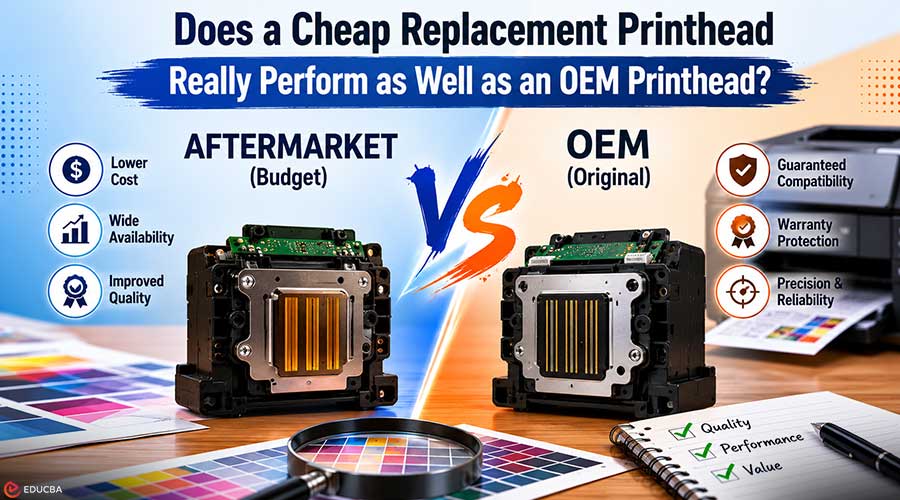
Every printer owner eventually faces the same decision. A critical part wears out, and you have to choose between paying full price for the manufacturer’s version or taking a risk on a budget alternative. Printheads sit right at the center of this debate because they directly control how ink reaches the page. Looking at real performance differences and letting the evidence guide the decision is more prudent than guessing which route makes the most sense, especially when evaluating Aftermarket printhead vs. OEM options.
How a Printhead Affects Print Quality in Aftermarket Printhead vs OEM Comparison?
The printhead is essentially the engine behind every printed page. It governs nozzle precision, droplet size, and thermal consistency, all of which shape how sharp, vibrant, and uniform the final output looks. A single flaw in this component can trigger visible streaks, color shifts, or uneven ink coverage across an entire batch.
That concern is precisely why so many buyers hesitate to stray from factory parts in the Aftermarket printhead vs OEM debate. Yet sourcing a dependable printhead outside the OEM channel has become a realistic option, as aftermarket production quality has steadily improved over the last ten years. Several third-party manufacturers now use comparable materials, similar nozzle configurations, and strict quality testing. Of course, not every low-cost option hits that standard, which makes careful research essential before committing.
Where OEM Parts Hold an Advantage in Printhead Decisions?
Guaranteed Compatibility
Factory-issued components are engineered for one specific printer model. Firmware handshakes, driver communication, and physical dimensions are all verified during development. That precision removes installation surprises and reduces the risk of calibration failures or persistent error messages in the Aftermarket printhead vs. OEM comparison.
Warranty Protection
Most printer brands require certified parts to maintain their warranty. Swapping in an unapproved component can cancel that coverage entirely, shifting future repair costs onto the owner. For businesses operating high-volume machines, losing warranty protection creates a significant financial risk, especially when weighing aftermarket printhead vs. OEM trade-offs.
Where Aftermarket Options Compete in Aftermarket Printhead vs OEM?
Lower Cost Per Unit
Budget replacements typically sell for 40 to 60 percent below OEM pricing. Home offices and smaller operations printing moderate volumes can redirect those savings elsewhere over 12 months without sacrificing noticeable output quality in the Aftermarket printhead vs OEM comparison.
Broader Availability
Third-party suppliers frequently carry parts for older or discontinued models that the original manufacturer no longer supports. That extended stock can keep older hardware functional for longer than expected, making it an important factor when considering support for legacy printers.
Improved Manufacturing Standards
Credible aftermarket brands have invested heavily in precision tooling and quality assurance, which now rival factory-level specifications. Independent lab assessments confirm that leading budget printheads perform comparably to OEM versions in resolution, color fidelity, and operational lifespan testing within the Aftermarket printhead-vs.-OEM context.
Key Factors to Evaluate in Aftermarket Printhead vs OEM Choices
Print Volume and Frequency
Machines running thousands of pages per week place heavy demands on every internal component. High-cycle environments require parts rated for sustained output, whether they carry an OEM label or come from a trusted third-party source in the Aftermarket, in the printhead-versus-OEM decision-making process.
Ink Compatibility
Some aftermarket printheads pair well with certain ink formulations but perform poorly with others. Verifying compatibility between the replacement unit and the ink already in use helps avoid clogs, adhesion issues, and accelerated wear in the Aftermarket printhead vs OEM comparison.
Supplier Reputation
Quality varies widely across budget manufacturers. Reading verified buyer reviews, checking return policies, and confirming test certifications separate reliable producers from those cutting corners on raw materials or assembly when evaluating Aftermarket printhead vs. OEM options.
Long-Term Cost Analysis in Printhead Considerations
A bargain part that fails in eight weeks can cost more than an OEM component that lasts a full year. Measuring the price per printed page, rather than comparing sticker prices alone, reveals a much clearer picture of the actual value in the Aftermarket printhead vs. OEM analysis.
Common Myths Worth Questioning in Printhead Choices
A common assumption is that non-OEM parts consistently perform worse. However, independent print lab testing challenges this view for several well-known third-party brands when comparing original and replacement printhead options. Another widespread assumption is that budget components gradually damage printers. Properly engineered replacements, built to exact tolerances, carry no greater mechanical risk than factory hardware.
A third misconception centers on color accuracy. In controlled side-by-side evaluations, trained reviewers regularly struggle to distinguish prints made with aftermarket components from those produced on original equipment, reinforcing findings from the Aftermarket printhead vs. OEM comparison.
Final Thoughts
Budget replacement printheads can genuinely rival OEM performance, provided buyers approach the purchase with care. Vetting supplier credibility, confirming ink compatibility, and running a realistic cost-per-page calculation all help minimize the risk of a disappointing result. The quality gap between factory and aftermarket options has narrowed significantly, making reliable budget parts more accessible across a wide range of printing needs in the Aftermarket printhead vs OEM debate.
Recommended Articles
We hope this guide on Aftermarket printhead vs OEM helps you make a more informed decision when choosing between budget replacements and manufacturer-grade printheads. Explore these recommended articles for additional insights and strategies to improve print performance, reduce costs, and extend printer lifespan.

