

Updated November 24, 2026
What is Beam Search?
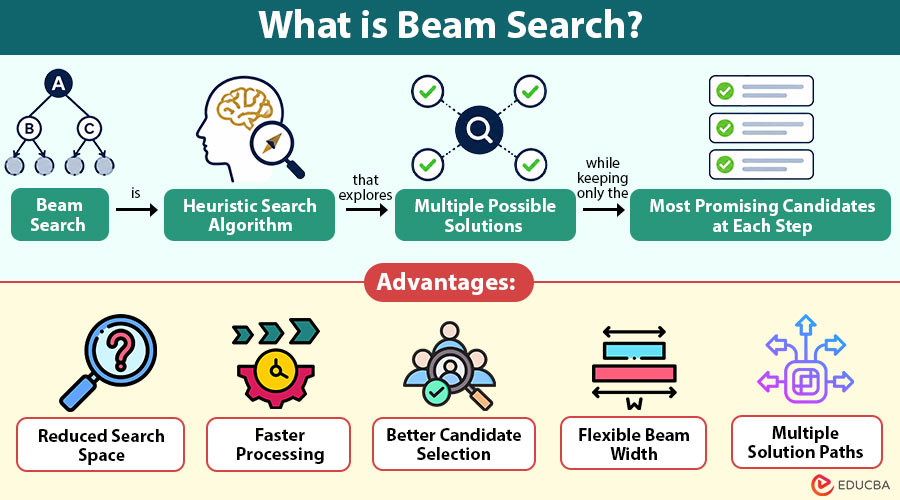
Beam search is heuristic search algorithm that explores multiple possible solutions while keeping only the most promising candidates at each step.
It is frequently utilized in speech recognition, natural language processing, artificial intelligence, and machine learning. Instead of examining every possible option, the algorithm selects a limited number of candidates based on their scores. This helps reduce the time and computational resources required to find a suitable solution.
For example, when an AI system translates a sentence from one language to another, several possible translations may exist. Beam search evaluates these alternatives and continues with the most promising options until it generates a complete translation.
Table of Contents:
Key Takeaways:
- Beam search explores multiple solution paths while retaining candidates with the highest evaluation scores.
- Beam width determines how many promising candidates remain available during each search iteration.
- Its effectiveness depends on suitable scoring methods, beam width, and available computational resources.
- It reduces unnecessary exploration by removing weaker candidates at every search stage.
How Does Beam Search Work?
Beam search works by expanding possible solutions at each step and retaining only a fixed number of candidates with the highest scores. This number is called the beam width.
The following steps explain how the algorithm operates:
1. Start with an Initial State
The algorithm begins with an initial condition or starting point from which it generates possible solutions.
2. Generate Candidate Options
It creates multiple possible next steps by expanding the current candidates according to the available choices.
3. Calculate Scores
Each candidate receives a score based on its probability, estimated quality, or suitability for solving the given problem.
4. Select the Best Candidates
The algorithm compares all generated options and keeps only the highest-scoring candidates within the specified beam width.
5. Expand Selected Candidates
It continues developing the retained options by generating new possibilities from each selected candidate.
6. Repeat the Process
The algorithm repeats scoring, ranking, and selection until it reaches a stopping condition or completes the solution.
7. Return the Final Result
It selects the best completed candidate according to the scoring method and returns it as the final solution.
Types of Beam Search
Beam search has different variations that support specific search requirements and improve the selection of possible solutions. The following are some commonly used variations:
1. Standard Beam Search
Standard beam search keeps a fixed number of the highest-scoring candidates at every search level. It removes weaker options to control computational requirements and simplify the search process.
2. Diverse Beam Search
Diverse beam search encourages the algorithm to produce different types of solutions rather than selecting several similar candidates. It is useful for generating varied sentences, captions, and creative text.
3. Stochastic Beam Search
Stochastic beam search introduces randomness into candidate selection instead of always choosing the highest-scoring options. This approach helps explore different possibilities and reduces dependence on a single search path.
4. Constrained Beam Search
Constrained beam search follows specific rules while generating possible solutions. It ensures that selected candidates satisfy requirements such as including particular words, maintaining a format, or following predefined conditions.
5. Length-Normalized Beam Search
Length-normalized beam search adjusts candidate scores according to their sequence lengths. This helps prevent the algorithm from favoring shorter outputs simply because their accumulated probability scores are higher.
Example of Beam Search
Consider an AI language model that needs to complete the sentence:
“The student is reading a…”
The model predicts several possible next words, each with a different probability.
Suppose the beam width is 2, meaning the algorithm can retain only two candidates at each step.
| Step | Candidate | Probability |
| Initial | Book | 0.60 |
| Initial | Newspaper | 0.30 |
| Initial | Car | 0.10 |
Since the beam width is 2, the algorithm retains Book and Newspaper while removing Car. It then expands the selected candidates:
| Candidate Sequence | Score |
| Reading a book | 0.60 × 0.80 = 0.48 |
| Reading a newspaper | 0.30 × 0.90 = 0.27 |
| Reading a book review | 0.60 × 0.50 = 0.30 |
| Reading a newspaper article | 0.30 × 0.70 = 0.21 |
The algorithm compares the resulting candidates and retains the two highest-scoring options.
Therefore, it continues exploring the most promising sequences instead of evaluating every possible combination. This example demonstrates how beam width controls the number of candidates considered during each search step.
Applications of Beam Search
It supports several AI tasks where systems must select suitable solutions from many possible alternatives. The following are its major applications:
1. Natural Language Processing
Language processing systems use beam search to generate meaningful sentences, complete text, and select suitable word sequences from multiple possible combinations.
2. Machine Translation
Translation systems use this algorithm to compare different sentence structures and word choices. It helps identify translations that receive higher scores from the language model.
3. Speech Recognition
Speech recognition systems apply beam search to identify possible word sequences from spoken audio. It helps select likely sentences based on acoustic information and language patterns.
4. Text Generation
AI writing systems use beam search to generate sentences by evaluating multiple possible word combinations. It helps produce outputs that follow the model’s probability predictions.
5. Image Captioning
Image captioning systems use beam search to generate descriptions of visual content. They compare possible word sequences to produce captions that match the important elements in an image.
6. Robotics
Robotic systems can use beam search to evaluate possible actions and movement sequences. It helps identify promising paths while limiting the number of alternatives considered.
7. Game Playing
Some game-playing systems use beam search to examine possible moves and future game situations. It helps narrow down available choices when exploring every possible move is expensive.
Advantages of Beam Search
Offers several advantages when solving problems that involve multiple possible choices and search paths.
1. Reduced Search Space
It examines only a limited number of promising candidates, reducing unnecessary exploration and making large search problems easier to handle.
2. Faster Processing
It avoids evaluating every possible solution, allowing AI systems to complete many search tasks with fewer computational resources.
3. Better Candidate Selection
It compares multiple alternatives at each step, helping systems choose options with stronger scores instead of following one path.
4. Flexible Beam Width
Developers can adjust the number of retained candidates according to available computing resources and the accuracy requirements of specific applications.
5. Multiple Solution Paths
It keeps several possible candidates simultaneously, reducing the risk of committing too early to one potentially unsuitable solution.
Limitations of Beam Search
Although beam search improves search efficiency, it has certain limitations that developers should consider when selecting an appropriate algorithm.
1. No Guaranteed Optimal Solution
It may remove a candidate that eventually leads to the best solution because its early score appears relatively weak.
2. Beam Width Dependency
A narrow beam may miss useful alternatives, while a wider beam requires more memory and computational resources during processing.
3. Local Decision Making
The algorithm selects candidates using their current scores, which may not accurately represent their potential quality in later search stages.
4. Repeated Similar Outputs
Standard beam search may produce several candidates with nearly identical structures, reducing the variety of generated results.
5. Scoring Bias
Its performance depends heavily on the scoring function, which may favor certain candidate lengths or patterns over other suitable alternatives.
6. Computational Requirements
Although it reduces the search space, maintaining and comparing multiple candidates can still require significant processing resources for complex problems.
Difference Between Beam Search and Breadth-First Search
The table below highlights the differences between the two:
| Basis | Beam Search | Breadth-First Search |
| Approach | Uses scores to select promising candidates | Explores nodes level by level |
| Candidate Selection | Retains a fixed number of candidates | Expands all available nodes at each level |
| Search Space | Explores a limited search space | May explore a much larger search space |
| Memory Usage | Depends on beam width and candidate size | Depends on beam width and candidate size |
| Speed | Often faster for large search spaces | Can become slower when many nodes exist |
| Optimality | Does not guarantee the optimal solution | Finds the shortest path in unweighted graphs |
| Main Use | AI generation and optimization tasks | Graph traversal and shortest-path problems |
Final Thoughts
Beam search is a useful algorithm for finding promising solutions without examining every available possibility. It reduces search complexity by retaining a limited number of high-scoring candidates during each step. Its applications include language generation, machine translation, speech recognition, and image captioning. However, its results depend on beam width and scoring methods. Selecting suitable settings helps developers balance processing speed, resource usage, and output quality across different AI applications.
Frequently Asked Questions (FAQs)
Q1. What is the main purpose of beam search?
Answer: The main purpose of beam search is to find promising solutions efficiently by exploring a limited number of high-scoring candidates.
Q2. What is beam width in beam search?
Answer: Beam width represents the maximum number of candidates that the algorithm retains at each search step.
Q3. Is beam search an informed search algorithm?
Answer: Yes, beam search is an informed search algorithm because it uses evaluation scores or heuristic information to guide candidate selection.
Q4. Does beam search always find the optimal solution?
Answer: No, beam search does not guarantee an optimal solution because it may discard candidates that could lead to better results later.
Recommended Articles
We hope that this EDUCBA information on “Beam Search” was beneficial to you. You can view EDUCBA’s recommended articles for more information –