


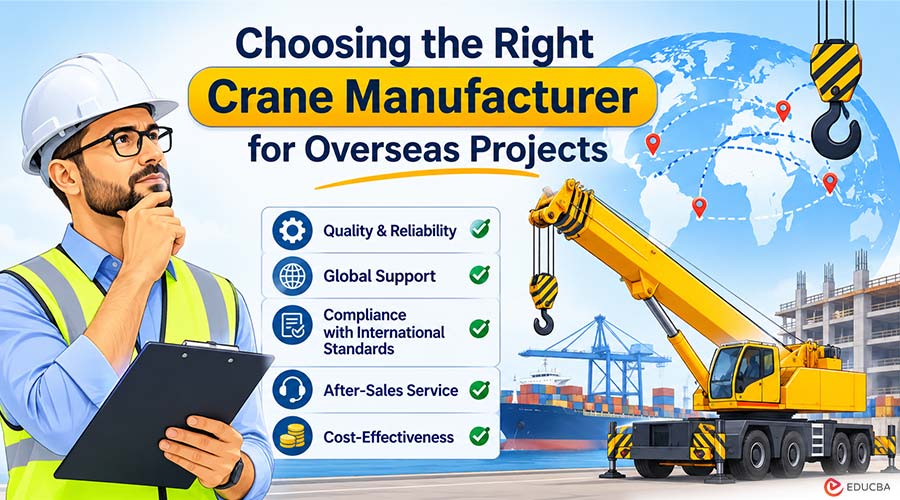
A crane is rarely a one-time purchase. Once installed, it operates for decades, carries valuable loads, and determines the pace of a plant, yard, or terminal. When a project is overseas, the stakes become even higher. The equipment is manufactured in one country, shipped across oceans, installed under different regulations, and serviced remotely.
That is why choosing the right crane manufacturer matters more than selecting a particular crane model. A reliable manufacturer understands project requirements and turns them into safe, compliant, and maintainable equipment. In contrast, an inexperienced supplier may offer an attractive quotation that becomes expensive after unexpected delays, customs issues, or difficulties obtaining spare parts.
This guide presents a practical 10-point checklist for evaluating a crane manufacturer, an overview of well-known crane brands across regions, and a simple scorecard to help overseas buyers compare quotations and make informed purchasing decisions.
Why Choosing the Right Crane Manufacturer Matters More Than the Price Tag
Two quotations for the same “20-ton double girder overhead crane” can describe very different machines. Steel grade, welding quality, hoist brand, electrical components, duty classification, and paint systems are often hidden behind a single line on the price sheet.
Choosing an experienced crane manufacturer helps buyers understand these differences in engineering quality, component selection, safety standards, and long-term maintenance requirements.
On an overseas project, the cost of making the wrong choice increases because of several factors:
- Shipping and re-shipping costs: Transporting heavy crane components across international borders can be slow and expensive.
- Commissioning delays: Installation problems can hold up the production line or facility the crane was purchased for.
- Compliance issues: Missing certifications or regulatory gaps can delay inspections and insurance approvals.
- Limited technical support: Spare parts and engineering assistance may be difficult to access across different countries and time zones.
Choosing a crane manufacturer is therefore as much a risk-management decision as a purchasing exercise.
The 10-Point Buyer’s Checklist for Choosing a Crane Manufacturer
1. Define the Lifting Requirements First
Before contacting a crane manufacturer, buyers should document the basic project requirements, including rated capacity, span, lifting height, working environment, duty class, and required travel speeds. Site conditions such as indoor or outdoor operation, ambient temperature, wind exposure, corrosive atmospheres, hazardous areas, and power supply requirements, including voltage and frequency, also require consideration.
A manufacturer can provide an accurate quotation only when the buyer clearly communicates the application. Vague inquiries often result in incomplete quotations, making it difficult to compare suppliers fairly.
Preparing a detailed technical specification before requesting quotations helps manufacturers understand the application and recommend suitable equipment.
2. Check Whether the Manufacturer Builds the Required Crane Type
Every crane manufacturer has its own area of specialization. Some focus on light and medium-duty workshop cranes, while others manufacture heavy steel mill equipment or port machinery. Buyers should review the manufacturer’s product range and project references to confirm that it regularly builds the required crane type and capacity range.
For example, an overhead crane for a precast concrete plant, a gantry crane for an open yard, and a rubber-tired gantry crane for a container terminal involve different engineering requirements. A manufacturer with proven experience in the relevant category is more likely to identify design challenges early.
Project photographs, technical specifications, and customer references can help buyers verify a manufacturer’s experience.
3. Verify Standards and Certifications
A reliable crane manufacturer should provide documented evidence of compliance with the standards applicable to the destination country. Buyers should check which design standards the crane follows and review copies of the supporting certificates.
Common references include:
- FEM and ISO duty classification: Used for crane and hoist design and duty classification.
- EN 13001: European standard covering crane safety and design.
- ASME B30.2 and OSHA 1910.179: References relevant to overhead and gantry crane requirements in the United States.
- CE marking: Relevant for products supplied into the European market under applicable legislation.
- ATEX requirements: Applicable to equipment designed for certain potentially explosive atmospheres.
- ISO 9001: Certification demonstrating a manufacturing facility’s commitment to established quality management standards.
The required standards depend on the destination country and project application. Equipment accepted in one market may require design modifications, additional documentation, or third-party inspections in another.
Buyers should verify the validity and scope of each certificate rather than relying only on a supplier’s claims.
4. Evaluate Engineering and Customization Capabilities
Standard catalog cranes can handle many applications, but overseas projects often require specific modifications. These may include a non-standard span, specialized hook, anti-sway control, different power supply, or custom lifting beam.
A capable crane manufacturer should have an in-house design team and the ability to provide structural calculations and general arrangement drawings before production. Buyers should also understand how the manufacturer handles technical revisions and design changes during the project.
A manufacturer that can explain the reasoning behind its design choices is generally a more dependable partner than one that only provides a price quotation.
Customization capabilities are particularly important for projects involving unusual lifting requirements, limited installation space, or challenging environmental conditions.
5. Inspect Key Components and Their Brands
The main crane structure is only one part of the equipment. Hoists, motors, reducers, wheels, brakes, limit switches, inverters, and electrical controls determine how the crane performs during daily operations.
An experienced crane manufacturer should be transparent about component specifications, supplier brands, and replacement part availability.
Buyers should request a detailed component list and check which brands or technical specifications are used for each part. Replacement components should also be readily available in the project region.
A crane built with accessible, standardized components is generally easier to maintain than one that depends on proprietary parts from a single supplier.
Component quality also influences operational reliability, maintenance expenses, and the equipment’s expected service life.
6. Assess Factory Capacity and Quality Control
Factory inspection helps buyers understand a manufacturer’s production capabilities and quality management practices. When an in-person visit isn’t possible, a video audit or virtual factory inspection can still provide useful insights.
The following factors indicate the manufacturer’s production and quality control capabilities:
- Organized production flow and manufacturing facilities.
- Qualified welders and documented welding procedures.
- Material traceability and inspection records.
- Dimensional checks during production.
- Consistent surface preparation and painting quality.
- Clear final inspection and load-testing procedures.
Buyers should review the tests performed before shipment. These may include no-load tests, rated-load tests, overload tests, electrical checks, and functional trials.
A professional crane manufacturer should maintain inspection records and provide relevant test reports to demonstrate that the equipment meets the agreed specifications.
7. Confirm Export Experience and Documentation
Exporting cranes involves more than loading equipment into a shipping container. An export-experienced crane manufacturer understands sea freight packing, component marking, packing lists, commercial invoices, certificates of origin, and the documentation required by customs and local inspection authorities.
Buyers should evaluate how many countries the manufacturer has supplied, which regions it serves regularly, and whether it can provide references from projects with similar regulations or environmental conditions.
The export documentation process also requires clarification. Manufacturers may handle these responsibilities directly or coordinate with freight forwarding partners.
A supplier with genuine international project experience is more likely to anticipate shipping, customs, and documentation challenges before they affect the delivery schedule.
8. Clarify Installation, Commissioning, and Training
Many overseas buyers underestimate the importance of installation and commissioning. Even a well-designed crane requires proper assembly, testing, and operational checks before it can be used safely.
The manufacturer’s service package may include:
- On-site supervision by a field engineer.
- Complete installation services.
- Technical drawings and installation manuals.
- Commissioning and load testing.
- Operator and maintenance staff training.
- Remote technical assistance.
Buyers should clarify who provides the lifting equipment required for installation, how commissioning will be scheduled, and how training will be delivered.
Document the full scope in writing, including travel expenses, accommodation, visas, and working hours for engineers visiting the project site. Clearly defined responsibilities help prevent misunderstandings and additional expenses.
9. Evaluate After-Sales Support and Spare Parts
A crane requires regular inspections, replacement of wear parts, and occasional repairs throughout its operating life. Before placing an order, buyers should confirm that the crane manufacturer has a dependable after-sales service process and can supply replacement parts within a reasonable timeframe.
Important factors include:
- Warranty duration and coverage.
- Response time for technical inquiries.
- Availability of spare parts.
- Remote troubleshooting support.
- On-site repair and maintenance services.
- Availability of technical manuals and maintenance documentation.
Providing a spare parts inventory for the initial two years helps buyers prepare for upcoming maintenance needs. Consider the manufacturer’s service representatives or authorized partners near the project location.
Response time matters in practice. A supplier that answers technical questions within a day provides more confidence than one that takes a week to respond.
10. Compare Total Cost of Ownership, Not Just Purchase Price
The cheapest quotation does not necessarily represent the lowest-cost crane. Buyers should evaluate the total cost of ownership instead of focusing only on the initial purchase price.
The following expenses require comparison:
- Purchase price: Equipment, accessories, and services included in the quotation.
- Freight and insurance: International shipping, insurance, customs duties, and local transportation.
- Installation costs: Assembly, commissioning, and local labor expenses.
- Energy consumption: Expected power requirements during operation.
- Maintenance requirements: Inspection schedules, servicing costs, and replacement components.
- Service life: Expected operating life and duty classification.
- Spare parts: Availability, delivery time, and replacement costs.
Every shortlisted supplier should provide a quotation based on the same technical specification. Significant price differences between quotations require further investigation before making a purchasing decision.
Well-Known Crane Manufacturers by Region
The global crane industry includes several established crane manufacturers specializing in different equipment categories and applications. Some companies concentrate on mobile and tower cranes for construction, while others build industrial overhead and gantry cranes or port equipment.
The following list is not a ranking. It provides a starting point for overseas buyers researching established names in the international crane market.
Europe
- Konecranes (Finland): A major group in industrial cranes, port equipment, and crane services, with operations in more than 50 countries.
- Demag (Germany): A crane and component brand with roots dating back to 1819, known for engineered overhead cranes and components. It is now part of the Konecranes group.
- Liebherr (Switzerland headquarters): A family-owned group whose crane portfolio includes mobile, crawler, tower, and maritime cranes.
- ABUS Kransysteme (Germany): Known for overhead crane systems and light crane solutions.
- GH Cranes & Components (Spain): An industrial overhead crane and component manufacturer with a long operating history.
- Palfinger (Austria): Known for loader cranes and marine lifting equipment.
North America
- Terex (United States): A long-established name in mobile and rough-terrain cranes.
- Manitowoc (United States): Known for its mobile and crawler crane brands, including Grove.
- Columbus McKinnon (United States): A supplier of hoists and industrial lifting solutions widely used in workshops and manufacturing plants.
- Gorbel (United States): Known for workstation bridge cranes and light crane systems.
Japan
- Tadano: A leading Japanese crane manufacturer and an established name in mobile cranes.
- Sumitomo Heavy Industries, Kobelco, and Kato: Established Japanese brands in construction and heavy crane equipment.
- Kito: Widely recognized for hoists and lifting equipment.
China
China is the world’s largest crane exporter by value, followed by Germany, according to 2021 trade figures. It also has an extensive supply base for overhead, gantry, and port cranes. Chinese manufacturers range from large construction equipment groups to specialized industrial crane factories.
Some established names include:
- XCMG, Zoomlion, and Sany: Large construction machinery groups with extensive mobile and tower crane product ranges.
- ZPMC: A major supplier of port cranes and container handling equipment.
- Voitto Crane: Based in Henan, the company exports a wide range of lifting equipment, including single- and double-girder overhead cranes, EOT and gantry cranes, KBK systems, FEM-standard European electric hoists, steel mill cranes, and related spare parts. The company reports exporting equipment to customers in 80 countries and serving industries such as steel, paper, power, automotive, and precast concrete.
- Weihua Crane: A Henan-based crane manufacturer operating since 1988 and exporting to more than 170 countries. Its portfolio includes rubber-tired gantry (RTG) cranes, rail-mounted container gantry cranes, ship-to-shore cranes, straddle carriers, portal slewing cranes, boat lifting cranes, overhead and EOT cranes, steel mill ladle cranes, and electric hoists.
When shortlisting suppliers from any region, buyers should apply the same evaluation criteria. A well-known brand does not eliminate the need to verify project references, technical specifications, and certifications. Similarly, buyers should not dismiss a less familiar manufacturer before reviewing its capabilities and supporting evidence.
Matching the Right Crane Manufacturer to the Project Type
Different projects require different engineering capabilities and manufacturing experience. Selecting a crane manufacturer with experience in the intended application helps ensure that the equipment meets operational demands, site conditions, and industry-specific requirements.
| Project type | What to prioritize in the manufacturer |
| Workshop or warehouse overhead crane | Standard range, fast delivery, reliable hoist and electrical components, easy spare parts supply |
| Steel mill or foundry | Heavy-duty design experience, high duty class (A7/A8), heat-resistant components, relevant project references |
| Precast concrete or open-yard gantry | Structural design for wind and outdoor use, rail and foundation guidance, installation support |
| Port or container terminal | Experience with RTG, rail mounted gantry or ship-to-shore cranes, automation and anti-sway control, commissioning capability |
| Hazardous or chemical plant | Explosion-proof design, relevant certification such as ATEX, documented material and electrical specifications |
These requirements help buyers identify manufacturers with relevant technical expertise rather than selecting suppliers based only on product availability or price.
A Simple Scorecard for Comparing Crane Manufacturer Quotations
A structured scorecard allows buyers to compare each crane manufacturer based on technical capabilities, quality standards, export experience, and long-term service support.
Each supplier can receive a rating from 1 to 5 for every criterion, followed by a calculation of the total score. You can also adjust the weighting based on project requirements. For example, after-sales support may matter more when an installation site is far from the manufacturer’s service network.
The following criteria provide a practical evaluation framework:
- Technical fit with the project specification.
- Standards and certification evidence.
- Engineering and customization capabilities.
- Component quality and brand transparency.
- Factory capacity and quality control.
- Export experience and documentation.
- Installation, commissioning, and training scope.
- After-sales response and spare parts supply.
- Total cost of ownership.
- Project references and communication quality.
A manufacturer offering a low purchase price but receiving poor scores for certification, factory quality, or after-sales support deserves further evaluation.
This approach helps buyers compare quotations more objectively and identify suppliers that offer better long-term value.
Common Mistakes to Avoid When Buying Cranes Overseas
International crane purchases involve several technical, financial, and logistical considerations. Avoiding common mistakes can help buyers reduce project risks and prevent unexpected expenses.
Some common mistakes include:
- Comparing different specifications: Evaluating quotations based on different technical requirements can lead to incorrect purchasing decisions.
- Selecting a supplier based only on price: Choosing a crane manufacturer without verifying certifications, factory capabilities, or customer references can create long-term problems.
- Ignoring export experience: Not verifying previous overseas projects may cause shipping, customs, and documentation delays.
- Leaving installation responsibilities undefined: Unclear agreements about installation and commissioning can lead to disputes and additional costs.
- Overlooking local requirements: Ignoring power supply, climate, and regulatory requirements until after placing the order can result in costly modifications.
- Skipping factory inspections: Not reviewing manufacturing quality or pre-shipment testing can increase the risk of receiving defective equipment.
- Neglecting spare parts planning: Not arranging access to spare parts and long-term maintenance support can affect equipment availability.
A structured supplier evaluation process helps buyers identify these risks before signing a purchase agreement.
Final Thoughts
Choosing the right crane manufacturer requires more than comparing product prices and specifications. Buyers must consider engineering expertise, manufacturing quality, safety certifications, export experience, and long-term technical support. A manufacturer that understands the project’s requirements and delivers reliable equipment can help reduce operational risks, avoid unexpected expenses, and ensure smooth installation.
For overseas projects involving overhead cranes, gantry cranes, port equipment, or steel mill cranes, a structured checklist makes manufacturer selection more reliable. Companies such as Weihua Crane and other established industrial crane manufacturers can be assessed based on their product range, technical capabilities, international project experience, and after-sales services. A well-informed purchasing decision helps businesses secure equipment that supports safe and efficient operations over the long term.
Recommended Articles
We hope this comprehensive guide on choosing the right crane manufacturer helps buyers make informed decisions for their overseas projects. Explore our recommended articles to learn more about industrial cranes, material handling equipment, lifting solutions, and equipment selection strategies. Discover practical insights to evaluate manufacturers, understand crane specifications, and improve lifting operations.

