


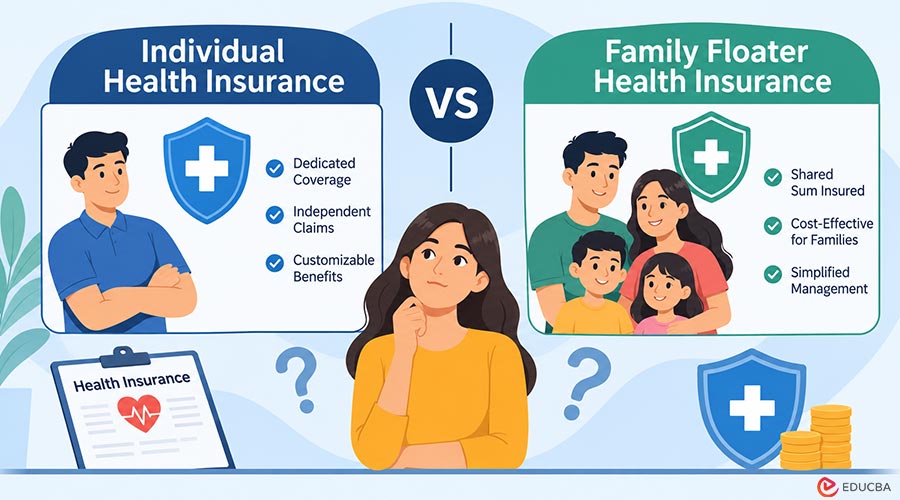
Choosing the right health insurance policy is an important step in protecting yourself and your family from unexpected medical expenses. In India, individuals can choose between individual health insurance plans and family floater policies based on their budget, age, medical history, and coverage needs. Understanding individual vs family floater health insurance helps you compare both options and choose a policy that best suits your healthcare needs.
Both options help manage eligible healthcare expenses, but they differ in how the sum insured is allocated and used. Understanding these differences can help you choose health insurance that balances affordability with suitable financial protection.
What is Individual Health Insurance?
An individual health insurance plan offers financial protection to one person through a predetermined coverage limit. The insurer pays eligible medical expenses according to the policy’s terms, limits, and exclusions.
How Coverage and the Sum Insured Apply to One Insured Person?
The sum insured is dedicated to the person covered by the policy. For example, if you purchase a policy with a sum insured of ₹5 lakh, eligible claims can be covered up to the applicable limit. Key features include:
- Dedicated Coverage: The sum insured is allocated to one insured person.
- Independent Claims: Claims made by other family members do not reduce this person’s coverage.
- Customizable Benefits: You can select coverage based on your healthcare needs and available options.
- Renewal Continuity: Coverage can continue through renewals, subject to policy terms and premium payment.
Who May Benefit from Individual Coverage?
Individual health insurance may suit people who live alone, have specific medical needs, or want independent coverage. It may also suit older adults and family members whose healthcare needs differ significantly from others.
What is Family Floater Health Insurance?
A family floater policy covers multiple eligible family members under one shared sum insured. Instead of assigning a separate sum insured to each member, the policy allows covered members to use the available amount according to its terms.
How a Shared Sum Insured Works for Family Members?
Suppose a family purchases a floater policy with ₹10 lakh coverage. If one member makes an eligible claim of ₹3 lakh, ₹7 lakh remains available for other eligible claims during the policy year, subject to the policy conditions. This structure can be convenient because you do not need to divide the entire coverage equally among family members in advance.
Who Can Generally Be Covered Under a Family Floater Policy?
Depending on the insurer’s eligibility rules, a family floater may cover:
- The policyholder and spouse.
- Dependent children.
- Dependent parents or other eligible family relationships, where permitted.
Eligibility, age limits, and family definitions vary by product, so review the policy wording before purchasing.
Individual vs Family Floater Health Insurance: Key Differences
Understanding the differences helps you choose a policy that meets your needs without compromising essential coverage.
| Comparison Factor | Individual Health Insurance | Family Floater Health Insurance |
| Sum Insured | Dedicated to one person | Shared among insured members |
| Premium | Based on individual risk and coverage | Based on factors including members’ ages and coverage |
| Multiple Claims | Other members do not use the insured person’s limit | Claims reduce the shared balance |
| Customisation | Can be tailored to an individual’s needs | Benefits generally apply under one policy structure |
| Family Management | Separate policies may require separate renewals | Eligible members can be managed under one policy |
| Suitable For | Individuals and members with distinct needs | Couples and families seeking shared coverage |
Premium Calculation and Factors That Influence Cost
Premiums depend on age, sum insured, location, selected benefits, and the insurer’s underwriting assessment. A family floater may be more economical for a young family, while separate policies may provide better-suited coverage for members with different medical requirements.
Flexibility to Customize Coverage for Different Members
Individual policies let you select coverage for each person’s needs. Family floaters simplify administration, but one shared arrangement may not suit every member equally.
What Happens When More Than One Family Member Needs Treatment?
- Individual Policies: Each insured person has a separate coverage limit.
- Family Floater Policies: Multiple members can claim, but their eligible claims draw from the same available sum insured.
- Practical Consideration: Families should assess whether the shared limit would be sufficient if two members required hospitalization in the same year.
Adding Members and Managing Coverage as Family Needs Change
Family floaters can simplify coverage management when a family grows. However, adding a spouse, newborn, or other eligible member depends on the insurer’s rules, applicable underwriting requirements, and policy terms.
Advantages of an Individual Health Insurance Plan
Dedicated Coverage That Is Not Shared with Other Insured Members
The key advantage is that other family members’ claims do not reduce the insured person’s sum insured. This can be valuable for people who want independent financial protection.
Suitability for People with Different Healthcare Needs
Individual coverage may suit:
- Older adults who need a higher sum insured.
- People with ongoing healthcare requirements.
- Adults who prefer independent policies.
- Family members who need different coverage options.
Potential Limitations to Consider
Individual policies can increase the overall cost when several family members need separate coverage. Managing multiple policies may also involve separate premiums, renewals, and claim documentation.
Advantages and Limitations of a Family Floater Plan
One Shared Policy for Eligible Family Members
A family floater offers convenience by covering eligible members under one policy. It can simplify policy administration and let members use the available sum insured as needed.
When a Family Floater May Be Cost-Effective?
A floater may be worth considering when family members are relatively young and have similar healthcare needs. However, actual savings depend on the premium quotation, coverage, and policy conditions.
The Risk of One Member Using a Large Part of the Shared Sum Insured
If one member needs expensive treatment, less coverage remains for other members. Families with older members or higher medical risks should consider whether separate policies would offer more appropriate protection.
Example: How the Same Sum Insured Can Work Differently?
Illustrating Separate Individual Coverage Versus a Shared Family Limit
Consider a family of three choosing between individual policies and a family floater.
| Particular | Individual Policies | Family Floater |
| Coverage Arrangement | ₹5 lakh per person | ₹15 lakh shared |
| Family’s Combined Coverage | ₹15 lakh across three policies | ₹15 lakh under one policy |
| First Member’s Claim | ₹4 lakh | ₹4 lakh |
| Second Member’s Claim | ₹3 lakh | ₹3 lakh |
| Remaining Family Coverage | ₹8 lakh across individual limits | ₹8 lakh shared |
In this example, the family floater has ₹8 lakh remaining after the two claims. Under individual policies, the remaining coverage is distributed across the three members’ separate limits. The amount available to a particular person will therefore differ.
Why Actual Benefits Depend on Policy Terms and Eligible Claims?
These figures illustrate the coverage structure, not a guaranteed claim outcome. Insurers pay eligible expenses according to policy limits, exclusions, waiting periods, co-payments, and other applicable conditions.
How to Choose Between Individual and Family Floater Health Insurance?
Before deciding, review the following factors:
- Age and Family Size: Younger families may find floaters convenient, while older members may need separate cover.
- Medical History: Consider existing conditions and expected treatment requirements.
- Healthcare Expenses: Estimate likely hospitalization costs and check preferred hospitals.
- Policy Conditions: Compare waiting periods, exclusions, co-payments, and treatment sub-limits.
- Premium and Renewals: Compare the overall cost with coverage quality and long-term affordability.
- Different Member Needs: Consider separate policies when one shared sum insured may not provide sufficient protection.
Understanding Hospitalisation Cover with ManipalCigna Infinix
ManipalCigna Infinix offers individual and family floater policy options, with ₹10 lakh and unlimited sum insured choices, subject to the selected variant and policy conditions. Its published benefits include inpatient hospitalisation, day-care treatment, pre- and post-hospitalisation expenses, and ambulance cover, making it an option to consider when comparing family health insurance plans.
When evaluating ManipalCigna Infinix, compare the available coverage options and review:
- Eligibility requirements for family members.
- Hospitalisation benefits and room eligibility.
- Waiting periods for pre-existing conditions and specified treatments.
- Optional deductible arrangements and their impact on premiums.
- Additional benefits and exclusions in the policy wording.
The right option depends on whether you need independent coverage or shared family protection.
Final Thoughts
Individual and family floater health insurance serve different needs. Individual policies provide dedicated coverage, while family floaters offer a shared sum insured and simpler policy management. Before choosing between individual vs family floater health insurance, compare premiums, coverage limits, medical history, and likely healthcare expenses. The right Health Insurance policy should offer suitable protection while remaining affordable over the long term.
Frequently Asked Questions (FAQs)
Q1. Is an individual health insurance plan better than a family floater plan?
Answer: Neither is universally better. Individual policies suit people who need independent coverage, while family floaters may suit younger families with similar healthcare needs.
Q2. Can a family have both individual and family floater health insurance?
Answer: Yes. A family can maintain individual policies for certain members and a floater for others, subject to policy eligibility and terms.
Q3. Is family floater health insurance usually cheaper than individual policies?
Answer: It can be more economical for some younger families, but premiums vary according to age, coverage, benefits, and underwriting factors. Compare actual quotations before deciding.
Q4. What happens if one family member uses most of the floater sum insured?
Answer: The remaining amount becomes available for other eligible claims. If the coverage is insufficient, the family may need to pay additional expenses from its own funds unless another applicable benefit provides coverage.
Q5. What should I compare before choosing a policy?
Answer: Compare the sum insured, premium, hospital network, waiting periods, exclusions, co-payments, deductibles, claim procedures, and renewal conditions. Choose the structure that best fits your family’s healthcare needs and budget.
Recommended Articles
We hope this comprehensive guide to Individual vs family floater health insurance helps you understand the key differences, benefits, and coverage options so you can make an informed decision. Check out these recommended articles for more insights into health insurance plans and ways to protect your family’s financial well-being.

