

Updated October 30, 2026
What is Data Granularity?
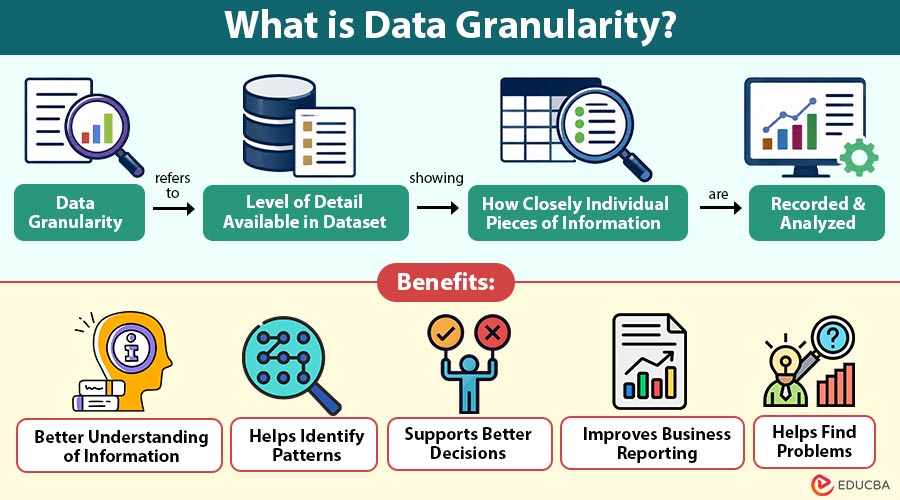
Data granularity refers to level of detail available in a dataset, showing how closely individual pieces of information are recorded and analyzed.
Imagine running a grocery store and checking your sales at the end of the month. One report shows that your store earned ₹5 lakh. Another report shows what customers purchased, how much they spent, and when they visited. Both reports provide useful information, but one contains more details than the other. This difference is called data granularity.
In simple words, data granularity tells us how detailed or summarized our information is. It helps businesses understand their data, identify patterns, prepare reports, and make better decisions.
Table of Contents:
- Meaning
- Importance
- Types
- Working
- Factors Affecting Data Granularity
- Benefits
- Challenges
- Examples
- Difference
- Applications
Key Takeaways:
- Data granularity determines how deeply businesses can examine information and understand specific operational activities.
- Fine-grained datasets reveal individual activities, while coarse-grained datasets simplify information for broader business evaluation.
- Selecting appropriate data detail helps organizations improve reporting accuracy and uncover meaningful business insights.
- Managing data granularity effectively reduces unnecessary complexity while supporting efficient analysis across different departments.
Why is Data Granularity Important?
Data granularity is important because it helps businesses understand information at the right level of detail. Without enough details, it can be difficult to identify problems or understand why certain changes happen.
For example, a restaurant owner notices that monthly sales have decreased. A monthly report shows the decline but does not explain when it happened. By checking daily sales records, the owner may discover that fewer customers visited on weekdays.
This information helps the owner understand the situation and plan ways to improve sales. Data granularity also helps businesses prepare useful reports, monitor daily activities, identify trends, and make decisions based on accurate information.
Types of Data Granularity
Data granularity is generally divided into two main types.
1. Fine-Grained Data
Fine-grained data contains detailed information about individual transactions, activities, or events, helping businesses understand exactly what happened at a particular time.
2. Coarse-Grained Data
Coarse-grained data provides summarized information by combining individual records into larger groups, making it easier to understand overall performance and business trends.
How Does Data Granularity Work?
Data granularity works by organizing information at different levels of detail based on what a business wants to understand or analyze.
Step 1: Collect Information
Businesses collect detailed information from sales, customer activities, transactions, and daily operations to understand what happens during different business activities.
Step 2: Organize the Data
Collected information is arranged into categories such as dates, products, customers, or locations, making it easier to find and compare records.
Step 3: Group the Information
Individual records are combined into daily, weekly, or monthly summaries to provide a broader picture of business activities and overall performance.
Step 4: Analyze the Results
Businesses examine detailed records or summarized reports to identify patterns, understand performance, and find areas where improvements may be needed.
Step 5: Make Decisions
Managers use the available information to plan activities, solve problems, and make decisions based on their business goals and requirements.
Factors Affecting Data Granularity
Several factors influence how much detail businesses need in their datasets.
1. Business Requirements
The purpose of collecting information determines how much detail is needed, as different business questions may require different levels of data.
2. Data Storage
Detailed information usually requires more storage space because businesses must maintain individual records instead of keeping only a few summarized figures.
3. Processing Time
Large amounts of detailed information may take longer to process, especially when businesses analyze millions of records across different systems.
4. Reporting Needs
Different departments need different information, as managers may prefer monthly summaries while analysts often require detailed records for deeper analysis.
5. Data Privacy
Detailed records may contain personal information, so businesses must protect sensitive details and provide access only to people who need them.
Benefits of Data Granularity
Choosing the right level of data granularity can help businesses understand information and improve their daily operations.
1. Better Understanding of Information
Detailed data helps businesses understand their performance, identify problems, and discover important information that may not appear in general summary reports.
2. Helps Identify Patterns
Businesses can study detailed information to understand customer habits, seasonal changes, and sales patterns that may influence their future business activities.
3. Supports Better Decisions
The right level of information helps managers compare results, understand business situations, and make decisions based on available facts and figures.
4. Improves Business Reporting
Data granularity helps businesses prepare detailed reports for specific departments and simple summaries for managers who need an overall performance overview.
5. Helps Find Problems
Detailed records allow businesses to investigate unexpected changes, identify possible causes, and understand which activities may be affecting their overall performance.
Challenges of Data Granularity
Although data granularity offers several advantages, managing detailed information can also create difficulties.
1. Large Amounts of Data
Fine-grained data can create large datasets because every transaction or activity is recorded separately, increasing storage and data management requirements.
2. Higher Processing Time
Analyzing detailed records may require additional time and computing resources, especially when businesses work with large datasets containing millions of entries.
3. Difficult Data Management
Managing detailed information can become complicated when records come from different sources, making it harder to maintain accuracy and consistency across systems.
4. Privacy Concerns
Detailed information may include sensitive customer or employee details, requiring businesses to follow proper security practices and protect personal information carefully.
5. Loss of Important Details
Coarse-grained data may hide important differences between individual records, making it difficult to understand specific problems or unusual changes in performance.
Examples of Data Granularity
Data granularity is used in many everyday situations. Here are some examples.
1. Retail Business
Retail stores use detailed purchase records to understand customer preferences, while monthly sales reports help owners review overall business performance and growth.
2. Education
Schools record individual subject marks to understand student performance, while class averages help teachers review the overall progress of their students.
3. Website Analytics
Website owners study individual page visits and clicks to understand visitor behavior, while monthly traffic reports show overall website performance trends.
4. Banking
Banks maintain detailed transaction records to track account activities, while summarized financial reports help management understand overall banking operations and performance.
5. Healthcare
Hospitals use individual appointment records to manage patient visits, while monthly reports help administrators understand service demand and plan available resources.
Difference Between Data Granularity and Data Aggregation
The table below highlights the key differences between the two:
| Data Granularity | Data Aggregation |
| Describes how detailed or summarized information is within a dataset. | Combines individual records to create useful summaries. |
| Can represent detailed or broad information. | Usually creates broader information from detailed records. |
| Helps determine what information is available for analysis. | Helps simplify information for reporting and comparison. |
| For example, recording each customer’s purchase separately. | For example, calculating total sales for an entire month. |
Applications of Data Granularity
Data granularity is used across different industries to manage information and understand performance.
1. Banking and Finance
Banks use detailed transaction records to monitor account activities, while summarized financial reports help management understand overall performance and business operations.
2. Healthcare
Hospitals analyze individual patient appointments to manage daily services, while monthly summaries help administrators understand demand and plan healthcare resources.
3. E-commerce
Online shopping businesses study individual purchases to understand customer preferences, while monthly sales reports help track revenue and overall product demand.
4. Marketing
Marketing teams analyze individual clicks and customer interactions to understand campaign performance, while summarized reports help measure overall marketing results.
5. Manufacturing
Manufacturing companies track individual production batches to monitor operations, while monthly production summaries help managers review output and identify performance changes.
6. Education
Educational institutions examine individual student marks to understand learning progress, while class averages help teachers evaluate overall academic performance and results.
Final Thoughts
Data granularity helps businesses analyze information at different levels of detail. Fine-grained data provides specific records, while coarse-grained data presents broader summaries. Both support different business needs. Choosing the right level of detail helps organizations identify problems, understand performance, prepare accurate reports, manage information efficiently, and make better decisions based on reliable data.
Frequently Asked Questions (FAQs)
Q1. What is the main purpose of data granularity?
Answer: The main purpose of data granularity is to determine how much detail is available for analysis. It helps organizations select suitable information for answering specific questions and understanding business activities.
Q2. What happens when data granularity is too high?
Answer: Extremely detailed datasets can become difficult to manage and analyze. Organizations may face increased storage costs, slower queries, and unnecessary complexity when handling information they do not actually need.
Q3. How does data granularity influence business intelligence?
Answer: Business intelligence tools use different levels of information to create dashboards and reports. Appropriate granularity allows users to explore specific results or examine broader organizational performance.
Q4. Can data granularity change over time?
Answer: Yes, organizations can change data granularity by combining detailed records into broader summaries. However, recovering individual details from summarized information usually requires access to the original records.
Recommended Articles
We hope that this EDUCBA information on “Data Granularity” was beneficial to you. You can view EDUCBA’s recommended articles for more information.