


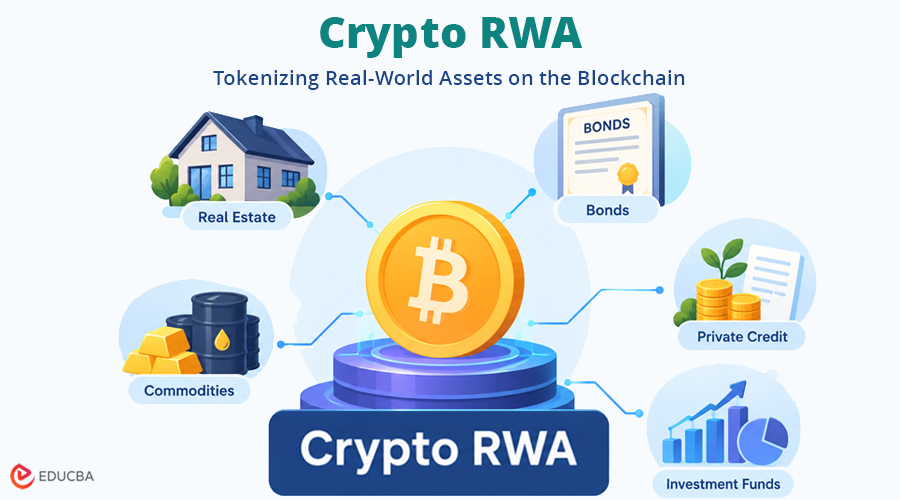
Crypto real-world assets have become one of the most debated investment themes in digital finance. Banks are experimenting with tokenized securities, asset managers are launching blockchain-based funds, and cryptocurrency companies are promoting a future where traditional investments move across decentralized networks, as CoinSpot notes. The excitement is understandable. Connecting bonds, real estate, private credit, and investment funds to blockchain infrastructure could create an enormous financial market. Yet the industry’s rapid expansion raises an uncomfortable question: is crypto RWA developing into a sustainable financial innovation, or are investors witnessing the early stages of another speculative bubble?
The distinction matters because promising technology and profitable investments are not the same. Cryptocurrency markets have repeatedly demonstrated how legitimate innovations can attract exaggerated expectations, misleading promotions, and excessive speculation. Investors exploring private trading communities should consider paid access only after checking reliability over time, especially when performance claims are hard to verify. The same discipline applies to Crypto RWA projects, where impressive asset valuations, institutional partnerships, and ambitious forecasts can sometimes mask limited liquidity or uncertain economic fundamentals.
A Financial Revolution With Two Very Different Stories
The optimistic view of RWA starts with a straightforward observation: traditional financial markets hold enormous amounts of capital, but the systems supporting them remain complex.
Securities transactions involve intermediaries, custody arrangements, settlement procedures, and regulatory requirements. Different institutions often maintain separate records that must be reconciled.
Tokenization could simplify selected processes by representing financial interests through programmable digital records.
In theory, this would allow approved participants to transfer assets more efficiently, automate certain administrative tasks, and coordinate transactions across compatible platforms.
The skeptical interpretation focuses on a different problem.
Many financial markets already function efficiently, and replacing established infrastructure requires significant investment. Blockchain technology may improve certain operations without delivering the revolutionary changes its supporters frequently promise.
Both interpretations can be valid simultaneously.
Crypto RWA may become an important part of modern finance, even as many RWA-related investments fail to generate attractive returns.
Understanding this possibility is essential for separating technological progress from market speculation.
The Numbers Look Impressive, but What Do They Measure?
Market forecasts are among the RWA industry’s strongest promotional arguments.
In 2024, McKinsey estimated that tokenized financial assets, excluding cryptocurrencies and stablecoins, could reach about $2 trillion by 2030. Its optimistic scenario projected a market size of nearly $4 trillion.
These projections suggest significant expansion potential.
However, forecasts describe possible future market sizes, not guaranteed investment returns.
Even current market statistics require careful interpretation.
A tokenized asset can be measured by its outstanding value, the amount represented on a blockchain, or the financial activity associated with it.
These measurements are not necessarily interchangeable.
Some platforms include assets represented through institutional arrangements, while others focus on tokens distributed to blockchain wallets.
As a result, two reports can describe substantially different market sizes without necessarily contradicting each other.
The distinction matters most when investors compare Crypto RWA growth with cryptocurrency market capitalization.
A billion dollars in tokenized bonds does not mean that a billion dollars of new wealth has been created.
The bonds may already have existed within traditional financial markets before their ownership interests were represented digitally.
Tokenization can improve asset management, but transferring existing financial value onto a blockchain is not the same as creating new economic value.
The Liquidity Illusion Nobody Wants to Discuss
One of tokenization’s most frequently advertised benefits is improved liquidity.
The argument sounds convincing.
If an investment can be divided into smaller digital units and transferred through blockchain infrastructure, investors might find it easier to buy or sell.
However, technical transferability and genuine market liquidity are different concepts.
An investor may own a tokenized interest in a commercial property but still struggle to find a buyer.
The underlying property may have limited demand, an uncertain valuation, or legal restrictions that affect ownership transfers.
Creating digital tokens does not automatically solve those problems.
A liquid market requires willing buyers and sellers, reliable pricing, market infrastructure, and confidence in the rights attached to the investment.
Without these conditions, a token may be transferable at any hour yet still hard to sell at a reasonable price.
This is particularly relevant to private credit, real estate, and alternative investment funds.
These assets often have limited liquidity for economic reasons that blockchain technology cannot eliminate.
The danger emerges when investors assume a tokenized product offers the liquidity of a major cryptocurrency exchange, even though it is backed by an asset that is difficult to sell.
For Crypto RWA investors, understanding the underlying asset’s liquidity is as important as evaluating the technology used to represent it.
Why Real Institutional Adoption Changes the Crypto RWA Debate?
The RWA market differs from earlier cryptocurrency trends because established financial institutions are helping drive its development.
BlackRock’s BUIDL fund, developed with Securitize, shows how blockchain infrastructure can connect with conventional investment products.
Franklin Templeton has also developed blockchain-enabled fund offerings, while other financial organizations have explored tokenized securities and settlement arrangements.
These initiatives provide evidence that tokenization has practical applications beyond speculative token trading.
However, institutional involvement should not be taken as proof that every Crypto RWA project is legitimate or financially attractive.
Large financial institutions frequently experiment with emerging technologies.
Some initiatives become successful commercial products, while others remain limited pilots or are eventually discontinued.
A major asset manager launching a tokenized fund does not establish the investment value of unrelated cryptocurrencies that use similar terminology.
Investors should distinguish between verified institutional products and speculative projects that merely reference the broader tokenization trend.
Serious participants strengthen the case for the technology, but they do not eliminate the possibility of excessive valuations elsewhere in the market.
When Crypto RWA Growth Becomes a Marketing Strategy
Every rapidly expanding financial sector develops a language of opportunity.
In Crypto RWA, promotional materials often emphasize trillion-dollar markets, institutional partnerships, and the potential to transform global finance.
These themes can describe genuine long-term potential.
They can also become tools for attracting speculative capital.
A project might announce plans to tokenize substantial real estate holdings without demonstrating that investors have enforceable claims on those properties.
Another platform may promote the theoretical value of assets it intends to represent while generating little actual revenue.
A cryptocurrency could increase in price following an RWA partnership announcement even when the partnership creates no meaningful demand for the token.
These situations show how market narratives can disconnect from economic fundamentals.
The problem is not enthusiasm itself.
Financial innovation requires investment, experimentation, and a willingness to pursue uncertain opportunities.
The problem arises when expectations grow much faster than the underlying business activity.
At that point, investors may begin paying for imagined future success rather than measurable commercial performance.
The Strange Economics of Crypto RWA and Tokenized Assets
RWA presents an unusual challenge for cryptocurrency investors because the underlying technology’s success does not necessarily translate into higher token prices.
Consider a financial institution that uses blockchain infrastructure to administer a tokenized investment fund.
The institution may earn management fees, while the technology provider receives compensation for issuance or administration services.
Investors in the fund receive returns determined by the underlying financial portfolio.
A cryptocurrency associated with the blockchain network may receive only a small portion of the economic benefits, if any.
This means the RWA market could expand significantly while certain related cryptocurrencies perform poorly.
The relationship between network adoption and token valuation depends on transaction fees, token utility, supply dynamics, and competitive conditions.
Some institutional systems may not require publicly traded cryptocurrencies at all.
Consequently, investors should avoid assuming that buying an RWA-themed token directly exposes them to the growth of tokenized financial assets.
The financial instrument, the technology platform, and the associated cryptocurrency may derive value from entirely different sources.
Could Tokenized Private Credit Become a Hidden Weakness?
Private credit is often presented as an attractive use case for tokenization because it connects blockchain technology to income-producing loans.
Specialized lenders can finance businesses outside traditional public bond markets.
Tokenization may improve investor administration, ownership records, and selected payment processes.
However, private credit introduces risks that can become especially significant during economic downturns.
Borrowers may see declining revenue, financing conditions may deteriorate, and defaults may rise.
Unlike publicly traded government bonds, private loans often lack transparent secondary-market pricing.
Valuations may depend on models, periodic assessments, or information provided by lending managers.
Blockchain technology cannot independently determine whether a borrower will repay a loan.
It also cannot guarantee that collateral will retain its value.
If tokenized private credit expands rapidly during favorable economic conditions, the market may face a tougher test as borrowers begin to experience financial stress.
The quality of underwriting and legal enforcement will ultimately matter more than the sophistication of the digital infrastructure.
For investors evaluating Crypto RWA opportunities, assessing borrower quality and the investment’s legal structure remains essential.
The First Serious Stress Test Has Yet to Be Fully Understood
A technology can appear reliable when markets are stable and investors are comfortable holding their positions.
The more revealing test comes when participants attempt to withdraw funds, liquidate investments, or transfer collateral during periods of financial uncertainty.
Tokenized markets may face challenges involving redemption requests, blockchain congestion, custody arrangements, and liquidity shortages.
A tokenized investment fund could experience heavy withdrawal demand while the underlying assets remain difficult to sell immediately.
Smart contracts may automate certain processes, but automation does not create additional market liquidity.
In some circumstances, faster transaction capabilities could intensify pressure by allowing participants to react more quickly to changing conditions.
Financial regulators have highlighted the possibility that tokenization may introduce new operational dependencies and channels through which financial stress can spread.
This does not mean that blockchain-based markets are inherently less stable than conventional systems.
It means we must carefully evaluate the financial consequences of large-scale adoption.
The long-term credibility of Crypto RWA will depend partly on how tokenized products perform during difficult market conditions, not only during periods of rapid growth.
Why the Bubble Comparison Is Not Entirely Fair
Skepticism about RWA is justified, but calling the entire sector a bubble overlooks meaningful differences between projects.
A regulated tokenized fund holding conventional securities is fundamentally different from a speculative cryptocurrency whose value depends primarily on promotional activity.
The fund may provide exposure to identifiable financial assets, with returns determined by the underlying portfolio.
Its blockchain infrastructure can support administration and transfer arrangements without requiring investors to speculate on a new token.
Similarly, a bank using distributed ledger technology for collateral management may achieve operational benefits without creating a speculative investment product.
These applications can remain useful even if cryptocurrency prices decline substantially.
The more appropriate question is not whether all RWA activity is speculative.
The real question is which segments have sustainable economic foundations and which depend on unrealistic assumptions about future adoption.
A market can contain valuable innovations and speculative bubbles at the same time.
The development of the internet demonstrated how transformative technology can survive the collapse of excessively valued companies.
Crypto RWA could show a similar split between durable financial applications and unsustainable investment narratives.
Regulation Could Become the Deciding Factor
The future of tokenization depends heavily on legal certainty.
When a digital token represents a financial asset, investors need to understand the rights attached to that token.
Those rights may involve direct ownership, shares in an investment vehicle, or contractual claims against an issuer.
Different structures create different risks.
If an issuer becomes insolvent, applicable laws and contractual arrangements will determine how token holders are treated.
Regulators must also consider custody standards, investor eligibility, market conduct, and financial stability.
Clear regulatory frameworks could encourage institutional participation by reducing uncertainty.
However, compliance requirements may raise costs and limit access to certain products.
Some blockchain platforms could struggle to adapt their business models.
Others may benefit from having developed strong legal and operational infrastructure from the beginning.
Regulation could therefore reshape competition across the RWA industry.
The projects that survive may not be those with the most aggressive marketing campaigns, but those capable of meeting demanding financial standards.
The Risk of Building Too Many Blockchain Markets
Another potential weakness involves fragmentation.
Different financial institutions and technology companies are developing tokenization systems using various blockchain networks and technical standards.
Some platforms operate on public networks, while others use permissioned infrastructure restricted to approved participants.
Each approach has potential advantages.
Public networks may provide broad technical ecosystems and transparent transaction records.
Permissioned systems may offer greater control over participants and transaction requirements.
However, incompatible infrastructure can limit the ability to transfer assets between platforms.
If tokenized securities become scattered across isolated systems, the expected improvements in liquidity and efficiency may be reduced.
Financial institutions could end up maintaining additional reconciliation processes rather than eliminating existing ones.
Interoperability will therefore become an important measure of progress.
The industry needs more than a growing number of tokenized products.
It needs infrastructure that allows those products to operate efficiently within the broader financial system.
For Crypto RWA to grow sustainably, blockchain networks and financial platforms must address these compatibility challenges.
What Would Genuine Crypto RWA Success Actually Look Like?
The strongest evidence of sustainable RWA adoption may be less dramatic than cryptocurrency investors expect.
Instead of spectacular token price increases, success could show up as lower operational costs, reliable settlement processes, and steady demand for tokenized financial products.
Asset managers might reduce administrative expenses.
Banks could improve the efficiency of selected collateral operations.
Investors may gain access to financial instruments through platforms that offer transparent rights and reliable redemption arrangements.
Technology providers could build recurring revenue from institutional customers.
These outcomes would demonstrate that tokenization solves practical problems.
The distinction between commercial progress and speculation becomes clearer when you examine whether customers keep using a service without promotional incentives.
A tokenization platform that generates recurring fees from established financial institutions has a different economic foundation than a project that depends on continuous token sales.
Sustainable growth requires a reason for customers to remain after the initial excitement fades.
The Most Likely Future May Be Neither Boom nor Collapse
Financial markets rarely follow the most extreme predictions.
RWA may not entirely replace traditional financial infrastructure, but it could become an important component of select financial services.
Government securities, investment funds, and institutional collateral operations may continue adopting tokenization where practical benefits justify the costs.
More complicated markets, including certain real estate and private credit products, could develop slowly because of legal restrictions and limited liquidity.
Some blockchain networks may attract substantial institutional activity, while others struggle to maintain relevance.
Speculative RWA cryptocurrencies could experience periods of rapid appreciation followed by severe corrections.
Meanwhile, regulated financial products may continue operating regardless of those price movements.
This combination would produce a market that is neither a universal financial revolution nor a complete failure.
It would represent a gradual technological transition accompanied by familiar investment cycles.
For investors, that possibility may be more realistic than expecting either uninterrupted exponential growth or the disappearance of tokenization.
The future of Crypto RWA could therefore involve steady adoption of useful financial applications alongside volatility and failures among speculative projects.
The Future Will Be Decided by Economics, Not Excitement
Crypto RWA could become a meaningful part of global finance.
The sector connects blockchain technology with established financial instruments and addresses operational challenges institutions have managed for decades.
Recognizable financial organizations, emerging commercial products, and continued investment in digital infrastructure support its development.
Yet the possibility of substantial growth does not justify every market valuation.
Tokenization cannot eliminate credit risk, guarantee liquidity, or transform weak financial assets into strong investments.
It also cannot ensure that cryptocurrencies associated with the industry will capture the economic benefits of adoption.
The next stage of RWA development will likely expose the difference between businesses creating measurable value and projects relying primarily on market enthusiasm.
Some will succeed by improving financial services. Others may fail because their commercial models cannot support the expectations built around them.
The future of crypto RWA may involve both massive growth and speculative bubbles, developing side by side within the same industry.
The most important question, therefore, is not whether tokenization will expand. The key question is whether individual projects can turn that expansion into reliable financial services, sustainable revenue, and lasting value for investors.
That test will determine which parts of the RWA market survive long after the excitement around the next cryptocurrency trend fades.
Recommended Articles
We hope this guide helps you understand Crypto RWA, its growth potential, investment risks, and the future of real-world asset tokenization. Explore our recommended articles for more insights on cryptocurrency markets, blockchain technology, digital asset investing, and financial innovation.

