


Updated October 15, 2026
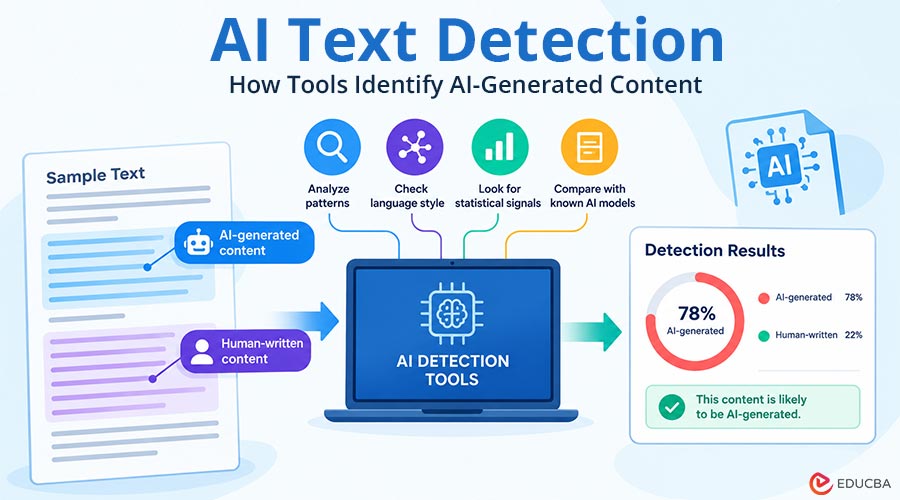
Teachers, editors, publishers, and hiring managers now use AI text detectors to estimate whether a tool like ChatGPT, Claude, or Gemini produced a piece of writing. Most people using them have no idea how they reach their scores. In this guide, we will explore how AI text detection works, the technologies behind it, common detection methods, and the reasons these tools sometimes produce inaccurate results.
Key Terms
Before exploring the detection process, it helps to understand several concepts commonly used in AI text detection.
- Token: A chunk of text a language model processes, roughly a word or part of a word.
- Language model: A system trained on large amounts of text to predict the next word or text segment in a sequence based on learned patterns.
- Perplexity: A measure of how unexpected or unpredictable a text is to a language model. Low perplexity means the model found the words easy to predict. AI-generated text tends to have low perplexity because models usually pick likely words.
- Burstiness: How much a text varies in sentence length and structure. Human writing tends to be bursty, mixing long and short sentences. AI text is often more uniform.
- Classifier: A machine learning model trained to sort inputs into categories, here “human” or “AI.”
- False positive: Human writing wrongly labeled as AI.
- False negative: AI writing wrongly labeled as human.
How Does AI Text Detection Work?
AI text detection typically involves several stages. Although the exact process varies between tools, many detectors follow a workflow similar to the one outlined below.
- Tokenize: The text is split into tokens.
- Extract features: The detector computes signals such as perplexity, burstiness, word frequency patterns, and phrase repetition. Classifier-based detectors also convert the text into numerical representations (embeddings).
- Classify: A trained model weighs those features and outputs a probability that the text is AI-generated.
- Apply a threshold: The vendor decides what probability counts as “likely AI.” This is as much a business decision as a technical one.
- Report: Many tools highlight the most machine-like sentences and provide an overall percentage.
A Simple Example
Compare these two sentences:
- “Climate change is one of the most pressing issues facing the world today.”
- “My grandfather farmed the same field for 40 years, and the rains stopped arriving when he expected them sometime in the 1990s.”
The first is built from extremely common phrases. A language model would predict nearly every word, so perplexity is low. The second contains specific, personal details a model would not predict, so perplexity is higher. A detector would rate the first as more likely AI, even though a human could easily have written it. This example also shows why detectors make mistakes: plenty of humans write generic sentences.
Types of AI Detectors
| Approach | How it works | Strength | Weakness |
| Statistical (perplexity-based) | Scores text predictability using a reference language model | Simple, explainable | Flags formal or simple human writing |
| Trained Classifier | Model fine-tuned on labeled human and AI text | Higher accuracy on familiar text | Struggles with new models and unfamiliar genres |
| Humanizer-aware Classifier | Classifier also trained on rewritten AI text | Harder to evade | Still produces false positives |
| Watermark Detection | Checks for a hidden signal added at generation time | Strong evidence when present | Only works if the generator added a watermark |
Why Detectors Make Mistakes?
Although AI detectors can help with preliminary analysis, their results are not always accurate. Several factors explain why they may incorrectly classify text.
- They estimate; they don’t know: Detectors measure statistical likelihood, not authorship.
- Writing styles overlap: Formal academic prose, technical documentation, and second-language writing can all look predictable. A 2023 Stanford study found detectors misclassified more than half of essays by non-native English speakers as AI-generated.
- Models change: A detector trained on older AI text can miss output from newer models.
- Thresholds differ: Two detectors can label the same text differently simply because they set different cutoffs.
How Rewriting Affects Detection?
Rewriting can change the statistical patterns that AI text detectors analyze. An AI humanizer rewrites AI-generated text to vary sentence structure, replace predictable phrasing, and shift those patterns closer to human writing.
Public benchmark data from HumanizerEval shows how much this varies by detector. In its September 2026 review, ten humanizers rewrote the same 50 texts. On average, the rewritten texts passed one lenient detector 95% of the time, but passed Pangram, a detector trained to recognize humanizer output, only 32% of the time. The lesson for learners: a single detector score tells you about that detector as much as about the text.
Final Thoughts
The best way to understand AI text detection is to experiment. Paste a few samples into an AI detector: a paragraph you wrote, a paragraph from a chatbot, and a paragraph you wrote in a very formal style. Compare the scores and look at which sentences get highlighted. You will quickly see which features drive the results, and why no detector should be treated as the final word.
Recommended Articles
We hope this comprehensive guide to AI text detection helps you understand how AI detectors work and interpret their results accurately. Check out these recommended articles for more insights into AI writing tools and content analysis.


