


Updated October 8, 2026
What is Causal Inference?
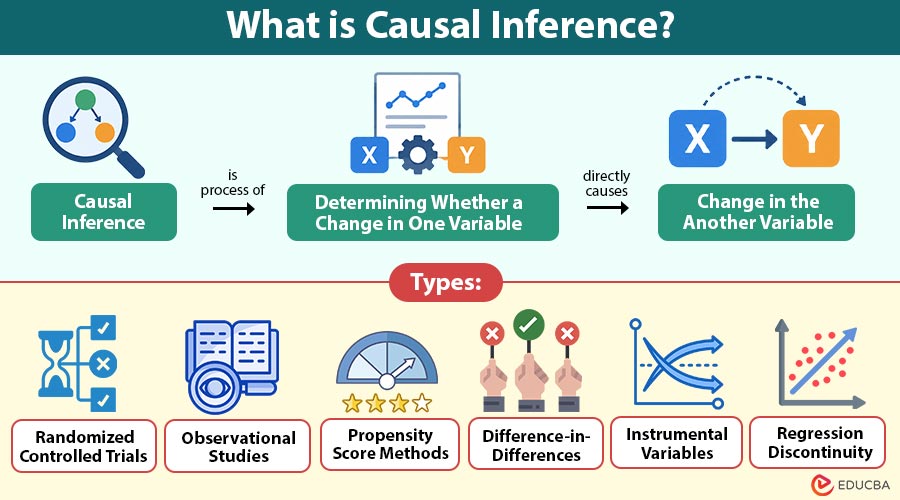
Causal inference is process of determining whether a change in one variable directly causes a change in the another variable.
It goes beyond identifying relationships or correlations between variables. While correlation shows that two variables are associated, causal inference asks whether changing one variable would actually change another.
For example, suppose a company notices that customers who receive promotional emails make more purchases. This relationship does not necessarily mean that the emails caused the additional purchases. These customers may already be more interested in the company’s products.
Causal inference helps researchers determine whether the promotional emails themselves increased purchases while accounting for other factors that could influence the outcome. It is widely used in healthcare, economics, marketing, social sciences, business analytics, and machine learning to support evidence-based decision-making.
Table of Contents:
Key Takeaways:
- Causal inference determines whether an action or intervention directly causes changes in specific outcomes.
- It distinguishes genuine cause-and-effect relationships from correlations that may result from other influencing factors.
- Researchers use experiments and observational methods to estimate causal effects while addressing confounding and bias.
- Causal inference helps organizations evaluate interventions and determine whether they produce meaningful improvements in real-world outcomes.
Why is Causal Inference Important?
Organizations often need to understand the effects of specific actions, policies, treatments, or interventions. Simply observing patterns in data may not provide enough evidence to make reliable decisions.
Causal inference helps answer questions such as:
- Does a new medicine improve patient outcomes?
- Does advertising increase product sales?
- Does a price reduction increase demand?
- Does employee training improve productivity?
- Does a government policy reduce unemployment?
- Does a website redesign increase conversions?
By identifying cause-and-effect relationships, organizations can make better decisions and evaluate whether an intervention actually produces the intended result.
How Does Causal Inference Work?
Causal inference generally involves several steps.
1. Define the Causal Question
The first step is to clearly identify the cause-and-effect relationship you want to study.
For example:
“Does offering a 10% discount increase online purchases?”
A clearly defined question helps identify the variables, population, intervention, and outcome to analyze.
2. Identify Treatment and Outcome Variables
The treatment variable represents the action, exposure, or intervention being studied.
The outcome variable represents the result that may be affected by the treatment.
For example, in a marketing study:
- Treatment: Promotional email
- Outcome: Number of purchases
3. Identify Confounding Variables
A confounder is variable that influences both the treatment and the outcome, potentially creating a misleading relationship.
For example, customer loyalty could influence whether a customer receives a promotional email and whether they make a purchase. Researchers need to identify and account for relevant confounding factors to estimate the causal effect more accurately.
4. Choose an Appropriate Method
Researchers select a causal inference method based on the available data and study design. Experimental and observational approaches may require different techniques.
5. Estimate the Causal Effect
The final step is to estimate how much the outcome changes because of the treatment or intervention.
For example:
Researchers may determine that customers who received a particular promotion purchased 12% more products than they would have without the promotion.
Types of Causal Inference
Causal inference can be performed using different research designs and statistical approaches.
1. Randomized Controlled Trials
Randomized controlled trials randomly assign participants to the treatment and control groups, helping researchers estimate causal effects by reducing systematic differences between groups.
2. Observational Studies
Observational studies analyze existing data without assigning treatments, requiring statistical methods to address confounding factors and selection bias affecting causal conclusions.
3. Propensity Score Methods
Propensity score methods estimate treatment probabilities using observed characteristics, helping researchers create comparable treatment and control groups for causal analysis.
4. Difference-in-Differences
Difference-in-differences compares changes in outcomes over time between treatment and comparison groups, helping estimate the effects of policies or interventions.
5. Instrumental Variables
Instrumental variables help estimate causal effects when unobserved confounding exists by using variables that influence treatment without directly affecting outcomes.
6. Regression Discontinuity
Regression discontinuity estimates causal effects when treatment assignment depends on a cutoff, comparing observations immediately above and below that threshold.
Applications of Causal Inference
Causal inference has applications across many industries.
1. Healthcare
Causal inference helps researchers determine whether treatments, medications, and healthcare interventions actually improve patient outcomes and overall health.
2. Marketing
Businesses use causal inference to measure whether advertisements, discounts, campaigns, or recommendations genuinely increase sales and customer engagement.
3. Economics
Economists use causal inference to evaluate how taxation, employment programs, interest rates, and economic policies affect outcomes.
4. Education
Schools and researchers use causal inference to assess whether teaching methods, scholarships, digital tools, or training improve student performance.
5. Public Policy
Governments use causal inference to estimate how policies involving healthcare, transportation, employment, taxation, and welfare affect populations.
6. Technology
Technology companies use causal inference to evaluate product changes, recommendation systems, interface modifications, and strategies affecting user engagement.
Benefits of Causal Inference
Causal inference provides several important benefits:
1. Better Decision-Making
Causal inference helps organizations determine whether specific actions produce desired outcomes, enabling more informed decisions based on reliable evidence.
2. Improved Experimentation
It provides structured frameworks for designing, conducting, and evaluating experiments to determine whether interventions genuinely create measurable effects.
3. Reduced Misleading Conclusions
It helps distinguish genuine cause-and-effect relationships from simple correlations, reducing misleading conclusions based on observed associations.
4. Policy Evaluation
Governments and organizations can use causal inference to measure intervention effects and determine whether policies achieve intended outcomes.
5. Resource Optimization
Businesses can identify strategies that produce meaningful results, helping them allocate budgets, time, and resources more efficiently.
6. Personalized Decisions
Causal models can estimate how different individuals or groups may respond to specific interventions, supporting more personalized decisions.
Challenges of Causal Inference
Despite its benefits, it can be challenging.
1. Confounding
Unobserved or poorly measured variables can influence treatment and outcomes simultaneously, making it difficult to accurately estimate causal relationships.
2. Selection Bias
Differences in how individuals enter treatment and control groups can create systematic differences, potentially producing misleading causal estimates.
3. Data Quality
Incomplete, inaccurate, inconsistent, or biased datasets can negatively affect causal analysis and reduce the reliability of estimated effects.
4. Incorrect Assumptions
Causal inference methods depend on specific assumptions about variables and relationships, and incorrect assumptions can produce unreliable conclusions.
5. Complex Causal Relationships
Real-world outcomes often involve multiple interacting factors, making it challenging to isolate and accurately estimate individual causal effects.
Difference Between Causal Inference and Correlation
The table below highlights the key differences between the two:
| Basis | Causal Inference | Correlation |
| Meaning | Determines whether one variable directly causes a change in another variable. | Measures strength and direction of the relationship between two variables. |
| Main Focus | Cause-and-effect relationships. | Associations between variables. |
| Purpose | Determines what would happen if a specific factor or intervention were changed. | Determines whether variables tend to change together. |
| Confounding Factors | Attempts to identify and control confounding factors that may affect the results. | Does not necessarily account for confounding factors. |
| Methods | Uses experiments, observational studies, causal models, and statistical techniques. | Commonly uses correlation coefficients and statistical analysis. |
| Intervention | Can evaluate the effect of an intervention or action. | Does not require an intervention. |
| Example | Determines whether increasing advertising spending actually causes higher sales. | Shows that advertising spending and sales are positively associated. |
Final Thoughts
Causal inference determines whether an intervention, exposure, or action actually causes changes in outcomes. Unlike correlation, it focuses on cause-and-effect relationships using experiments, observational data, statistical methods, and causal models. It helps healthcare, marketing, economics, education, policy, and technology organizations make evidence-based decisions by understanding what happens when conditions change.
Frequently Asked Questions (FAQs)
Q1. What data is needed for causal inference?
Answer: Causal inference can use experimental or observational data, depending on the research question and the method being applied.
Q2. Is causal inference useful for business decisions?
Answer: Yes. It can help businesses understand the effects of decisions involving products, pricing, customer experiences, and other business activities.
Q3. Can causal inference be used with large datasets?
Answer: Yes. Causal inference can be applied to large datasets using statistical and computational techniques designed to analyze complex information.
Q4. How does causal inference support research?
Answer: It provides methods for evaluating evidence and determining whether observed changes can reasonably be attributed to specific factors.
Recommended Articles
We hope that this EDUCBA information on “Causal Inference” was beneficial to you. You can view EDUCBA’s recommended articles for more information.


