


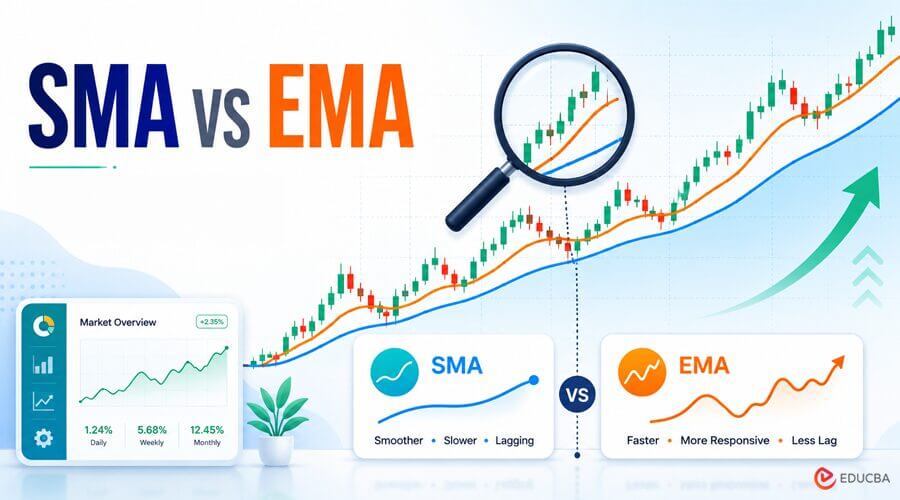
Moving averages help traders filter out short-term price movements and better understand the overall market trend. Among the different types available, the Simple Moving Average (SMA) and Exponential Moving Average (EMA) are two commonly used choices.
Both use historical price data, and both can help identify trends, dynamic support and resistance, and potential trading signals. The main difference is how they treat recent prices. That difference affects how quickly each moving average responds when the market changes direction.
So, when comparing SMA vs EMA, which one should you use? Let us understand how they differ.
What is SMA?
A Simple Moving Average finds the average price over a specific number of periods, with each price receiving the same weight.
For example, a 20-day SMA adds the closing prices of the previous 20 trading sessions and divides the total by 20. Each day’s closing price contributes equally to the final value.
Because every closing price in the period gets equal weight, SMA values react more gradually to recent price changes. This creates a smoother line but can also mean that it takes longer to reflect a sudden change in momentum.
Traders use different periods depending on the trend they want to study. Shorter periods follow price more closely, while longer periods provide a broader view of the trend.
What is EMA?
An Exponential Moving Average also calculates an average over a specified period, but it assigns greater weight to more recent prices.
Due to this, the EMA responds more quickly than the SMA when current market prices change. For example, if a stock suddenly begins moving higher, its EMA will generally adjust faster than an SMA calculated over the same period.
This higher responsiveness makes EMA more suitable for traders who want their moving average to follow recent price action more closely. Intraday traders usually use the EMA over SMA.
When Can Traders Use SMA?
SMA can be suitable when a trader wants a smoother representation of the broader trend without giving extra importance to the latest price movements.
For example, a trader studying a longer-term trend may use a longer-period SMA to see whether the price is generally trading above or below its average. SMA can act as support or resistance when the price often moves around it.
However, because SMA reacts gradually, signals based on it may appear later when the market changes direction quickly.
When Can Traders Use EMA?
EMA may suit traders who place greater importance on recent price action.
Short-term and intraday traders may prefer this responsiveness because the EMA follows current price movements more closely. Traders can observe whether price remains above or below an EMA, reacts around it during pullbacks, or whether shorter and longer EMAs cross.
Its faster response has a drawback. In sideways or volatile markets, frequent price changes can create more moving-average interactions that do not develop into sustained trends.
Can You Use SMA and EMA Together?
Traders do not necessarily have to choose one moving average exclusively.
An SMA can provide a smoother view of the broader trend, while an EMA can help track more recent changes in price behavior. Comparing the two can add context on whether recent momentum aligns with the broader trend.
Traders exploring courses for technical analysis can also learn how moving averages are combined with price action, trend analysis, and other indicators to interpret market conditions.
Final Thoughts
SMA vs EMA comes down to how each moving average responds to price changes. SMA assigns equal importance to each price, resulting in a smoother average, whereas EMA places greater emphasis on recent prices and responds more quickly to market changes.
Rather than asking which moving average is best overall, traders can think about what they want the indicator to show. SMA can provide better overall trend context, while EMA may be more appropriate when recent price action matters more.
Many stock market courses for beginners introduce SMA and EMA early because many advanced indicators are primarily based on SMA and EMA.
Recommended Articles
We hope this guide helps you understand the key differences between SMA and EMA and choose the right moving average for your trading strategy. Explore these recommended articles for more insights into technical analysis, stock market indicators, trading strategies, market trends, and investing.

